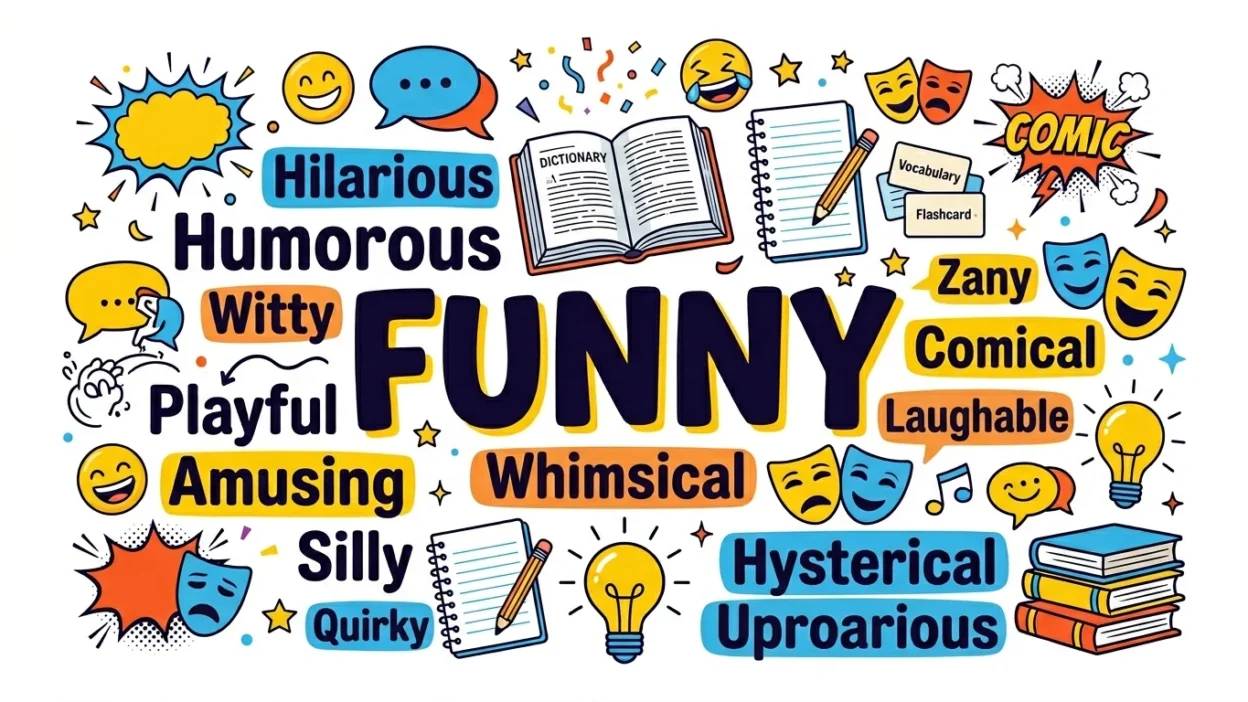
The word funny is one of the most commonly used adjectives in English. People use it to describe something that makes them laugh, smile or feel amused. It can refer to jokes, stories, movies, people, situations and even unusual events.
While “funny” is a useful word, using it repeatedly can make your writing sound repetitive. Learning synonyms for funny can help students, ESL learners, writers and content creators express different types of humor more accurately and creatively.
In this guide, you’ll learn the meaning of “funny,” discover 30 useful synonyms, see practical examples and understand when to use each one.
What Does Funny Mean?
Funny means causing laughter, amusement or enjoyment. It can also describe something strange or unusual.
Example:
The comedian told a funny joke that made everyone laugh.
The word can describe people, conversations, performances, situations and entertainment.
Why Learn Synonyms for Funny?
Learning alternatives to “funny” can help you:
- Improve your vocabulary
- Avoid repetition in writing
- Describe different styles of humor
- Improve storytelling and content creation
- Express amusement more accurately
- Make your writing more engaging
Different synonyms emphasize different types of humor, from lighthearted amusement to uncontrollable laughter.
30 Synonyms for Funny
1. Humorous
Meaning: Full of humor and amusement.
Example: The article included several humorous stories.
Best Usage Context: Writing and conversations.
2. Hilarious
Meaning: Extremely funny.
Example: The movie was absolutely hilarious.
Best Usage Context: Strong laughter.
3. Amusing
Meaning: Causing mild enjoyment or laughter.
Example: The child’s comment was amusing.
Best Usage Context: Everyday situations.
4. Entertaining
Meaning: Providing enjoyment and amusement.
Example: The show was entertaining from start to finish.
Best Usage Context: Performances and media.
5. Comical
Meaning: Funny in an amusing way.
Example: The actor made a comical expression.
Best Usage Context: Visual humor.
6. Witty
Meaning: Cleverly funny.
Example: She is known for her witty remarks.
Best Usage Context: Conversations and writing.
7. Clever
Meaning: Funny because it is intelligent or creative.
Example: The advertisement used a clever joke.
Best Usage Context: Humor with intelligence.
8. Playful
Meaning: Lighthearted and fun.
Example: The puppy had a playful personality.
Best Usage Context: Casual situations.
9. Lighthearted
Meaning: Cheerful and amusing.
Example: The film had a lighthearted tone.
Best Usage Context: Stories and entertainment.
10. Laughable
Meaning: So funny it causes laughter.
Example: His excuse was laughable.
Best Usage Context: Humor and criticism.
11. Ridiculous
Meaning: So silly it becomes funny.
Example: The situation was ridiculous.
Best Usage Context: Strange events.
12. Silly
Meaning: Playfully foolish and funny.
Example: The children enjoyed silly games.
Best Usage Context: Casual humor.
13. Goofy
Meaning: Funny in a clumsy or playful way.
Example: He made a goofy face.
Best Usage Context: Informal conversations.
14. Zany
Meaning: Wildly funny and unconventional.
Example: The show featured zany characters.
Best Usage Context: Comedy and entertainment.
15. Quirky
Meaning: Unusually funny or charming.
Example: She has a quirky sense of humor.
Best Usage Context: Personality descriptions.
16. Jocular
Meaning: Fond of joking.
Example: He maintained a jocular attitude.
Best Usage Context: Formal writing.
17. Merry
Meaning: Cheerfully amusing.
Example: The gathering was merry and fun.
Best Usage Context: Celebrations.
18. Cheerful
Meaning: Creating happiness and amusement.
Example: Her cheerful stories lifted everyone’s mood.
Best Usage Context: Positive interactions.
19. Delightful
Meaning: Pleasantly amusing.
Example: The performance was delightful.
Best Usage Context: Entertainment and events.
20. Side Splitting
Meaning: Extremely funny.
Example: The comedian delivered a side splitting routine.
Best Usage Context: Strong comedy.
21. Intense
Meaning: Causing uncontrollable laughter.
Example: The sketch was Intense.
Best Usage Context: Very funny situations.
22. Riotous
Meaning: Extremely amusing and lively.
Example: The play was riotous fun.
Best Usage Context: Comedy performances.
23. Comic
Meaning: Related to humor or comedy.
Example: The film had strong comic elements.
Best Usage Context: Literature and entertainment.
24. Satirical
Meaning: Funny while criticizing something.
Example: The article used satirical humor.
Best Usage Context: Social commentary.
25. Ironical
Meaning: Funny because of unexpected contrast.
Example: The ending was ironical and amusing.
Best Usage Context: Literature and discussions.
26. Whimsical
Meaning: Playfully unusual and amusing.
Example: The artwork had a whimsical style.
Best Usage Context: Creativity and art.
27. Droll
Meaning: Oddly funny.
Example: His droll humor appealed to many people.
Best Usage Context: Subtle humor.
28. Bantering
Meaning: Playfully teasing and joking.
Example: The friends spent hours bantering.
Best Usage Context: Conversations.
29. Priceless
Meaning: Extremely funny or memorable.
Example: Her reaction was priceless.
Best Usage Context: Informal speech.
30. Uproarious
Meaning: Causing loud and uncontrollable laughter.
Example: The audience found the show uproarious.
Best Usage Context: Powerful comedy.
Comparison Guide: When to Use Different Synonyms for Funny
| Synonym | Best For | Tone |
|---|---|---|
| Humorous | General humor | Neutral |
| Hilarious | Strong laughter | Enthusiastic |
| Witty | Clever jokes | Intelligent |
| Amusing | Mild humor | Friendly |
| Silly | Childlike humor | Casual |
| Quirky | Unique humor | Positive |
| Satirical | Social criticism | Intellectual |
| Intense | Extreme laughter | Informal |
| Delightful | Pleasant entertainment | Warm |
| Uproarious | Loud comedy | Strong |
How to Choose the Right Synonym
For Everyday Humor
Use:
- Humorous
- Amusing
- Funny
- Entertaining
These work in most situations.
For Strong Laughter
Use:
- Hilarious
- Intense
- Side Splitting
- Uproarious
These emphasize intense humor.
For Clever Humor
Use:
- Witty
- Clever
- Satirical
- Ironical
These focus on intelligence and creativity.
For Playful Humor
Use:
- Silly
- Goofy
- Playful
- Whimsical
These suit casual and lighthearted situations.
For Formal Writing
Use:
- Humorous
- Jocular
- Satirical
- Droll
These fit professional and academic contexts.
Common Mistakes When Using Synonyms for Funny
Using Strong Words Too Frequently
Words like “hilarious” and “uproarious” should be reserved for genuinely funny situations.
Ignoring the Type of Humor
Some synonyms describe clever humor, while others describe silly or exaggerated humor.
Using Informal Words in Professional Writing
Words like “goofy” may not fit formal contexts.
Repeating the Same Alternative
Using varied vocabulary makes your writing more engaging and expressive.
Conclusion
Learning synonyms for funny can improve your vocabulary and help you describe humor more accurately. While “funny” is a versatile word, alternatives such as humorous, amusing, witty, hilarious, whimsical and uproarious allow you to express different styles and levels of humor with greater precision.
The best synonym depends on the context and the type of amusement you want to convey. By understanding these alternatives, you’ll be able to write with greater creativity, confidence and variety in both academic and everyday situations.