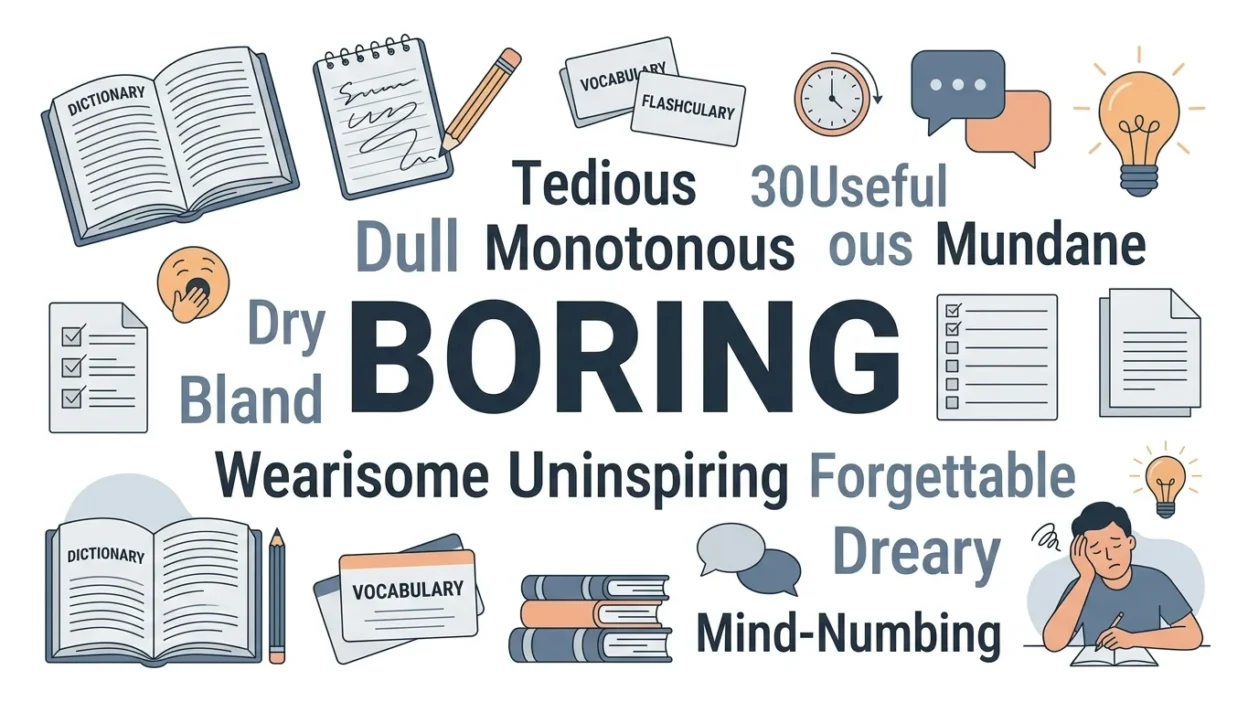
The word boring is commonly used to describe something that fails to capture interest, excitement or attention. Whether you’re talking about a lecture, movie, book, conversation, task or event, “boring” is often the first word people use when something feels dull or uninteresting.
While “boring” is simple and effective, using it repeatedly can make your writing feel repetitive. Learning synonyms for boring can help students, ESL learners, writers and content creators express different levels and types of dullness more accurately.
In this guide, you’ll learn the meaning of “boring,” discover 30 useful synonyms, see practical examples and understand when to use each one.
What Does Boring Mean?
Boring means not interesting, exciting, or engaging. It describes something that causes boredom or fails to hold attention.
Example:
The meeting was so boring that several people lost focus.
The word can describe activities, people, conversations, books, movies, classes, and experiences.
Why Learn Synonyms for Boring?
Learning alternatives to “boring” can help you:
- Improve your vocabulary
- Avoid repetition in writing
- Describe dull situations more accurately
- Improve essays and creative writing
- Express different levels of disinterest
- Communicate more effectively
Different synonyms emphasize different aspects of boredom, such as monotony, lack of excitement, or predictability.
30 Synonyms for Boring
1. Dull
Meaning: Lacking excitement or interest.
Example: The presentation was dull and repetitive.
Best Usage Context: General descriptions.
2. Tedious
Meaning: Long, repetitive, and tiresome.
Example: Filling out the paperwork was tedious.
Best Usage Context: Tasks and work.
3. Monotonous
Meaning: Repetitive and lacking variety.
Example: The machine made a monotonous sound.
Best Usage Context: Repetition.
4. Uninteresting
Meaning: Not attracting attention.
Example: The article was uninteresting.
Best Usage Context: General situations.
5. Tiresome
Meaning: Causing fatigue through repetition.
Example: The long speech became tiresome.
Best Usage Context: Conversations and events.
6. Mundane
Meaning: Ordinary and lacking excitement.
Example: He wanted a break from mundane routines.
Best Usage Context: Everyday life.
7. Dry
Meaning: Lacking emotion or entertainment.
Example: The lecture felt dry and technical.
Best Usage Context: Academic content.
8. Flat
Meaning: Lacking energy or excitement.
Example: The performance felt flat.
Best Usage Context: Entertainment.
9. Lifeless
Meaning: Without energy or enthusiasm.
Example: The discussion became lifeless.
Best Usage Context: Conversations and events.
10. Colorless
Meaning: Lacking excitement or personality.
Example: The story seemed colorless.
Best Usage Context: Writing and art.
11. Repetitive
Meaning: Repeating the same thing too often.
Example: The training video was repetitive.
Best Usage Context: Tasks and content.
12. Predictable
Meaning: Easy to guess and lacking surprise.
Example: The movie had a predictable ending.
Best Usage Context: Stories and entertainment.
13. Stale
Meaning: No longer fresh or interesting.
Example: The jokes felt stale.
Best Usage Context: Ideas and humor.
14. Wearisome
Meaning: Causing tiredness or boredom.
Example: The journey became wearisome.
Best Usage Context: Formal writing.
15. Slow
Meaning: Moving at an uninteresting pace.
Example: The film started very slow.
Best Usage Context: Movies and events.
16. Dreary
Meaning: Dull and depressing.
Example: The weather was dreary all week.
Best Usage Context: Atmosphere and mood.
17. Humdrum
Meaning: Lacking excitement and variety.
Example: He grew tired of his humdrum routine.
Best Usage Context: Daily life.
18. Uninspiring
Meaning: Failing to motivate or excite.
Example: The design looked uninspiring.
Best Usage Context: Creativity and work.
19. Forgettable
Meaning: Not memorable or interesting.
Example: The film was forgettable.
Best Usage Context: Entertainment.
20. Ordinary
Meaning: Common and not special.
Example: The meal was ordinary.
Best Usage Context: General descriptions.
21. Bland
Meaning: Lacking excitement, flavor, or character.
Example: The speech sounded bland.
Best Usage Context: Food and communication.
22. Routine
Meaning: Common and repetitive.
Example: The work became routine.
Best Usage Context: Jobs and habits.
23. Mechanical
Meaning: Done without creativity or feeling.
Example: His answers sounded mechanical.
Best Usage Context: Behavior and work.
24. Passive
Meaning: Lacking activity or energy.
Example: The audience remained passive.
Best Usage Context: Participation.
25. Sleep Inducing
Meaning: So boring it makes people sleepy.
Example: The lecture was sleep inducing.
Best Usage Context: Informal descriptions.
26. Unexciting
Meaning: Not stimulating or thrilling.
Example: The event was unexciting.
Best Usage Context: General use.
27. Listless
Meaning: Lacking energy or enthusiasm.
Example: The conversation became listless.
Best Usage Context: Mood and atmosphere.
28. Spiritless
Meaning: Without energy or liveliness.
Example: The performance felt spiritless.
Best Usage Context: Entertainment.
29. Drab
Meaning: Dull and lacking appeal.
Example: The room looked drab.
Best Usage Context: Appearance and design.
30. Mind Numbing
Meaning: Extremely boring and mentally exhausting.
Example: The repetitive task was mind numbing.
Best Usage Context: Strong criticism.
Comparison Guide: When to Use Different Synonyms for Boring
| Synonym | Best For | Tone |
|---|---|---|
| Dull | General situations | Neutral |
| Tedious | Long tasks | Negative |
| Monotonous | Repetition | Descriptive |
| Mundane | Everyday routines | Neutral |
| Dry | Lectures and information | Professional |
| Predictable | Movies and stories | Critical |
| Bland | Speech and content | Mild |
| Dreary | Atmosphere and mood | Emotional |
| Forgettable | Entertainment | Critical |
| Mind-Numbing | Extreme boredom | Strong |
How to Choose the Right Synonym
For Work and Tasks
Use:
- Tedious
- Repetitive
- Routine
- Monotonous
These emphasize repetition and effort.
For Books and Movies
Use:
- Predictable
- Forgettable
- Dull
- Flat
These describe entertainment that lacks excitement.
For Daily Life
Use:
- Mundane
- Humdrum
- Ordinary
- Unexciting
These refer to common routines.
For Formal Writing
Use:
- Wearisome
- Uninspiring
- Colorless
- Dry
These fit professional and academic contexts.
For Strong Criticism
Use:
- Mind-Numbing
- Dreary
- Lifeless
- Sleep Inducing
These express intense boredom.
Common Mistakes When Using Synonyms for Boring
Using Strong Words Too Frequently
Words like “mind-numbing” and “sleep-inducing” should be reserved for situations that are truly dull.
Ignoring Context
Some synonyms describe repetitive tasks, while others describe entertainment or moods.
Choosing Overly Formal Words
Words like “wearisome” may sound unnatural in casual conversation.
Repeating the Same Alternative
Using varied vocabulary keeps your writing more engaging and expressive.
Conclusion
Learning synonyms for boring can improve your vocabulary and help you describe dull situations more accurately. While “boring” is a useful word, alternatives such as dull, tedious, monotonous, mundane, uninspiring and forgettable allow you to express different types of boredom with greater precision.
The best synonym depends on the context and the level of boredom you want to convey. By understanding these alternatives, you’ll be able to write with greater clarity, variety and confidence in both academic and everyday situation.