
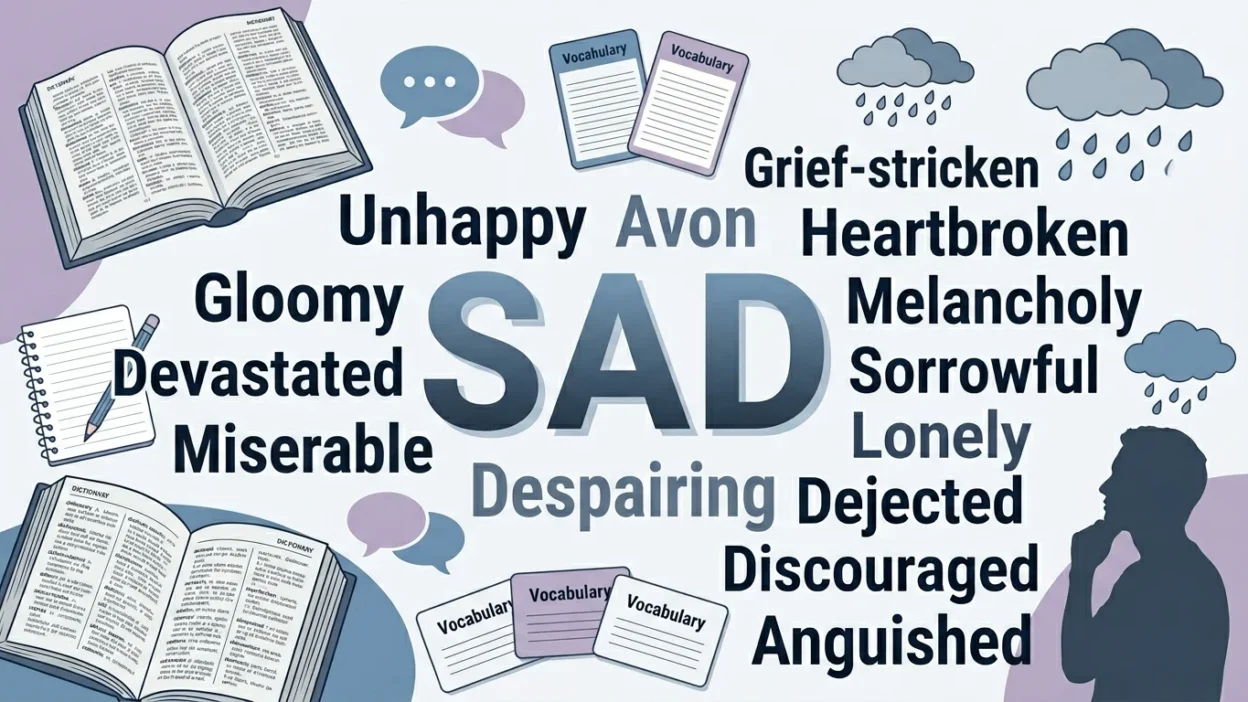
The word sad is one of the most commonly used emotional words in English. People use it to describe feelings of unhappiness, disappointment, grief, or emotional pain. While “sad” is simple and effective, using the same word repeatedly can make your writing feel repetitive and less expressive.
Learning synonyms for sad can help students, ESL learners, writers, and content creators describe emotions more accurately. Different words can express different levels of sadness, from mild disappointment to deep sorrow. Choosing the right synonym helps readers better understand the feelings being described.
In this guide, you’ll learn the meaning of “sad,” discover 30 useful synonyms, see practical examples, and understand when to use each one.
What Does Sad Mean?
Sad means feeling unhappy, sorrowful, disappointed, or emotionally upset. People may feel sad because of loss, failure, loneliness, bad news, or difficult situations.
Example:
She felt sad when her best friend moved away.
The word can describe temporary emotions or deeper feelings of grief and sorrow.
Why Learn Synonyms for Sad?
Learning alternatives to “sad” can help you:
- Improve your vocabulary
- Avoid repetition in writing
- Express emotions more precisely
- Make stories more engaging
- Strengthen essays and creative writing
- Communicate feelings more clearly
Different situations require different emotional words, and the right synonym can add depth to your writing.
30 Synonyms for Sad
1. Unhappy
Meaning: Not feeling happy.
Example: He seemed unhappy about the decision.
Best Usage Context: General sadness.
2. Sorrowful
Meaning: Feeling deep sadness.
Example: She was sorrowful after hearing the news.
Best Usage Context: Loss and grief.
3. Gloomy
Meaning: Feeling down or pessimistic.
Example: He felt gloomy during the rainy week.
Best Usage Context: Mood descriptions.
4. Depressed
Meaning: Feeling extremely sad and discouraged.
Example: She felt depressed after losing her job.
Best Usage Context: Serious emotional struggles.
5. Miserable
Meaning: Extremely unhappy.
Example: The cold weather made everyone miserable.
Best Usage Context: Strong discomfort or sadness.
6. Heartbroken
Meaning: Deeply hurt emotionally.
Example: He was heartbroken after the breakup.
Best Usage Context: Relationships and loss.
7. Devastated
Meaning: Extremely shocked and sad.
Example: The family was devastated by the tragedy.
Best Usage Context: Major losses.
8. Downcast
Meaning: Feeling discouraged and sad.
Example: She looked downcast after the interview.
Best Usage Context: Visible disappointment.
9. Disappointed
Meaning: Sad because expectations were not met.
Example: He was disappointed with the results.
Best Usage Context: Everyday situations.
10. Blue
Meaning: Feeling mildly sad.
Example: I’ve been feeling a little blue lately.
Best Usage Context: Informal conversations.
11. Melancholy
Meaning: A quiet and thoughtful sadness.
Example: The song created a feeling of melancholy.
Best Usage Context: Literature and art.
12. Mournful
Meaning: Expressing grief or sorrow.
Example: She gave a mournful look.
Best Usage Context: Loss and remembrance.
13. Dejected
Meaning: Feeling low because of failure or disappointment.
Example: He felt dejected after losing the match.
Best Usage Context: Setbacks.
14. Despairing
Meaning: Feeling a loss of hope.
Example: She sounded despairing about the future.
Best Usage Context: Serious emotional situations.
15. Woeful
Meaning: Full of sadness.
Example: He gave a woeful sigh.
Best Usage Context: Literary writing.
16. Crestfallen
Meaning: Embarrassed and disappointed.
Example: She looked crestfallen after the mistake.
Best Usage Context: Personal failures.
17. Grief-Stricken
Meaning: Overwhelmed with grief.
Example: The family was grief-stricken after the loss.
Best Usage Context: Bereavement.
18. Lonely
Meaning: Sad because of isolation.
Example: He felt lonely in the new city.
Best Usage Context: Social situations.
19. Hurt
Meaning: Emotionally wounded.
Example: She felt hurt by the comment.
Best Usage Context: Relationships.
20. Distressed
Meaning: Very upset or worried.
Example: The news left him distressed.
Best Usage Context: Emotional reactions.
21. Troubled
Meaning: Worried and unhappy.
Example: She seemed troubled by recent events.
Best Usage Context: Concerns and worries.
22. Somber
Meaning: Serious and sad.
Example: The ceremony had a somber atmosphere.
Best Usage Context: Formal occasions.
23. Dismal
Meaning: Depressingly bad or gloomy.
Example: The team had a dismal season.
Best Usage Context: Negative situations.
24. Regretful
Meaning: Feeling sadness about past actions.
Example: He felt regretful about his decision.
Best Usage Context: Mistakes and reflection.
25. Hopeless
Meaning: Feeling that nothing will improve.
Example: She felt hopeless after repeated failures.
Best Usage Context: Serious emotional situations.
26. Brokenhearted
Meaning: Deeply sad because of emotional pain.
Example: He was brokenhearted after the loss.
Best Usage Context: Relationships and grief.
27. Discouraged
Meaning: Losing confidence or hope.
Example: She felt discouraged by the criticism.
Best Usage Context: Challenges and setbacks.
28. Sullen
Meaning: Quietly unhappy and withdrawn.
Example: The child remained sullen all afternoon.
Best Usage Context: Mood and behavior.
29. Tearful
Meaning: Crying or close to crying.
Example: She became tearful during the speech.
Best Usage Context: Emotional moments.
30. Anguished
Meaning: Experiencing intense emotional pain.
Example: He gave an anguished cry.
Best Usage Context: Extreme sadness.
Comparison Guide: When to Use Different Synonyms for Sad
| Synonym | Best For | Tone |
|---|---|---|
| Unhappy | General sadness | Neutral |
| Disappointed | Expectations not met | Mild |
| Gloomy | Negative mood | Casual |
| Heartbroken | Relationship pain | Strong |
| Devastated | Major loss | Very Strong |
| Lonely | Isolation | Emotional |
| Melancholy | Thoughtful sadness | Literary |
| Distressed | Emotional upset | Serious |
| Somber | Formal sadness | Professional |
| Anguished | Extreme emotional pain | Intense |
How to Choose the Right Synonym
For Everyday Sadness
Use:
- Unhappy
- Blue
- Disappointed
- Gloomy
These words fit common situations.
For Deep Emotional Pain
Use:
- Heartbroken
- Brokenhearted
- Devastated
- Anguished
These express intense sadness.
For Loss and Grief
Use:
- Sorrowful
- Mournful
- Grief-Stricken
These are suitable when discussing loss.
For Disappointment and Failure
Use:
- Dejected
- Crestfallen
- Discouraged
- Regretful
These focus on setbacks and unmet expectations.
For Formal or Literary Writing
Use:
- Melancholy
- Somber
- Woeful
- Despairing
These words create a more sophisticated tone.
Common Mistakes When Using Synonyms for Sad
Using Strong Words Too Often
Words like “devastated” and “anguished” should be reserved for serious situations.
Ignoring Emotional Intensity
Different synonyms express different levels of sadness. Choose carefully.
Using Formal Words in Casual Conversations
Words like “melancholy” or “woeful” may sound unnatural in everyday speech.
Overusing Emotional Descriptions
Too many strong emotional words can make writing feel exaggerated.
Conclusion
Learning synonyms for sad can help you communicate emotions with greater accuracy and depth. While “sad” is a useful word, alternatives such as unhappy, disappointed, gloomy, heartbroken, sorrowful, devastated, and melancholy allow you to express different shades of emotion more effectively.
The best synonym depends on the situation, tone, and intensity of the feeling. By understanding these alternatives, you’ll be able to write more engaging stories, create stronger content, and express emotions with confidence and clarity.