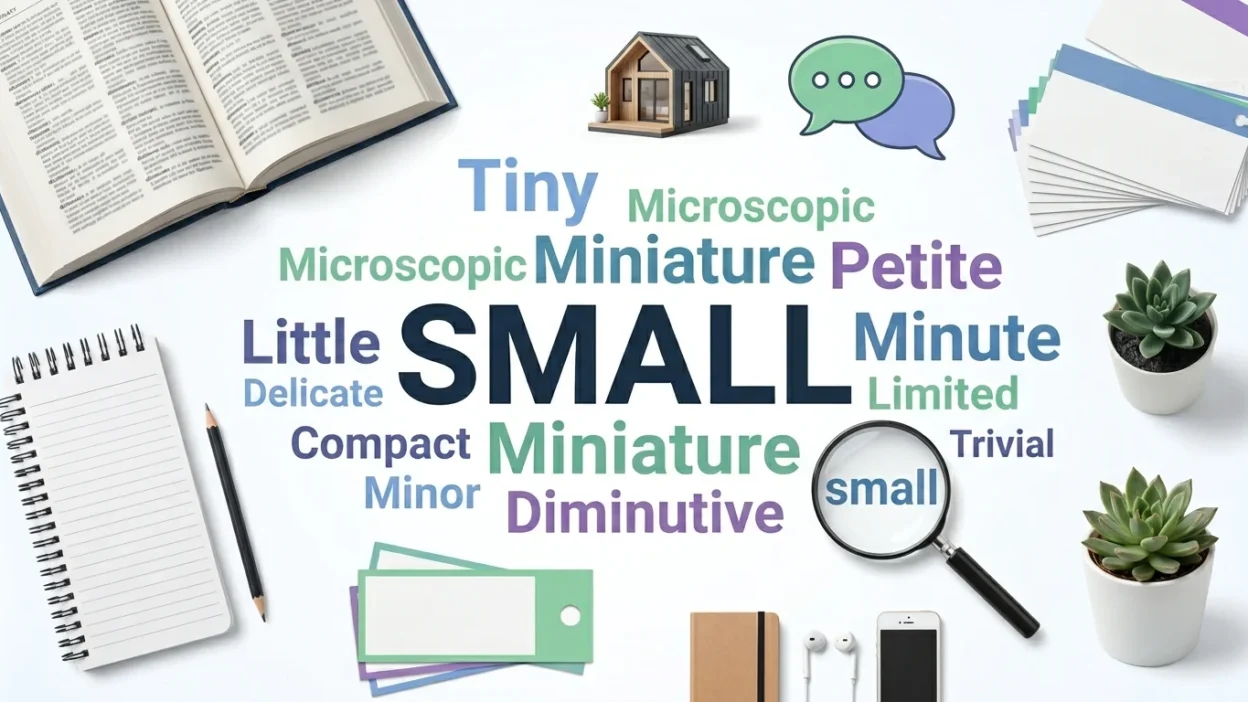
The word small is one of the most commonly used adjectives in English. We use it to describe things that are little in size, amount, importance or degree. While “small” is a simple and useful word, using it repeatedly can make your writing feel repetitive and less descriptive.
Learning synonyms for small can help students, ESL learners, writers, and content creators express ideas more accurately. Different synonyms can describe physical size, quantity, importance, or even age. Choosing the right word helps readers understand exactly what you mean.
In this guide, you’ll learn the meaning of “small,” discover 30 useful synonyms, see example sentences, and understand when to use each one.
What Does Small Mean?
Small means little in size, amount, number, or degree. It describes something that is not large when compared to others of its kind.
Example:
They live in a small apartment near the city center.
The word can refer to physical objects, groups, amounts, businesses, or even levels of importance.
Why Learn Synonyms for Small?
Learning alternatives to “small” can help you:
- Improve your vocabulary
- Avoid repetition
- Make writing more descriptive
- Communicate more clearly
- Strengthen essays and stories
- Express different shades of meaning
Different situations require different words, and the right synonym can make your writing more precise and engaging.
30 Synonyms for Small
1. Tiny
Meaning: Very small in size.
Example: A tiny insect landed on the leaf.
Best Usage Context: Very small objects.
2. Little
Meaning: Small in size or amount.
Example: The little girl smiled happily.
Best Usage Context: Everyday descriptions.
3. Miniature
Meaning: A much smaller version of something.
Example: The museum displayed a miniature castle.
Best Usage Context: Models and replicas.
4. Petite
Meaning: Small and attractively sized.
Example: She has a petite frame.
Best Usage Context: People and fashion.
5. Compact
Meaning: Small but efficiently arranged.
Example: The compact car is easy to park.
Best Usage Context: Products and spaces.
6. Minute
Meaning: Extremely small.
Example: The scientist examined minute particles.
Best Usage Context: Scientific contexts.
7. Microscopic
Meaning: So small it can only be seen with a microscope.
Example: Microscopic organisms live in water.
Best Usage Context: Science and biology.
8. Diminutive
Meaning: Very small in size.
Example: The actor was diminutive but confident.
Best Usage Context: Formal writing.
9. Pocket-Sized
Meaning: Small enough to fit in a pocket.
Example: He carried a pocket-sized notebook.
Best Usage Context: Portable items.
10. Slight
Meaning: Small in degree or amount.
Example: There was a slight delay in the schedule.
Best Usage Context: Minor changes or differences.
11. Modest
Meaning: Small and not excessive.
Example: They live in a modest home.
Best Usage Context: Lifestyle and possessions.
12. Limited
Meaning: Small in quantity or extent.
Example: The event has limited seating.
Best Usage Context: Availability.
13. Minor
Meaning: Not very important or serious.
Example: The issue caused only minor problems.
Best Usage Context: Importance and significance.
14. Inconsequential
Meaning: Too small to matter much.
Example: The mistake was inconsequential.
Best Usage Context: Formal discussions.
15. Narrow
Meaning: Small in width.
Example: They walked through a narrow street.
Best Usage Context: Measurements and spaces.
16. Short
Meaning: Small in length or height.
Example: He wrote a short message.
Best Usage Context: Length and duration.
17. Sparse
Meaning: Small in number and spread out.
Example: The area had sparse vegetation.
Best Usage Context: Quantities and distribution.
18. Meager
Meaning: Small and insufficient.
Example: The workers received meager wages.
Best Usage Context: Amounts and resources.
19. Scant
Meaning: Barely enough.
Example: There was scant evidence available.
Best Usage Context: Information and supplies.
20. Insignificant
Meaning: Small in importance.
Example: The change seemed insignificant at first.
Best Usage Context: Importance and impact.
21. Trivial
Meaning: Small and unimportant.
Example: They argued over a trivial matter.
Best Usage Context: Everyday issues.
22. Lightweight
Meaning: Small in weight.
Example: The lightweight laptop is easy to carry.
Best Usage Context: Products and equipment.
23. Reduced
Meaning: Made smaller in size or amount.
Example: The store offered reduced prices.
Best Usage Context: Changes and adjustments.
24. Undersized
Meaning: Smaller than normal.
Example: The shirt looked undersized.
Best Usage Context: Clothing and objects.
25. Slim
Meaning: Small in width or amount.
Example: They have a slim chance of winning.
Best Usage Context: Probability and size.
26. Fine
Meaning: Very thin or small.
Example: The artist used a fine brush.
Best Usage Context: Details and texture.
27. Delicate
Meaning: Small and easily damaged.
Example: The flower had delicate petals.
Best Usage Context: Fragile objects.
28. Petite-Sized
Meaning: Smaller than average.
Example: The store offers petite-sized clothing.
Best Usage Context: Fashion and apparel.
29. Mini
Meaning: Smaller version of something.
Example: She bought a mini backpack.
Best Usage Context: Products and designs.
30. Wee
Meaning: Very small.
Example: The puppy was still wee and playful.
Best Usage Context: Informal and British English.
Comparison Guide: When to Use Different Synonyms for Small
| Synonym | Best For | Tone |
|---|---|---|
| Tiny | Very small objects | Everyday |
| Petite | People and fashion | Positive |
| Compact | Efficient design | Professional |
| Minute | Extremely small things | Formal |
| Minor | Small importance | Neutral |
| Meager | Insufficient amounts | Negative |
| Trivial | Unimportant matters | Casual |
| Delicate | Fragile objects | Descriptive |
| Mini | Products and designs | Informal |
| Wee | Very small things | Friendly |
How to Choose the Right Synonym
For Physical Size
Use:
- Tiny
- Little
- Miniature
- Compact
- Mini
These focus on actual dimensions.
For Small Amounts
Use:
- Limited
- Meager
- Scant
- Sparse
These describe quantity.
For Low Importance
Use:
- Minor
- Trivial
- Insignificant
- Inconsequential
These emphasize significance rather than size.
For Fashion and Appearance
Use:
- Petite
- Petite-Sized
- Slim
These are commonly used for people and clothing.
For Scientific or Technical Writing
Use:
- Minute
- Microscopic
These provide precise descriptions.
Common Mistakes When Using Synonyms for Small
Using Formal Words in Casual Situations
Words like “diminutive” or “inconsequential” may sound unnatural in everyday conversation.
Confusing Size With Importance
Some synonyms describe physical size, while others describe significance.
Choosing Negative Words Unnecessarily
Words like “meager” and “scant” often imply insufficiency, not just small size.
Repeating the Same Synonym
Using a variety of alternatives makes writing more engaging.
Conclusion
Learning synonyms for small can make your writing more descriptive, precise, and engaging. While “small” is a useful word, alternatives such as tiny, petite, compact, miniature, minor, limited, and microscopic allow you to communicate more specific meanings.
The best synonym depends on the context and the exact idea you want to express. By understanding these alternatives, you’ll improve your vocabulary and write with greater confidence and clarity in both academic and everyday situations.