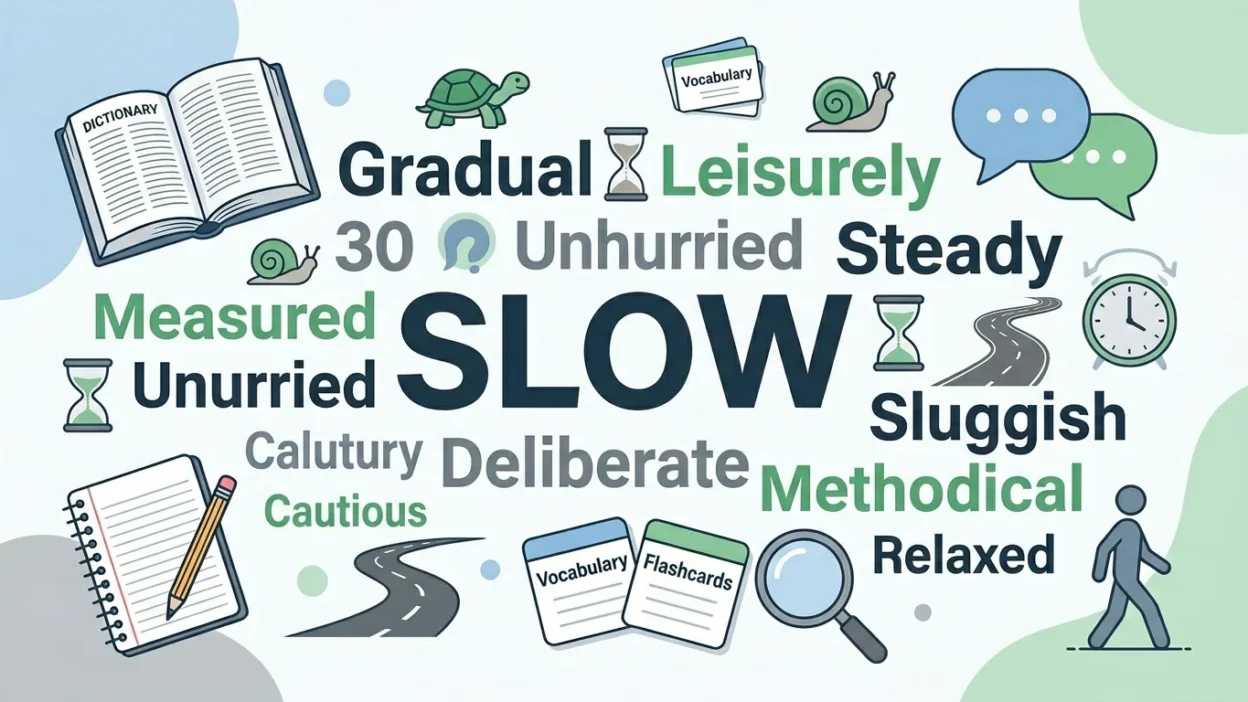
The word slow is one of the most commonly used adjectives in English. We use it to describe movement, progress, reactions, learning, growth, or anything that happens at a low speed. While “slow” is simple and effective, using it repeatedly can make your writing feel repetitive.
Learning synonyms for slow can help students, ESL learners, writers, and content creators express ideas more accurately. Some synonyms describe physical movement, while others refer to delayed progress, careful actions, or lack of speed. Choosing the right word can make your writing clearer and more engaging.
In this guide, you’ll learn the meaning of “slow,” discover 30 useful synonyms, see practical examples, and understand when to use each one.
What Does Slow Mean?
Slow means moving, happening, or progressing at a low speed. It can describe people, vehicles, processes, reactions, or activities that take more time than expected.
Example:
Traffic was slow during the morning rush hour.
The word can refer to physical speed, mental processing, business growth, or overall progress.
Why Learn Synonyms for Slow?
Learning alternatives to “slow” can help you:
- Improve your vocabulary
- Avoid repetition
- Write more descriptively
- Express different types of slowness
- Improve essays and stories
- Communicate more precisely
Different situations require different words, and the right synonym helps convey the exact meaning you want.
30 Synonyms for Slow
1. Gradual
Meaning: Happening little by little over time.
Example: The company experienced gradual growth.
Best Usage Context: Progress and change.
2. Leisurely
Meaning: Relaxed and unhurried.
Example: They enjoyed a leisurely walk in the park.
Best Usage Context: Relaxing activities.
3. Unhurried
Meaning: Done without rushing.
Example: She took an unhurried approach to the project.
Best Usage Context: Calm situations.
4. Deliberate
Meaning: Slow because it is careful and intentional.
Example: He made a deliberate decision.
Best Usage Context: Thoughtful actions.
5. Measured
Meaning: Controlled and careful.
Example: The speaker gave a measured response.
Best Usage Context: Formal communication.
6. Steady
Meaning: Consistent and not rushed.
Example: The team made steady progress.
Best Usage Context: Long-term improvement.
7. Moderate
Meaning: Not fast or extreme.
Example: The car traveled at a moderate speed.
Best Usage Context: Speed and intensity.
8. Sluggish
Meaning: Moving slowly and lacking energy.
Example: The economy showed sluggish growth.
Best Usage Context: Business and performance.
9. Lethargic
Meaning: Slow because of low energy.
Example: He felt lethargic after the illness.
Best Usage Context: Health and energy.
10. Lazy
Meaning: Unwilling to move or work quickly.
Example: The lazy afternoon felt peaceful.
Best Usage Context: Casual descriptions.
11. Lagging
Meaning: Falling behind in progress.
Example: Sales are lagging behind expectations.
Best Usage Context: Business and performance.
12. Delayed
Meaning: Happening later than expected.
Example: The flight was delayed by bad weather.
Best Usage Context: Schedules and timing.
13. Behind
Meaning: Not keeping up with others.
Example: The project is behind schedule.
Best Usage Context: Progress tracking.
14. Crawling
Meaning: Moving extremely slowly.
Example: Traffic was crawling through downtown.
Best Usage Context: Movement and transportation.
15. Plodding
Meaning: Moving slowly with effort.
Example: The hikers continued at a plodding pace.
Best Usage Context: Physical movement.
16. Tardy
Meaning: Late or delayed.
Example: His tardy arrival caused concern.
Best Usage Context: Formal situations.
17. Prolonged
Meaning: Lasting longer than usual.
Example: The meeting became prolonged.
Best Usage Context: Time and duration.
18. Drawn-Out
Meaning: Continuing for too long.
Example: The negotiations became drawn-out.
Best Usage Context: Processes and events.
19. Relaxed
Meaning: Not rushed.
Example: They enjoyed a relaxed weekend.
Best Usage Context: Lifestyle and activities.
20. Easygoing
Meaning: Calm and not hurried.
Example: He has an easygoing personality.
Best Usage Context: Personality descriptions.
21. Methodical
Meaning: Done carefully and step by step.
Example: She used a methodical approach.
Best Usage Context: Work and planning.
22. Careful
Meaning: Taking time to avoid mistakes.
Example: The surgeon was careful throughout the operation.
Best Usage Context: Precision and accuracy.
23. Cautious
Meaning: Moving slowly to avoid risks.
Example: Investors remained cautious.
Best Usage Context: Decision-making.
24. Idle
Meaning: Not active or moving.
Example: The machines remained idle.
Best Usage Context: Work and equipment.
25. Dormant
Meaning: Inactive for a period of time.
Example: The volcano remained dormant.
Best Usage Context: Nature and activity.
26. Passive
Meaning: Not actively responding or moving.
Example: He remained passive during the discussion.
Best Usage Context: Behavior and participation.
27. Sedate
Meaning: Calm and slow-moving.
Example: The town had a sedate atmosphere.
Best Usage Context: Formal descriptions.
28. Dragging
Meaning: Moving or progressing very slowly.
Example: The project is dragging on.
Best Usage Context: Delays and frustration.
29. Poky
Meaning: Annoyingly slow.
Example: The old computer feels poky.
Best Usage Context: Informal speech.
30. Slothful
Meaning: Extremely lazy and slow.
Example: His slothful habits affected productivity.
Best Usage Context: Strong criticism.
Comparison Guide: When to Use Different Synonyms for Slow
| Synonym | Best For | Tone |
|---|---|---|
| Gradual | Progress and growth | Professional |
| Leisurely | Relaxed activities | Positive |
| Deliberate | Careful decisions | Formal |
| Steady | Consistent progress | Neutral |
| Sluggish | Weak performance | Negative |
| Delayed | Timing issues | Neutral |
| Methodical | Step-by-step work | Professional |
| Cautious | Risk avoidance | Formal |
| Crawling | Extremely slow movement | Descriptive |
| Dragging | Slow progress | Informal |
How to Choose the Right Synonym
For Relaxed Activities
Use:
- Leisurely
- Relaxed
- Easygoing
- Unhurried
These create a calm and positive tone.
For Careful Actions
Use:
- Deliberate
- Methodical
- Careful
- Cautious
These emphasize thoughtfulness rather than lack of speed.
For Delays and Problems
Use:
- Delayed
- Lagging
- Sluggish
- Dragging
These highlight slow progress.
For Professional Writing
Use:
- Gradual
- Measured
- Methodical
- Steady
These sound formal and polished.
For Extremely Slow Movement
Use:
- Crawling
- Plodding
- Poky
These emphasize very low speed.
Common Mistakes When Using Synonyms for Slow
Confusing Careful with Slow
Words like “deliberate” and “methodical” often suggest quality and precision, not weakness.
Using Negative Words Unnecessarily
Terms such as “sluggish” and “slothful” carry negative meanings.
Choosing Informal Words in Formal Writing
Words like “poky” may not fit professional or academic contexts.
Repeating the Same Alternative
Using a variety of synonyms improves readability and keeps writing engaging.
Conclusion
Learning synonyms for slow can improve your vocabulary and make your writing more precise. While “slow” is a useful word, alternatives such as gradual, leisurely, deliberate, steady, methodical, and cautious allow you to communicate different types of slowness more effectively.
The best synonym depends on the context and the message you want to convey. By understanding these alternatives, you’ll be able to write with greater clarity, variety, and confidence in both academic and everyday situations.