
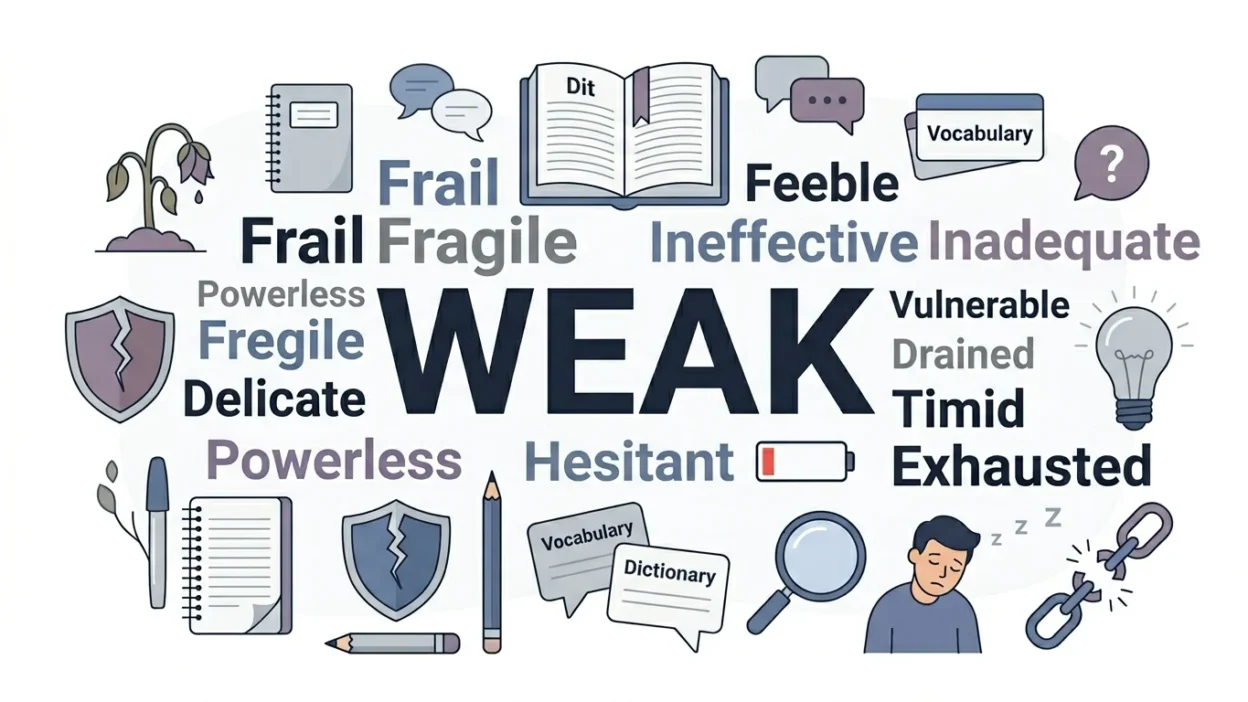
The word weak is commonly used in English to describe a lack of strength, power, effectiveness, or intensity. It can refer to people, arguments, performances, materials, relationships, and even emotions. While “weak” is a simple and useful word, using it repeatedly can make your writing sound repetitive.
Learning synonyms for weak can help students, ESL learners, writers, and content creators express ideas more precisely. Different synonyms describe different types of weakness, such as physical weakness, poor quality, lack of influence, or insufficient effort.
In this guide, you’ll learn the meaning of “weak,” discover 30 useful synonyms, see practical examples, and understand when to use each one.
What Does Weak Mean?
Weak means lacking strength, power, effectiveness, or intensity. It can describe physical condition, mental determination, arguments, materials, or performance.
Example:
After being sick for a week, he felt weak and tired.
The word can also describe things that are ineffective or not convincing.
Why Learn Synonyms for Weak?
Learning alternatives to “weak” can help you:
- Improve your vocabulary
- Avoid repetition
- Write more accurately
- Express different levels of weakness
- Improve essays and creative writing
- Communicate ideas more effectively
The right synonym can help readers better understand the specific type of weakness being described.
30 Synonyms for Weak
1. Frail
Meaning: Physically weak and delicate.
Example: The frail older man needed assistance.
Best Usage Context: Health and age.
2. Fragile
Meaning: Easily broken or damaged.
Example: The vase was fragile and valuable.
Best Usage Context: Objects and emotional situations.
3. Feeble
Meaning: Lacking physical strength.
Example: His feeble voice was barely audible.
Best Usage Context: Physical condition.
4. Delicate
Meaning: Easily harmed or damaged.
Example: The flower has delicate petals.
Best Usage Context: Objects and health.
5. Powerless
Meaning: Unable to influence or control.
Example: They felt powerless to stop the changes.
Best Usage Context: Authority and influence.
6. Ineffective
Meaning: Not producing desired results.
Example: The treatment proved ineffective.
Best Usage Context: Performance and results.
7. Inadequate
Meaning: Not enough or insufficient.
Example: The resources were inadequate.
Best Usage Context: Professional writing.
8. Deficient
Meaning: Lacking something necessary.
Example: The report was deficient in detail.
Best Usage Context: Formal contexts.
9. Inferior
Meaning: Lower in quality.
Example: The cheaper product was inferior.
Best Usage Context: Comparisons.
10. Poor
Meaning: Not good in quality or performance.
Example: The team delivered a poor performance.
Best Usage Context: General criticism.
11. Flimsy
Meaning: Weak and easily damaged.
Example: The chair felt flimsy.
Best Usage Context: Physical objects.
12. Unstable
Meaning: Not strong or secure.
Example: The structure appeared unstable.
Best Usage Context: Buildings and situations.
13. Vulnerable
Meaning: Easily harmed or attacked.
Example: Young children are vulnerable to illness.
Best Usage Context: Risk and protection.
14. Helpless
Meaning: Unable to take action.
Example: She felt helpless during the emergency.
Best Usage Context: Emotional situations.
15. Timid
Meaning: Lacking confidence or courage.
Example: The timid student avoided speaking.
Best Usage Context: Personality traits.
16. Hesitant
Meaning: Uncertain and lacking confidence.
Example: He seemed hesitant to answer.
Best Usage Context: Decision-making.
17. Unconvincing
Meaning: Not persuasive.
Example: The explanation was unconvincing.
Best Usage Context: Arguments and discussions.
18. Faulty
Meaning: Not functioning properly.
Example: The machine stopped because of faulty wiring.
Best Usage Context: Equipment and systems.
19. Substandard
Meaning: Below the expected quality.
Example: The contractor used substandard materials.
Best Usage Context: Professional assessments.
20. Dull
Meaning: Lacking strength or intensity.
Example: The presentation was dull and uninspiring.
Best Usage Context: Experiences and performances.
21. Mild
Meaning: Not strong or intense.
Example: She experienced mild symptoms.
Best Usage Context: Health and emotions.
22. Faint
Meaning: Very weak or difficult to notice.
Example: A faint sound came from outside.
Best Usage Context: Sensory descriptions.
23. Slack
Meaning: Lacking energy or effort.
Example: Productivity became slack during the summer.
Best Usage Context: Work and performance.
24. Lax
Meaning: Not strict or strong enough.
Example: The company had lax security policies.
Best Usage Context: Rules and standards.
25. Soft
Meaning: Not firm or strong.
Example: The ground was soft after the rain.
Best Usage Context: Physical descriptions.
26. Spineless
Meaning: Lacking courage or determination.
Example: His spineless response disappointed many people.
Best Usage Context: Criticism.
27. Cowardly
Meaning: Showing a lack of bravery.
Example: The cowardly act drew criticism.
Best Usage Context: Behavior and actions.
28. Exhausted
Meaning: Extremely tired and weak.
Example: The runners were exhausted after the race.
Best Usage Context: Physical condition.
29. Drained
Meaning: Lacking energy after effort.
Example: She felt emotionally drained.
Best Usage Context: Physical and emotional states.
30. Worn-Out
Meaning: Extremely tired or weakened.
Example: After the long journey, he felt worn-out.
Best Usage Context: Fatigue and overuse.
Comparison Guide: When to Use Different Synonyms for Weak
| Synonym | Best For | Tone |
|---|---|---|
| Frail | Physical weakness | Neutral |
| Fragile | Easily damaged things | Descriptive |
| Ineffective | Poor results | Professional |
| Inadequate | Insufficient resources | Formal |
| Vulnerable | Risk and exposure | Serious |
| Timid | Lack of confidence | Neutral |
| Faint | Very weak signals or sounds | Descriptive |
| Lax | Weak rules or standards | Professional |
| Exhausted | Extreme tiredness | Everyday |
| Drained | Emotional or physical fatigue | Emotional |
How to Choose the Right Synonym
For Physical Weakness
Use:
- Frail
- Feeble
- Exhausted
- Worn-Out
These focus on physical condition.
For Poor Performance
Use:
- Ineffective
- Inadequate
- Deficient
- Poor
These work well in professional and academic writing.
For Emotional Vulnerability
Use:
- Vulnerable
- Helpless
- Drained
These emphasize emotional states.
For Lack of Confidence
Use:
- Timid
- Hesitant
- Spineless
These describe behavior and personality.
For Weak Objects or Structures
Use:
- Fragile
- Flimsy
- Unstable
These describe physical durability.
Common Mistakes When Using Synonyms for Weak
Using Harsh Words Unnecessarily
Words like “spineless” and “cowardly” carry strong negative judgments.
Confusing Physical and Emotional Weakness
Some synonyms describe health, while others describe confidence or performance.
Ignoring Context
A synonym that works for a person may not fit an object or situation.
Repeating One Alternative
Using varied vocabulary makes your writing clearer and more engaging.
Conclusion
Learning synonyms for weak can improve your vocabulary and make your writing more precise. While “weak” is a useful word, alternatives such as frail, fragile, ineffective, vulnerable, inadequate, and exhausted can help you communicate different types of weakness more accurately.
The best synonym depends on the context and the specific meaning you want to express. By understanding these alternatives, you’ll be able to write with greater clarity, confidence, and variety in both academic and everyday situations.