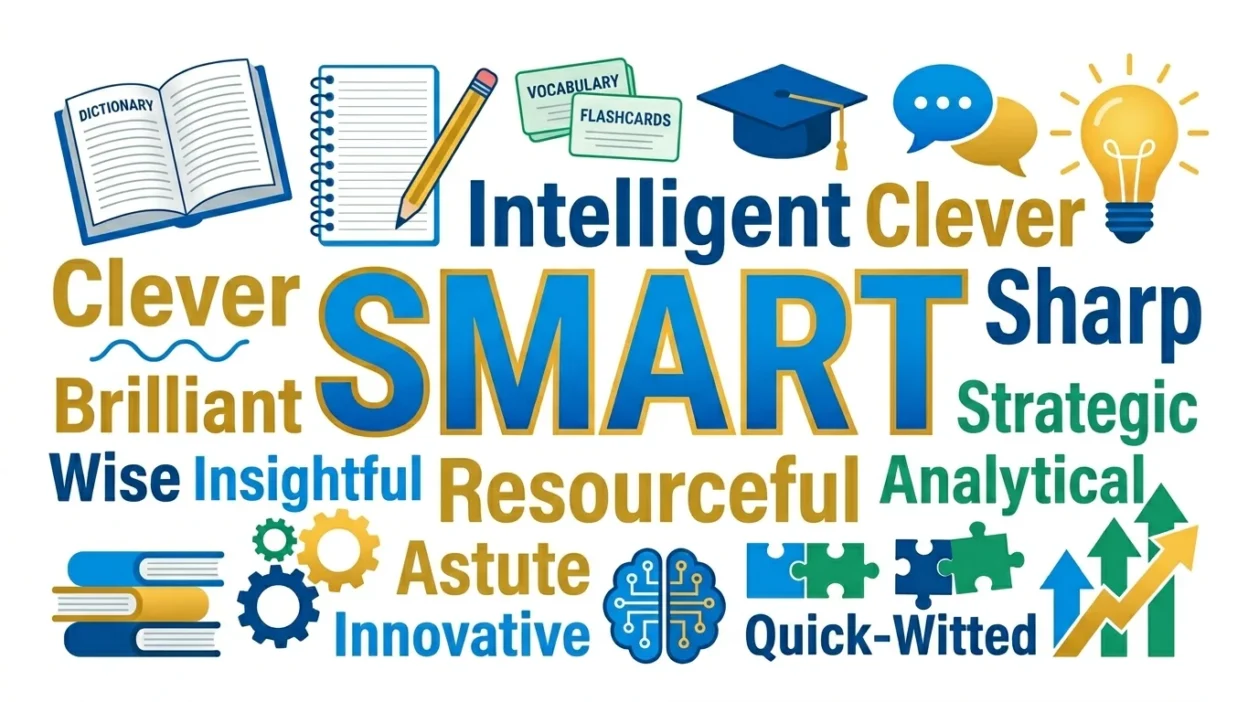
The word smart is one of the most commonly used adjectives in English. People use it to describe intelligence, quick thinking, good judgment, problem-solving skills, and even stylish appearance. Because it has multiple meanings, “smart” appears frequently in conversations, academic writing, workplace communication, and creative content.
While “smart” is a useful word, using it repeatedly can make your writing sound repetitive. Learning synonyms for smart can help students, ESL learners, writers, and content creators express ideas more accurately and choose words that better match different situations.
In this guide, you’ll learn the meaning of “smart,” discover 30 useful synonyms, see practical examples, and understand when to use each one.
What Does Smart Mean?
Smart generally means intelligent, quick to learn, or able to make good decisions. It can also describe someone who is well-dressed or stylish.
Example:
She is smart and always finds creative solutions to problems.
The word can refer to intelligence, wisdom, practical knowledge, or appearance depending on the context.
Why Learn Synonyms for Smart?
Learning alternatives to “smart” can help you:
- Improve your vocabulary
- Avoid repetition in writing
- Express different types of intelligence
- Make essays and stories more engaging
- Communicate more precisely
- Sound more professional and confident
Different synonyms highlight different qualities, such as knowledge, creativity, wisdom, or quick thinking.
30 Synonyms for Smart
1. Intelligent
Meaning: Having a high level of understanding and learning ability.
Example: She is an intelligent student.
Best Usage Context: General intelligence.
2. Clever
Meaning: Quick at learning and solving problems.
Example: That was a clever solution.
Best Usage Context: Problem-solving.
3. Bright
Meaning: Quick to learn and understand.
Example: The bright young boy excelled in school.
Best Usage Context: Education and learning.
4. Brilliant
Meaning: Extremely intelligent.
Example: She is a brilliant scientist.
Best Usage Context: Exceptional intelligence.
5. Sharp
Meaning: Quick-thinking and alert.
Example: He has a sharp mind.
Best Usage Context: Mental ability.
6. Wise
Meaning: Having good judgment and experience.
Example: Her wise advice helped everyone.
Best Usage Context: Decision-making.
7. Knowledgeable
Meaning: Having a lot of information about a subject.
Example: The guide was knowledgeable about history.
Best Usage Context: Expertise.
8. Educated
Meaning: Having received a good education.
Example: She is highly educated.
Best Usage Context: Academic discussions.
9. Insightful
Meaning: Showing deep understanding.
Example: He made an insightful observation.
Best Usage Context: Analysis and discussions.
10. Perceptive
Meaning: Good at noticing and understanding things.
Example: She is perceptive and observant.
Best Usage Context: Human behavior.
11. Astute
Meaning: Able to understand situations accurately.
Example: He is an astute businessman.
Best Usage Context: Business and strategy.
12. Ingenious
Meaning: Extremely creative and inventive.
Example: The engineer developed an ingenious design.
Best Usage Context: Innovation.
13. Inventive
Meaning: Good at creating new ideas.
Example: She has an inventive approach to teaching.
Best Usage Context: Creativity.
14. Resourceful
Meaning: Able to find solutions quickly.
Example: The resourceful traveler handled the problem calmly.
Best Usage Context: Practical problem-solving.
15. Analytical
Meaning: Skilled at examining information carefully.
Example: His analytical skills impressed the team.
Best Usage Context: Research and business.
16. Logical
Meaning: Using clear reasoning.
Example: She made a logical argument.
Best Usage Context: Decision-making.
17. Intellectual
Meaning: Interested in serious thinking and knowledge.
Example: He enjoys intellectual discussions.
Best Usage Context: Academic settings.
18. Gifted
Meaning: Naturally talented or intelligent.
Example: The gifted student learned quickly.
Best Usage Context: Education.
19. Talented
Meaning: Having natural ability.
Example: She is a talented writer.
Best Usage Context: Skills and abilities.
20. Capable
Meaning: Having the ability to do something well.
Example: He is a capable manager.
Best Usage Context: Workplace and skills.
21. Competent
Meaning: Skilled and effective.
Example: The technician is highly competent.
Best Usage Context: Professional environments.
22. Savvy
Meaning: Having practical knowledge.
Example: She is tech-savvy.
Best Usage Context: Modern and informal contexts.
23. Shrewd
Meaning: Clever in practical matters.
Example: The investor made a shrewd decision.
Best Usage Context: Business and finance.
24. Observant
Meaning: Quick to notice details.
Example: He is observant and rarely misses anything.
Best Usage Context: Awareness and attention.
25. Quick-Witted
Meaning: Able to think and respond quickly.
Example: She is quick-witted and funny.
Best Usage Context: Conversations and humor.
26. Brainy
Meaning: Very intelligent.
Example: The brainy student won the competition.
Best Usage Context: Informal conversations.
27. Scholarly
Meaning: Related to serious academic learning.
Example: He has a scholarly approach to research.
Best Usage Context: Education and academia.
28. Thoughtful
Meaning: Showing careful consideration.
Example: She gave a thoughtful answer.
Best Usage Context: Communication and relationships.
29. Strategic
Meaning: Good at planning effectively.
Example: The CEO made a strategic decision.
Best Usage Context: Business and leadership.
30. Innovative
Meaning: Introducing new ideas and methods.
Example: The company is known for innovative products.
Best Usage Context: Creativity and business.
Comparison Guide: When to Use Different Synonyms for Smart
| Synonym | Best For | Tone |
|---|---|---|
| Intelligent | General intelligence | Neutral |
| Clever | Problem-solving | Everyday |
| Brilliant | Exceptional intelligence | Strong |
| Wise | Judgment and experience | Positive |
| Astute | Business decisions | Professional |
| Analytical | Research and logic | Formal |
| Resourceful | Practical solutions | Positive |
| Savvy | Modern knowledge | Informal |
| Strategic | Planning and leadership | Professional |
| Innovative | Creativity and ideas | Modern |
How to Choose the Right Synonym
For Academic Intelligence
Use:
- Intelligent
- Brilliant
- Scholarly
- Intellectual
These emphasize learning and knowledge.
For Practical Problem-Solving
Use:
- Clever
- Resourceful
- Savvy
- Shrewd
These highlight real-world skills.
For Business and Leadership
Use:
- Astute
- Strategic
- Analytical
- Competent
These work well in professional settings.
For Creativity and Innovation
Use:
- Ingenious
- Inventive
- Innovative
- Gifted
These focus on original thinking.
For Good Judgment
Use:
- Wise
- Thoughtful
- Logical
- Perceptive
These emphasize decision-making and understanding.
Common Mistakes When Using Synonyms for Smart
Using Formal Words in Casual Conversations
Words like “astute” and “scholarly” may sound too formal in everyday speech.
Confusing Intelligence with Knowledge
Someone can be knowledgeable without being highly intelligent, and vice versa.
Overusing Strong Words
Words like “brilliant” should be reserved for truly exceptional intelligence.
Ignoring Context
Different synonyms describe different types of intelligence and ability.
Conclusion
Learning synonyms for smart can improve your vocabulary and help you communicate more effectively. While “smart” is a useful word, alternatives such as intelligent, clever, brilliant, wise, resourceful, strategic, and innovative allow you to express different forms of intelligence and skill more accurately.
The best synonym depends on the context and the specific quality you want to highlight. By understanding these alternatives, you’ll be able to write with greater precision, confidence, and variety in both academic and everyday situations.