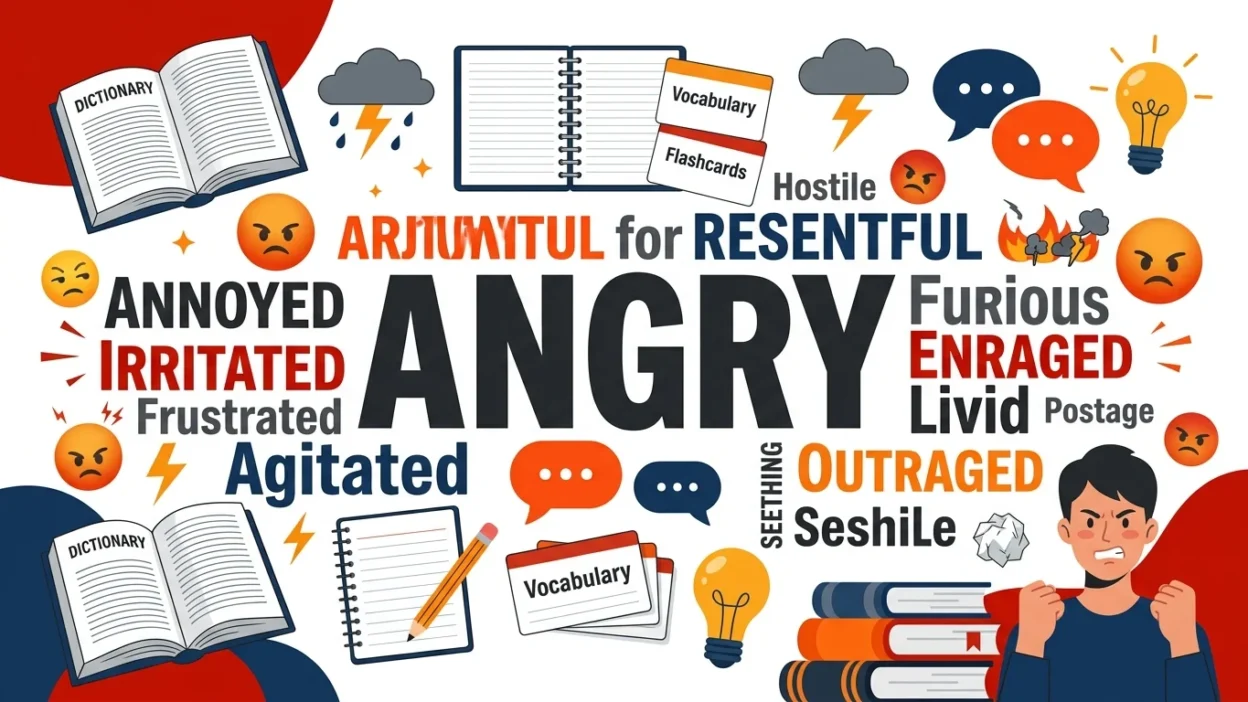
The word angry is one of the most commonly used adjectives in English. It describes feelings of annoyance, frustration, irritation or intense displeasure. Whether you’re talking about a person, a situation or an emotional reaction, “angry” is often the first word that comes to mind.
However, using the same word repeatedly can make your writing feel repetitive. Learning synonyms for angry can help students, ESL learners, writers and content creators express different levels and types of anger more accurately.
In this guide, you’ll learn the meaning of “angry,” discover 30 useful synonyms, see practical examples and understand when to use each one.
What Does Angry Mean?
Angry means feeling strong displeasure, irritation, or hostility because of a situation, person, or event.
Example:
She was angry when she discovered the mistake.
The word can describe mild annoyance, frustration or intense rage.
Why Learn Synonyms for Angry?
Learning alternatives to “angry” can help you:
- Improve your vocabulary
- Avoid repetition in writing
- Describe emotions more precisely
- Improve storytelling and character development
- Express different levels of frustration
- Make your writing more engaging
Different synonyms emphasize varying degrees of anger, from mild irritation to extreme fury.
30 Synonyms for Angry
1. Mad
Meaning: Angry or upset.
Example: He was mad about the delay.
Best Usage Context: Informal conversations.
2. Upset
Meaning: Emotionally disturbed or unhappy.
Example: She was upset by the news.
Best Usage Context: Mild anger and disappointment.
3. Annoyed
Meaning: Slightly angry or irritated.
Example: I was annoyed by the constant noise.
Best Usage Context: Everyday situations.
4. Irritated
Meaning: Feeling bothered or impatient.
Example: He became irritated by the interruptions.
Best Usage Context: Minor frustrations.
5. Frustrated
Meaning: Angry because something is difficult or unfair.
Example: She felt frustrated by the slow progress.
Best Usage Context: Challenges and obstacles.
6. Agitated
Meaning: Nervous and angry.
Example: The customer became agitated while waiting.
Best Usage Context: Stressful situations.
7. Cross
Meaning: Slightly angry or bad-tempered.
Example: She seemed cross after the argument.
Best Usage Context: British English and casual speech.
8. Testy
Meaning: Easily annoyed or impatient.
Example: He became testy during the meeting.
Best Usage Context: Formal and informal settings.
9. Resentful
Meaning: Angry because of perceived unfairness.
Example: She felt resentful about the decision.
Best Usage Context: Long-term anger.
10. Bitter
Meaning: Deeply angry and unhappy.
Example: He remained bitter about the loss.
Best Usage Context: Lasting negative feelings.
11. Indignant
Meaning: Angry because something is unfair or wrong.
Example: The citizens were indignant about the corruption.
Best Usage Context: Moral issues.
12. Offended
Meaning: Hurt and angry by words or actions.
Example: She was offended by the comment.
Best Usage Context: Personal interactions.
13. Displeased
Meaning: Not satisfied and somewhat angry.
Example: The manager was displeased with the results.
Best Usage Context: Professional situations.
14. Furious
Meaning: Extremely angry.
Example: He was furious when he heard the news.
Best Usage Context: Strong anger.
15. Enraged
Meaning: Filled with intense anger.
Example: The unfair decision enraged the crowd.
Best Usage Context: Severe anger.
16. Livid
Meaning: Extremely angry.
Example: She was livid after being blamed unfairly.
Best Usage Context: Intense emotions.
17. Outraged
Meaning: Very angry because something is shocking or unfair.
Example: People were outraged by the scandal.
Best Usage Context: Public reactions.
18. Incensed
Meaning: Extremely angry and offended.
Example: He was incensed by the accusation.
Best Usage Context: Formal writing.
19. Wrathful
Meaning: Full of intense anger.
Example: The king gave a wrathful response.
Best Usage Context: Literary writing.
20. Irate
Meaning: Very angry.
Example: The irate customer demanded a refund.
Best Usage Context: Formal and professional use.
21. Fuming
Meaning: Extremely angry.
Example: She was fuming after the argument.
Best Usage Context: Informal speech.
22. Seething
Meaning: Angrily controlling strong emotions.
Example: He sat quietly, seething with anger.
Best Usage Context: Hidden anger.
23. Raging
Meaning: Expressing powerful anger.
Example: The coach was raging after the defeat.
Best Usage Context: Extreme anger.
24. Hostile
Meaning: Showing anger and opposition.
Example: The discussion became hostile.
Best Usage Context: Relationships and conflicts.
25. Belligerent
Meaning: Aggressively angry.
Example: The man became belligerent during the dispute.
Best Usage Context: Conflict situations.
26. Temperamental
Meaning: Easily angered.
Example: The actor had a temperamental personality.
Best Usage Context: Personality traits.
27. Stormy
Meaning: Full of anger and conflict.
Example: They had a stormy relationship.
Best Usage Context: Relationships.
28. Explosive
Meaning: Likely to become angry suddenly.
Example: He has an explosive temper.
Best Usage Context: Character descriptions.
29. Ferocious
Meaning: Extremely fierce and angry.
Example: The crowd reacted with ferocious anger.
Best Usage Context: Strong emotional situations.
30. Vexed
Meaning: Annoyed and frustrated.
Example: She felt vexed by the repeated mistakes.
Best Usage Context: Mild to moderate irritation.
Comparison Guide: When to Use Different Synonyms for Angry
| Synonym | Best For | Intensity |
|---|---|---|
| Annoyed | Small frustrations | Low |
| Irritated | Minor problems | Low |
| Frustrated | Challenges and obstacles | Low Medium |
| Resentful | Long-term anger | Medium |
| Indignant | Unfair situations | Medium |
| Furious | Strong anger | High |
| Enraged | Extreme anger | Very High |
| Outraged | Public reactions | High |
| Hostile | Conflict and opposition | High |
| Livid | Intense emotional anger | Very High |
How to Choose the Right Synonym
For Mild Anger
Use:
- Annoyed
- Irritated
- Upset
- Vexed
These describe everyday frustrations.
For Moderate Anger
Use:
- Frustrated
- Resentful
- Agitated
- Indignant
These express stronger emotional reactions.
For Extreme Anger
Use:
- Furious
- Enraged
- Livid
- Incensed
These emphasize intense emotions.
For Public or Moral Reactions
Use:
- Outraged
- Indignant
- Hostile
- Belligerent
These fit social and political discussions.
For Creative Writing
Use:
- Wrathful
- Seething
- Raging
- Ferocious
These create vivid emotional imagery.
Common Mistakes When Using Synonyms for Angry
Using Strong Words Too Frequently
Words like “enraged” and “livid” should be reserved for genuinely intense situations.
Confusing Anger with Disappointment
Words like “upset” may indicate sadness as well as anger.
Ignoring Intensity Levels
Not all synonyms carry the same emotional strength.
Repeating the Same Alternative
Using varied vocabulary makes your writing more expressive and engaging.
Conclusion
Learning synonyms for angry can improve your vocabulary and help you describe emotions more accurately. While “angry” is a useful word, alternatives such as annoyed, irritated, frustrated, indignant, furious and enraged allow you to express different levels and types of anger with greater precision.
The best synonym depends on the context and the intensity of the emotion you want to convey. By understanding these alternatives, you’ll be able to write with greater clarity, confidence and emotional depth in both academic and everyday situations.