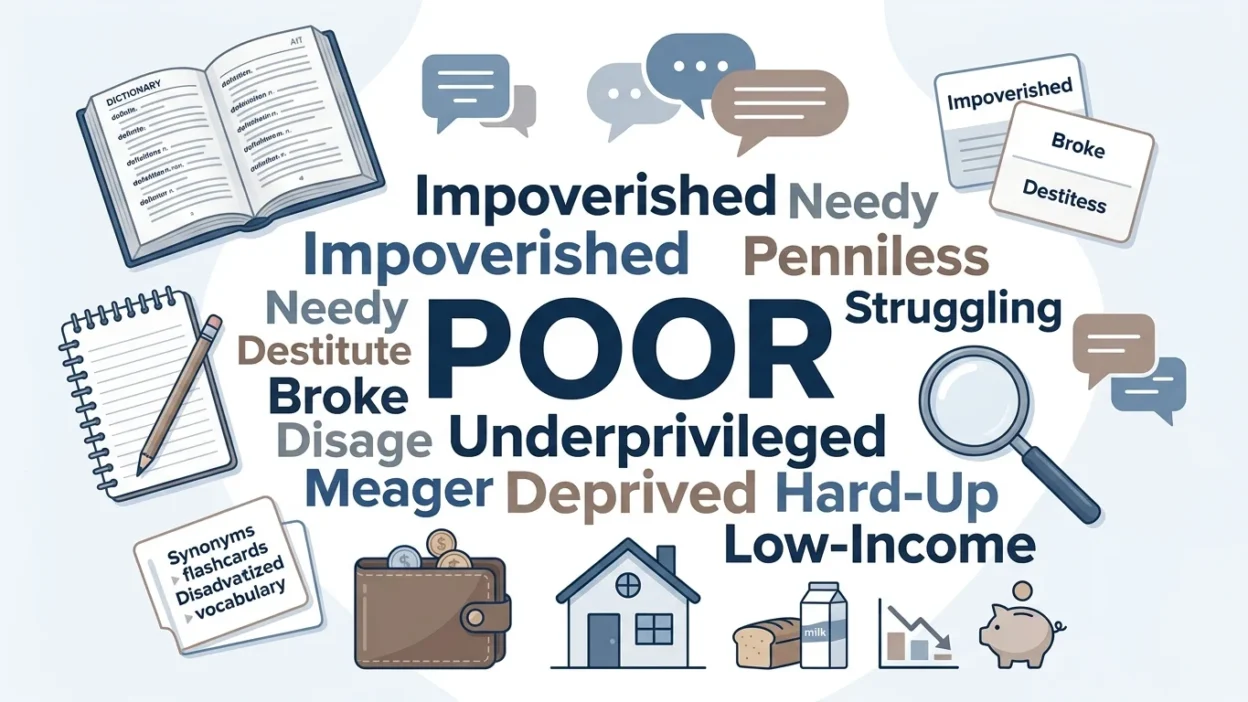
The word poor is commonly used in English to describe a lack of money, low quality, weak performance, or unfortunate conditions. Because it has several meanings, it appears frequently in conversations, academic writing, news articles, and everyday communication.
While “poor” is a simple and useful word, using it repeatedly can make your writing sound repetitive. Learning synonyms for poor can help students, ESL learners, writers, and content creators express ideas more accurately and choose words that better fit different situations.
In this guide, you’ll learn the meaning of “poor,” discover 30 useful synonyms, see practical examples, and understand when to use each one.
What Does Poor Mean?
Poor generally means having little money or lacking the resources needed for a comfortable life. It can also describe something of low quality, weak performance, or an unsatisfactory condition.
Example:
The family struggled because they were poor and had limited income.
The word can refer to financial hardship, quality, performance, health, or circumstances.
Why Learn Synonyms for Poor?
Learning alternatives to “poor” can help you:
- Improve your vocabulary
- Avoid repetition in writing
- Express different types of hardship or weakness
- Improve essays and stories
- Communicate more precisely
- Sound more professional and descriptive
Different synonyms highlight different aspects of poverty, quality, or performance.
30 Synonyms for Poor
1. Impoverished
Meaning: Extremely poor and lacking resources.
Example: Many impoverished families need support.
Best Usage Context: Poverty and economics.
2. Needy
Meaning: Lacking basic necessities.
Example: The charity helps needy children.
Best Usage Context: Social assistance.
3. Destitute
Meaning: Extremely poor with almost no possessions.
Example: The disaster left many people destitute.
Best Usage Context: Severe poverty.
4. Penniless
Meaning: Having no money.
Example: After the trip, he was nearly penniless.
Best Usage Context: Financial situations.
5. Broke
Meaning: Having little or no money.
Example: I’m broke until payday.
Best Usage Context: Informal conversations.
6. Indigent
Meaning: Poor and in need of assistance.
Example: The program supports indigent communities.
Best Usage Context: Formal writing.
7. Underprivileged
Meaning: Lacking opportunities or advantages.
Example: The organization serves underprivileged youth.
Best Usage Context: Education and society.
8. Disadvantaged
Meaning: Having fewer opportunities than others.
Example: Disadvantaged students received scholarships.
Best Usage Context: Social discussions.
9. Low-Income
Meaning: Earning less money than average.
Example: The policy benefits low-income families.
Best Usage Context: Economic discussions.
10. Struggling
Meaning: Experiencing financial or personal difficulties.
Example: The struggling business needed investment.
Best Usage Context: General hardship.
11. Inferior
Meaning: Lower in quality.
Example: The product was inferior to its competitors.
Best Usage Context: Comparisons.
12. Substandard
Meaning: Below the expected quality level.
Example: The building used substandard materials.
Best Usage Context: Professional assessments.
13. Mediocre
Meaning: Average and not very good.
Example: The movie received mediocre reviews.
Best Usage Context: Performance and quality.
14. Weak
Meaning: Lacking strength or effectiveness.
Example: The team delivered a weak performance.
Best Usage Context: Results and performance.
15. Inadequate
Meaning: Not enough or insufficient.
Example: The funding was inadequate.
Best Usage Context: Formal writing.
16. Unsatisfactory
Meaning: Not meeting expectations.
Example: The results were unsatisfactory.
Best Usage Context: Professional evaluations.
17. Deficient
Meaning: Lacking something important.
Example: The report was deficient in detail.
Best Usage Context: Academic and formal contexts.
18. Faulty
Meaning: Not working correctly.
Example: The device stopped because of faulty wiring.
Best Usage Context: Equipment and systems.
19. Shabby
Meaning: Old, worn out, and unattractive.
Example: The hotel looked shabby.
Best Usage Context: Appearance and condition.
20. Miserable
Meaning: Very bad or unpleasant.
Example: They lived in miserable conditions.
Best Usage Context: Living situations.
21. Unfortunate
Meaning: Experiencing bad circumstances.
Example: It was an unfortunate situation.
Best Usage Context: General discussions.
22. Meager
Meaning: Small and insufficient.
Example: The workers earned meager wages.
Best Usage Context: Income and resources.
23. Sparse
Meaning: Thinly distributed or limited.
Example: The area has sparse vegetation.
Best Usage Context: Resources and nature.
24. Limited
Meaning: Restricted in amount or scope.
Example: They had limited resources available.
Best Usage Context: General use.
25. Scant
Meaning: Barely enough.
Example: There was scant evidence.
Best Usage Context: Formal writing.
26. Modest
Meaning: Small but acceptable.
Example: They live in a modest home.
Best Usage Context: Neutral descriptions.
27. Deprived
Meaning: Lacking basic needs or opportunities.
Example: The deprived community needed support.
Best Usage Context: Social issues.
28. Hard-Up
Meaning: Experiencing financial difficulty.
Example: Many families were hard-up during the recession.
Best Usage Context: Informal conversations.
29. Bankrupt
Meaning: Unable to pay debts.
Example: The company went bankrupt.
Best Usage Context: Business and finance.
30. Insolvent
Meaning: Unable to meet financial obligations.
Example: The organization became insolvent.
Best Usage Context: Legal and financial contexts.
Comparison Guide: When to Use Different Synonyms for Poor
| Synonym | Best For | Tone |
|---|---|---|
| Impoverished | Severe poverty | Formal |
| Needy | People needing help | Compassionate |
| Broke | Lack of money | Informal |
| Low-Income | Economic discussions | Neutral |
| Struggling | Hardship and challenges | Positive |
| Mediocre | Average quality | Neutral |
| Inadequate | Insufficient resources | Formal |
| Miserable | Very bad conditions | Strong |
| Modest | Simple living | Neutral |
| Bankrupt | Financial failure | Professional |
How to Choose the Right Synonym
For Financial Poverty
Use:
- Impoverished
- Destitute
- Penniless
- Low-Income
- Needy
These focus on a lack of money and resources.
For Low Quality
Use:
- Inferior
- Mediocre
- Substandard
- Unsatisfactory
These describe poor performance or quality.
For Difficult Circumstances
Use:
- Struggling
- Unfortunate
- Miserable
- Deprived
These emphasize hardship.
For Professional Writing
Use:
- Indigent
- Inadequate
- Deficient
- Insolvent
These sound more formal and precise.
For Everyday Conversations
Use:
- Broke
- Hard-Up
- Struggling
- Modest
These are common and easy to understand.
Common Mistakes When Using Synonyms for Poor
Using Harsh Words Too Frequently
Words like “destitute” and “miserable” describe extreme situations and should be used carefully.
Confusing Poverty with Low Quality
Some synonyms describe financial hardship, while others describe weak performance or products.
Using Informal Words in Formal Writing
Words like “broke” may not fit academic or professional contexts.
Ignoring Context
Always choose a synonym that matches the specific type of poverty, quality, or hardship being discussed.
Conclusion
Learning synonyms for poor can improve your vocabulary and help you communicate more precisely. While “poor” is a versatile word, alternatives such as impoverished, needy, struggling, inadequate, mediocre, and deprived allow you to express different types of hardship, low quality, and limited resources more effectively.
The best synonym depends on the context and the exact meaning you want to convey. By understanding these alternatives, you’ll be able to write with greater clarity, confidence, and variety in both academic and everyday situations.