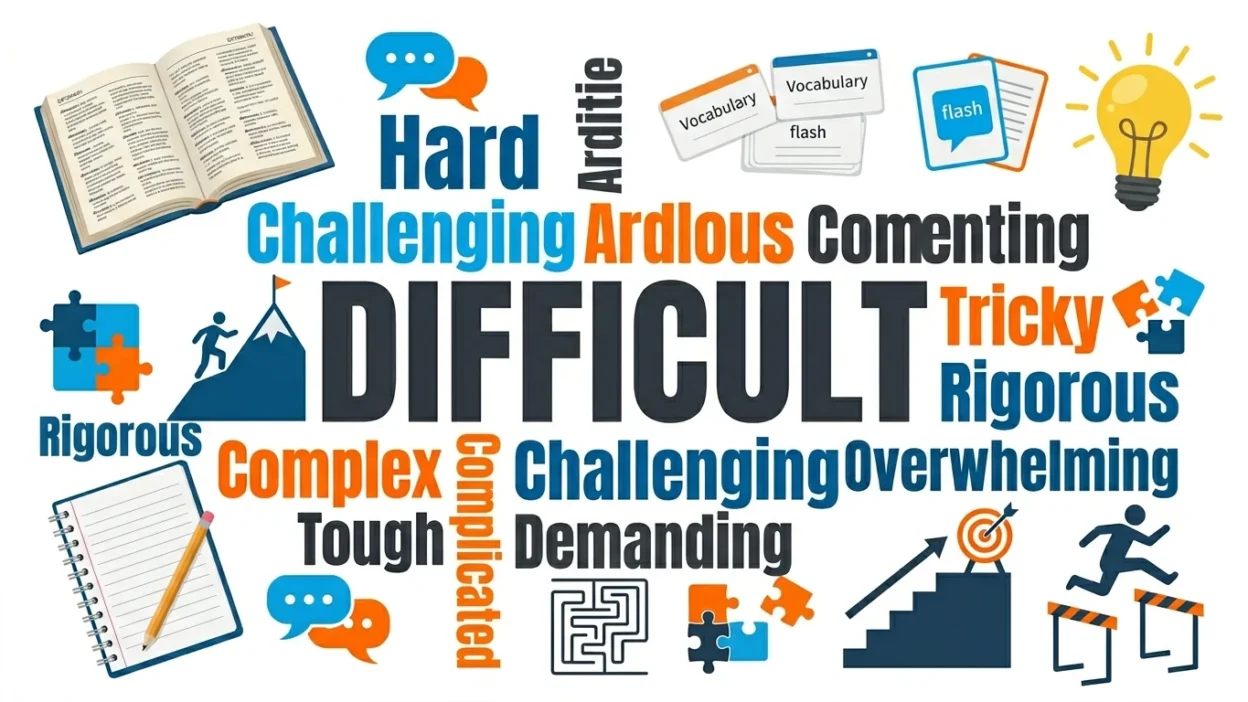
The word difficult is one of the most commonly used adjectives in English. It describes tasks, situations, problems or experiences that require significant effort, skill, patience or understanding. While “difficult” is a useful and versatile word, using it repeatedly can make your writing feel repetitive.
Learning synonyms for difficult can help students, ESL learners, writers and content creators express challenges more precisely. Some synonyms emphasize complexity, while others focus on effort, severity or emotional difficulty.
In this guide, you’ll learn the meaning of “difficult,” discover 30 useful synonyms, see practical examples, and understand when to use each one.
What Does Difficult Mean?
Difficult means hard to do, understand, solve, or deal with. It often requires extra effort, skill, knowledge, or patience.
Example:
The final exam was difficult, and many students struggled to complete it.
The word can describe tasks, decisions, relationships, situations, and experiences.
Why Learn Synonyms for Difficult?
Learning alternatives to “difficult” can help you:
- Improve your vocabulary
- Avoid repetition in writing
- Describe challenges more accurately
- Improve essays and stories
- Communicate ideas clearly
- Sound more professional and expressive
Different synonyms highlight different types and levels of difficulty.
30 Synonyms for Difficult
1. Hard
Meaning: Requiring a lot of effort.
Example: Learning a new language can be hard.
Best Usage Context: Everyday situations.
2. Challenging
Meaning: Difficult but rewarding.
Example: The project was challenging and exciting.
Best Usage Context: Work and education.
3. Tough
Meaning: Very difficult to handle or complete.
Example: It was a tough decision.
Best Usage Context: General use.
4. Complicated
Meaning: Having many parts or details.
Example: The instructions were complicated.
Best Usage Context: Processes and systems.
5. Complex
Meaning: Consisting of many interconnected parts.
Example: The issue is more complex than it appears.
Best Usage Context: Academic and professional writing.
6. Demanding
Meaning: Requiring a lot of effort or attention.
Example: She has a demanding job.
Best Usage Context: Work and responsibilities.
7. Arduous
Meaning: Extremely difficult and tiring.
Example: The hikers faced an arduous journey.
Best Usage Context: Formal writing.
8. Strenuous
Meaning: Requiring great physical or mental effort.
Example: The athletes completed strenuous training.
Best Usage Context: Physical activities.
9. Laborious
Meaning: Requiring considerable time and effort.
Example: Data entry can be laborious.
Best Usage Context: Work tasks.
10. Grueling
Meaning: Extremely exhausting and difficult.
Example: The race was grueling.
Best Usage Context: Intense challenges.
11. Exhausting
Meaning: Causing extreme tiredness.
Example: The long meeting was exhausting.
Best Usage Context: Physical and mental effort.
12. Tricky
Meaning: Difficult because it requires careful handling.
Example: The puzzle was tricky.
Best Usage Context: Everyday situations.
13. Problematic
Meaning: Creating difficulties or concerns.
Example: The policy proved problematic.
Best Usage Context: Professional discussions.
14. Troublesome
Meaning: Causing problems or inconvenience.
Example: The software bug was troublesome.
Best Usage Context: Problems and issues.
15. Burdensome
Meaning: Difficult because it feels like a heavy responsibility.
Example: The paperwork became burdensome.
Best Usage Context: Responsibilities.
16. Daunting
Meaning: Appearing difficult or intimidating.
Example: Starting a business can seem daunting.
Best Usage Context: New challenges.
17. Intimidating
Meaning: Making someone feel nervous because of difficulty.
Example: The interview process was intimidating.
Best Usage Context: Emotional challenges.
18. Intricate
Meaning: Very detailed and complicated.
Example: The design was intricate and impressive.
Best Usage Context: Art and technical subjects.
19. Confusing
Meaning: Hard to understand.
Example: The explanation was confusing.
Best Usage Context: Learning and communication.
20. Puzzling
Meaning: Difficult to understand or explain.
Example: The result was puzzling.
Best Usage Context: Mysteries and questions.
21. Knotty
Meaning: Difficult to solve.
Example: They faced a knotty legal issue.
Best Usage Context: Formal discussions.
22. Formidable
Meaning: Very difficult because of strength or size.
Example: The team faced a formidable opponent.
Best Usage Context: Competition.
23. Severe
Meaning: Very serious or intense.
Example: The country experienced severe economic problems.
Best Usage Context: Serious situations.
24. Rigorous
Meaning: Extremely thorough and demanding.
Example: The course has rigorous requirements.
Best Usage Context: Education and standards.
25. Taxing
Meaning: Requiring a lot of energy or effort.
Example: The task was mentally taxing.
Best Usage Context: Work and concentration.
26. Exacting
Meaning: Requiring great care and effort.
Example: The job has exacting standards.
Best Usage Context: Professional settings.
27. Unmanageable
Meaning: Too difficult to control.
Example: The workload became unmanageable.
Best Usage Context: Responsibilities.
28. Overwhelming
Meaning: So difficult that it feels impossible to handle.
Example: The amount of work was overwhelming.
Best Usage Context: Stressful situations.
29. Impossible
Meaning: Unable to be done.
Example: The deadline seemed impossible to meet.
Best Usage Context: Extreme difficulty.
30. Herculean
Meaning: Requiring extraordinary effort.
Example: Completing the project was a Herculean task.
Best Usage Context: Formal and dramatic writing.
Comparison Guide: When to Use Different Synonyms for Difficult
| Synonym | Best For | Tone |
|---|---|---|
| Hard | Everyday challenges | Casual |
| Challenging | Positive difficulties | Motivational |
| Complex | Detailed issues | Professional |
| Demanding | Work and responsibilities | Neutral |
| Arduous | Extremely difficult tasks | Formal |
| Daunting | Intimidating challenges | Emotional |
| Tricky | Small problems | Informal |
| Rigorous | Strict standards | Academic |
| Overwhelming | High stress situations | Emotional |
| Formidable | Strong opposition | Formal |
How to Choose the Right Synonym
For Everyday Situations
Use:
- Hard
- Tough
- Tricky
- Challenging
These sound natural in daily conversations.
For Professional Writing
Use:
- Complex
- Problematic
- Rigorous
- Exacting
These fit workplace and academic contexts.
For Physical Effort
Use:
- Strenuous
- Grueling
- Arduous
- Exhausting
These emphasize physical difficulty.
For Mental Challenges
Use:
- Confusing
- Puzzling
- Taxing
- Intricate
These focus on understanding and thinking.
For Extreme Difficulty
Use:
- Formidable
- Overwhelming
- Impossible
- Herculean
These describe major challenges.
Common Mistakes When Using Synonyms for Difficult
Using Extreme Words Too Often
Words like “impossible” and “Herculean” should be reserved for truly difficult situations.
Confusing Complexity with Difficulty
Something can be complex without being difficult, and vice versa.
Ignoring Tone
Some synonyms sound formal, while others fit casual conversations better.
Repeating One Alternative
Using a variety of synonyms makes your writing more engaging and professional.
Conclusion
Learning synonyms for difficult can improve your vocabulary and help you communicate challenges more accurately. While “difficult” is a useful word, alternatives such as challenging, complex, demanding, daunting, arduous, and formidable allow you to express different levels and types of difficulty more effectively.
The best synonym depends on the context and the specific challenge you want to describe. By understanding these alternatives, you’ll be able to write with greater clarity, confidence, and variety in both academic and everyday situations.