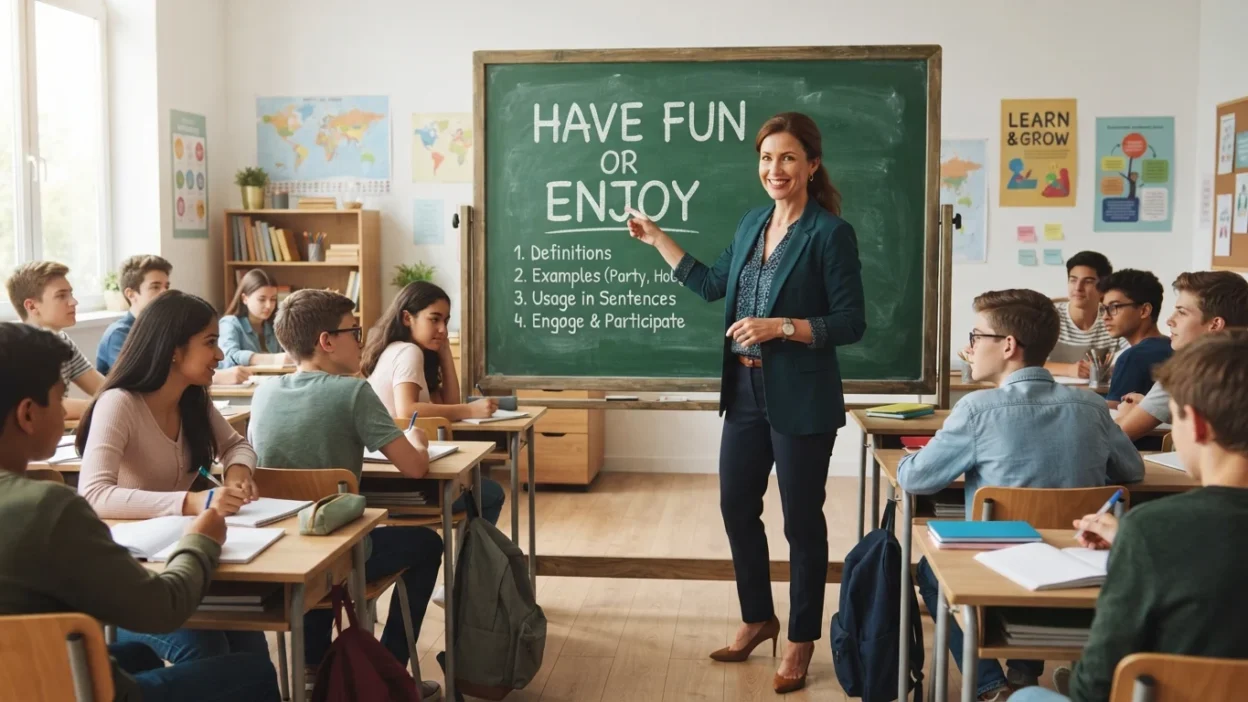
“Have fun” and “enjoy” both express the idea of experiencing pleasure or having a good time but they are used differently in English. Have fun is a common expression used to wish someone an enjoyable experience, while enjoy is a verb that usually needs an object or a specific grammatical structure. For example, “Have fun at the party!” and “Enjoy the party!” are both natural.
The main difference is grammatical as well as stylistic. Have fun is an expression that often stands alone, especially when saying goodbye or wishing someone a good time. Enjoy is more flexible and can be used with things, activities, events, food, experiences and more. English learners sometimes confuse these expressions because they can communicate a similar message. Understanding when to use each one will help your English sound more natural in everyday conversations, messages, travel situations and social interactions.
Quick Answer: Have Fun or Enjoy?
Have fun is an expression meaning “enjoy yourself” or “have a good time.” Enjoy is a verb meaning to get pleasure from something. You can say “Have fun at the party!” or “Enjoy the party!” Both are correct, but enjoy usually needs an object, while have fun can be used by itself.
Why Do People Confuse “Have Fun” and “Enjoy”?
People confuse these expressions because they often communicate a similar basic idea: having a pleasant experience.
For example:
Have fun at the concert!
and:
Enjoy the concert!
Both tell someone to have a good experience.
However, their sentence structures are different.
Have fun is a fixed expression:
Have fun!
Enjoy is a verb:
Enjoy the movie.
Enjoy your meal.
I enjoyed the trip.
Another important difference is that have fun focuses more on having a good time, often in a relaxed or social situation. Enjoy can describe pleasure more generally.
“Have Fun” Meaning and Usage
Have fun means to enjoy yourself or have a good time.
It is especially common in casual conversations when someone is going somewhere, doing an activity, or attending an event.
Common examples
Have fun at the party!
Have fun on your vacation!
Have fun at the concert!
We had fun at the beach.
The children had fun playing outside.
The expression can be used in different tenses.
Present or future
Have fun at the game!
Past
We had fun at the party.
Continuous
We are having fun on our trip.
Negative
Don’t have too much fun without me!
“Have fun” is generally friendly, informal, and conversational.
“Enjoy” Meaning and Usage
Enjoy is a verb meaning to get pleasure or satisfaction from something.
It can be used with many different things, including:
- food
- movies
- books
- music
- trips
- activities
- events
- experiences
- conversations
- hobbies
Examples:
I enjoy reading.
She enjoys classical music.
We enjoyed the movie.
Enjoy your meal!
Unlike have fun, enjoy can also describe a general or long-term preference.
I enjoy learning languages.
He enjoys cooking.
They enjoy spending time together.
“Enjoy” with a noun
I enjoyed the concert.
“Enjoy” with an -ing form
She enjoys swimming.
I enjoy reading.
“Enjoy yourself”
You can also use enjoy yourself when you want to tell someone to have a good time.
Enjoy yourself at the party!
This is very close in meaning to Have fun!
Have Fun vs Enjoy: Comparison Table
| Feature | Have Fun | Enjoy |
|---|---|---|
| Basic meaning | Have a good time | Get pleasure from something |
| Grammar | Fixed expression | Verb |
| Can stand alone? | Yes | Usually needs an object or context |
| Common tone | Casual and friendly | Neutral and flexible |
| Common example | Have fun at the party! | Enjoy the party! |
| With activities | Have fun playing games. | Enjoy playing games. |
| Past form | Had fun | Enjoyed |
| With food | Have fun eating! | Enjoy your meal! |
| General preferences | Less common | Very common |
| Example | We had fun yesterday. | I enjoy reading. |
When Should You Use “Have Fun”?
Use have fun when you want to talk about or wish someone a pleasant and enjoyable experience.
When saying goodbye
Have fun at the party!
Have fun on your trip!
At social events
Have fun at the wedding!
During recreational activities
Have fun playing football!
With children
Have fun at the playground!
When describing a past experience
We had a lot of fun at the beach.
The expression is especially natural when the activity is recreational, social, or exciting.
When Should You Use “Enjoy”?
Use enjoy when you want to say that someone gets pleasure from something.
Food
Enjoy your meal!
Movies
Did you enjoy the movie?
Books
I really enjoyed this book.
Activities
She enjoys swimming.
Travel
We enjoyed our vacation.
General interests
He enjoys playing guitar.
Formal or polite situations
I hope you enjoy your stay.
“Enjoy” is often more flexible than have fun because it can describe both short experiences and regular preferences.
20 Examples of “Have Fun” and “Enjoy”
- Have fun at the party tonight!
- I hope you enjoy the concert.
- We had fun at the beach yesterday.
- She enjoys reading mystery novels.
- Have fun on your vacation!
- Did you enjoy the movie?
- The children had fun at the park.
- I enjoy spending time with my family.
- Have fun at the football game!
- Please enjoy your meal.
- We had a lot of fun during our trip.
- He enjoys playing tennis.
- Have fun at the wedding!
- I hope you enjoy your stay.
- They had fun dancing all night.
- She enjoyed the birthday celebration.
- Have fun with your friends!
- I really enjoy learning new languages.
- We enjoyed talking with our guests.
- Have fun and take lots of pictures!
Common Mistakes With “Have Fun” and “Enjoy”
Mistake 1: Saying “Enjoy!” without context
“Enjoy!” can sometimes stand alone in casual English, especially when the object is obvious.
For example, when giving someone food, you can say:
Enjoy!
However, for English learners, enjoy + object is often the clearest structure.
Enjoy your meal!
Mistake 2: Saying “Enjoy your fun”
This is not the normal expression.
❌ Enjoy your fun!
More natural:
✅ Have fun!
or:
✅ Enjoy yourself!
Mistake 3: Using “enjoy to” incorrectly
After enjoy, use a noun or -ing form, not an infinitive.
❌ I enjoy to read books.
✅ I enjoy reading books.
Mistake 4: Saying “have fun” for every situation
“Have fun” is usually associated with an enjoyable experience or activity.
For general preferences, enjoy is usually more natural.
I enjoy reading.
This is more natural than:
I have fun reading.
The second sentence can be correct, but it emphasizes the enjoyment of the activity rather than simply stating a preference.
Mistake 5: Confusing “enjoy” with “enjoy yourself”
Compare:
Enjoy the party.
Enjoy yourself at the party.
Both are correct. The first focuses on the event; the second focuses on the person’s experience.
Memory Trick: Fun = Have, Pleasure = Enjoy
A simple way to remember the difference is:
FUN → HAVE
Have fun!
PLEASURE → ENJOY
Enjoy the movie!
Another useful pattern is:
Have fun doing something.
Enjoy doing something.
For example:
Have fun playing tennis.
Enjoy playing tennis.
Both can be correct, but they have slightly different conversational uses.
American English vs British English
Both have fun and enjoy are common in American and British English.
There is no major grammatical difference between the two varieties in how these expressions are normally used.
Examples in both varieties include:
Have fun at the party!
Enjoy your meal!
I enjoyed the movie.
She enjoys reading.
One small difference may appear in conversational style or preferred vocabulary depending on the speaker, but the basic grammar and meanings remain the same.
Similar Words and Expressions
Several expressions can communicate a similar idea to have fun or enjoy, but their meanings and tones can vary.
Have a good time
This is very close to have fun.
Have a good time at the party!
Enjoy yourself
This means to have a pleasant or enjoyable experience.
Enjoy yourself on your vacation!
Have a great time
This is a stronger, enthusiastic version of have a good time.
Have a great time at the concert!
Have a blast
This is informal and means to have a very exciting or enjoyable time.
We had a blast at the festival.
Appreciate
Appreciate can mean to recognize the value or quality of something. It does not always mean having fun.
I appreciate your help.
Relish
Relish means to enjoy something greatly or deeply.
She relished the opportunity to travel.
Like
Like expresses preference or enjoyment.
I like watching movies.
It is broader and often less expressive than enjoy.
Final Verdict: Have Fun or Enjoy?
Both have fun and enjoy are correct expressions, but they are used in different ways.
Use have fun when you mean:
- have a good time
- enjoy yourself
- experience something pleasantly
- wish someone an enjoyable experience
Use enjoy when you mean:
- get pleasure from something
- appreciate an experience
- like doing something
- experience pleasure from food, entertainment, activities, or events
Compare:
Have fun at the party!
Enjoy the party!
Both work naturally.
But:
I enjoy reading.
is more natural than:
I have fun reading.
when you are simply describing a regular interest or preference.
Frequently Asked Questions
Is “have fun” the same as “enjoy”?
They are similar but not exactly identical. Have fun usually means to have a good time, while enjoy means to get pleasure from something.
Is it correct to say “enjoy yourself”?
Yes. Enjoy yourself is a natural expression meaning to have a good time.
Enjoy yourself at the party!
Can I say “enjoy” by itself?
Yes, especially when the object is obvious from the context.
Enjoy!
However, enjoy + object is often clearer.
Enjoy your meal!
Is “enjoy to” grammatically correct?
Usually not when enjoy means getting pleasure from an activity. Use the -ing form.
❌ I enjoy to swim.
✅ I enjoy swimming.
Should I say “have fun” or “enjoy your trip”?
Both are correct.
Have fun on your trip!
Enjoy your trip!
Have fun sounds more casual and focuses on having a good time. Enjoy your trip focuses more directly on getting pleasure from the trip.
Is “have fun” informal?
Yes, have fun is generally casual and friendly. It is very common in everyday conversations.
What is another way to say “have fun”?
Common alternatives include:
- Have a good time!
- Have a great time!
- Enjoy yourself!
- Have a blast!
- Enjoy!
The best choice depends on the situation and level of formality.
Remember This
The easiest rule is:
Have fun = have a good time.
Enjoy = get pleasure from something.
Remember these patterns:
- Have fun at the party.
- Have fun on your trip.
- Enjoy the movie.
- Enjoy your meal.
- Enjoy reading.
- Enjoy yourself.
One especially useful grammar rule is:
Enjoy + noun or -ing form
I enjoy music.
I enjoy reading.
Avoid:
❌ I enjoy to read.
Instead:
✅ I enjoy reading.
Conclusion
Have fun and enjoy are both natural English expressions but they serve slightly different purposes. Have fun is a friendly expression that means to have a good time and is especially common when wishing someone well before an activity or event. Enjoy is a versatile verb that means to get pleasure from something and can be used with food, movies, activities, experiences, hobbies and more.
The simplest way to remember the difference is “have fun” = “have a good time,” while “enjoy” = “get pleasure from something.” Both can sometimes describe the same experience, such as a party or vacation but their grammar and emphasis are different. Once you learn these basic patterns, choosing between have fun and enjoy becomes much easier.