
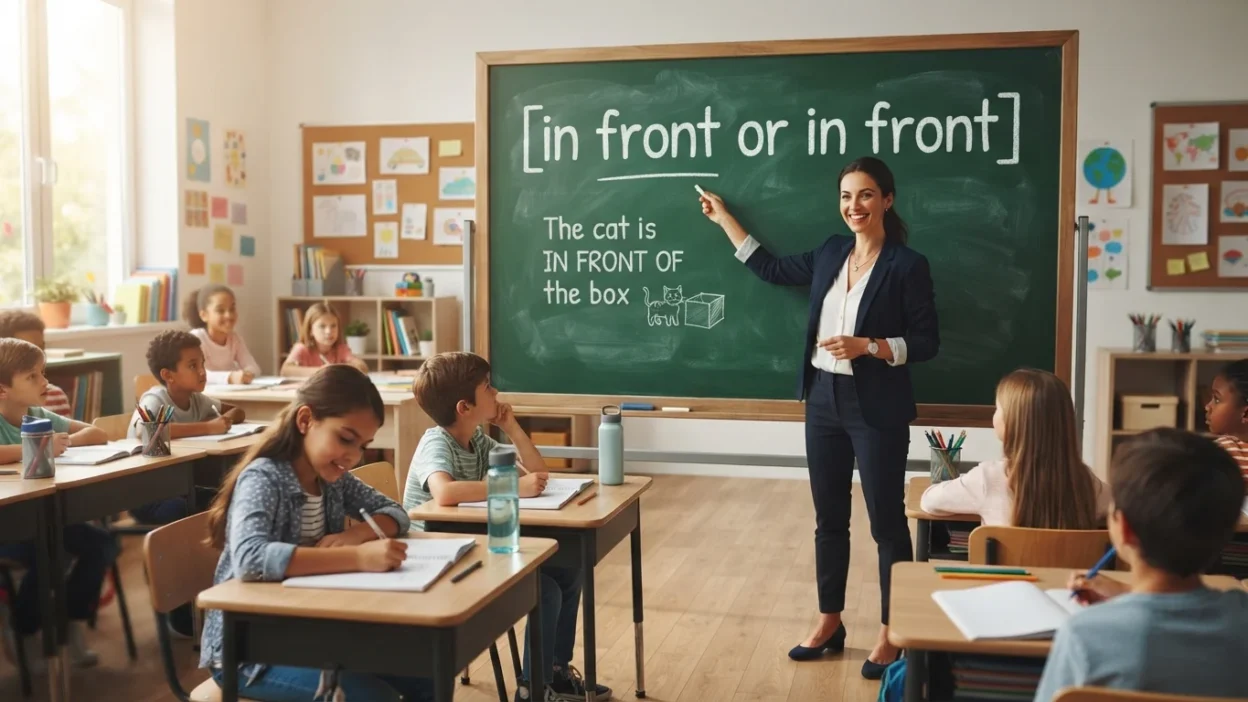
If you are wondering whether to write “infront” or “in front,” the correct standard English form is “in front” two separate words. In front is used to describe a position, location or situation where someone or something is ahead of or before another person or thing. For example, “The car is parked in front of the house.”
The spelling “infront” is generally considered incorrect in standard English. English learners may confuse these forms because many English expressions combine words into a single word over time. However, in front remains a two word phrase in standard usage. Understanding this distinction is especially important in school assignments, professional writing, emails and everyday communication.
Quick Answer: Infront or In Front?
“In front” is the correct standard English form. It is written as two words and usually describes a position ahead of or before someone or something. “Infront” is generally a misspelling and should be avoided in standard writing. For example: “She is standing in front of the door.”
Why Do People Confuse “Infront” and “In Front”?
The confusion happens mainly because in front sounds like one connected phrase when spoken.
English has many compound words that are written together, such as:
- inside
- outside
- beforehand
- everywhere
- sometimes
Because of this, learners may assume that in front should also be written as one word.
However, standard English keeps in front as two words.
Compare:
The teacher is in front of the class.
Not:
❌ The teacher is infront of the class.
The phrase is made up of in + front, and it normally functions as a prepositional phrase.
“In Front” Meaning and Usage
In front means ahead of, before, or at the forward side of something.
It is commonly followed by of:
in front of + person/place/thing
Examples
The car is parked in front of the house.
She is standing in front of me.
There is a tree in front of the building.
He sat in front of the television.
The phrase can describe physical location, position, or sometimes a figurative situation.
Physical location
The bus stopped in front of the school.
Position relative to someone
Please stand in front of me.
Public presence
He spoke in front of a large audience.
Here, in front of does not mean physically ahead of the audience. It can mean before or in the presence of other people.
“Infront” Is It Correct?
Infront is generally not correct in standard English.
If you mean the phrase describing position or location, write:
✅ in front
Not:
❌ infront
For example:
❌ The store is infront of the bank.
✅ The store is in front of the bank.
The one-word form may appear as a spelling error or informal typo, but it is not the standard form used in careful English writing.
Infront vs In Front: Comparison Table
| Expression | Correct? | Meaning | Example |
|---|---|---|---|
| in front | Yes | Ahead of or before something | The car is in front of the house. |
| in front of | Yes | Located ahead of something/someone | She stood in front of me. |
| infront | No, in standard English | Usually a misspelling of “in front” | ❌ He stood infront of the door. |
| front | Yes | The forward part or side | The front of the building is beautiful. |
When Should You Use “In Front”?
Use in front when describing a position, location or situation involving something ahead or before something else.
The taxi is waiting in front of the hotel.
She stood in front of her friend.
In front of an object
The bicycle is in front of the garage.
Before an audience
He gave a speech in front of hundreds of people.
Before a camera
She felt nervous in front of the camera.
In a line or queue
Depending on context, in front of can describe someone’s position relative to others.
There were three people in front of me.
20 Examples of “In Front”
- The car is parked in front of the house.
- She is standing in front of the door.
- There is a large tree in front of the school.
- He sat in front of me during the meeting.
- The bus stopped in front of the station.
- Please wait in front of the building.
- The children are playing in front of the house.
- I saw him in front of the store.
- She spoke in front of a large audience.
- There were several people in front of us.
- The teacher stood in front of the students.
- My car is parked in front of the office.
- He placed the chair in front of the desk.
- We met in front of the restaurant.
- She felt nervous in front of the camera.
- A taxi was waiting in front of the hotel.
- Don’t stand in front of the television.
- The dog was sitting in front of the fireplace.
- He stopped in front of the gate.
- I had to speak in front of my classmates.
Common Mistakes With “Infront” and “In Front”
Mistake 1: Writing “infront” as one word
❌ The shop is infront of the bank.
✅ The shop is in front of the bank.
Always use two words in standard English.
Mistake 2: Forgetting “of”
When referring to the position relative to another person or thing, in front of is normally the required phrase.
❌ She is standing in front the house.
✅ She is standing in front of the house.
Mistake 3: Confusing “in front” with “front”
These expressions are related but not identical.
The car is in front of the house.
Here, in front of describes the car’s location.
The front of the house needs painting.
Here, front is a noun referring to the forward side of the house.
Mistake 4: Using “infront” in formal writing
Even if readers understand what you mean, infront is not the standard spelling. Use in front in essays, applications, emails, reports, and professional documents.
Memory Trick: In Front Has Two Feet
A simple way to remember the spelling is:
IN + FRONT = two words
Imagine the words standing separately:
IN FRONT
You can also remember:
In front of the house
There is no need to join in and front together.
Think:
“In” has to stand in front of “front.”
So you write:
in front
not:
❌ infront
American English vs British English
There is no significant spelling difference between American and British English for this expression.
Both varieties use:
in front
and:
in front of
Examples:
- American English: The car is in front of the house.
- British English: The car is in front of the house.
The incorrect one-word spelling infront is not the standard form in either variety.
Similar Words and Expressions
Several words and phrases can express related ideas, but they are not always interchangeable with in front.
Ahead of
Ahead of can describe a position that is farther forward.
The car ahead of us stopped suddenly.
Before
Before can refer to position in space, time, or order.
She arrived before me.
At the front of
At the front of often emphasizes being positioned at the forward part of something.
He was sitting at the front of the classroom.
In the front
In the front can refer to being inside the front section of a place or vehicle.
We sat in the front of the bus.
Opposite
Opposite means facing or located across from something.
The bank is opposite the supermarket.
Behind
Behind is the opposite directional relationship.
The car is behind the building.
Final Verdict: Infront or In Front?
The correct standard English form is “in front,” written as two separate words.
Use:
✅ The car is in front of the house.
Avoid:
❌ The car is infront of the house.
The phrase in front of is used to describe location, position, or being before someone or something. It can also be used for situations involving an audience:
She spoke in front of the class.
The easiest rule is simple:
In front = two words.
Frequently Asked Questions
Is “infront” one word or two?
The standard form is two words: “in front.”
“Infront” is generally considered a misspelling.
Is “in front of” correct?
Yes. In front of is the standard phrase used when describing the position of something or someone relative to another person or thing.
The car is in front of the house.
Why is “infront” incorrect?
Standard English treats in front as a two-word phrase. The words are not normally combined into infront.
Do you say “in front” or “infront”?
Say and write in front.
Correct:
She is standing in front of me.
Incorrect in standard English:
❌ She is standing infront of me.
Should “in front of” always have “of”?
When you identify what something is positioned ahead of, of is normally used.
The car is in front of the house.
However, in front can also be used without of when the context already makes the meaning clear.
Please move in front.
Is “in front” the same in American and British English?
Yes. Both American and British English use in front as the standard spelling.
What is an easy way to remember “in front”?
Remember that in front contains two separate words:
IN + FRONT
Never combine them into infront in standard English writing.
Remember This
The key rule is:
In front = correct
Infront = incorrect in standard English
Use:
- in front of the house
- in front of me
- in front of the school
- in front of the audience
- in front of the camera
Remember that in front stays as two words, even when it is followed by of.
Conclusion
The correct spelling is in front, not infront. The phrase is used to describe a position ahead of or before someone or something. It is commonly followed by of, as in “The car is in front of the house” or “She stood in front of me.” It can also describe being before an audience as in “He spoke in front of the class.”
The good news is that this spelling rule is easy to remember. Simply keep in and front as two separate words. Whether you are writing an English assignment, sending a professional email or having an everyday conversation, use in front for the standard form. Remember: in front = two words, infront = misspelling.