
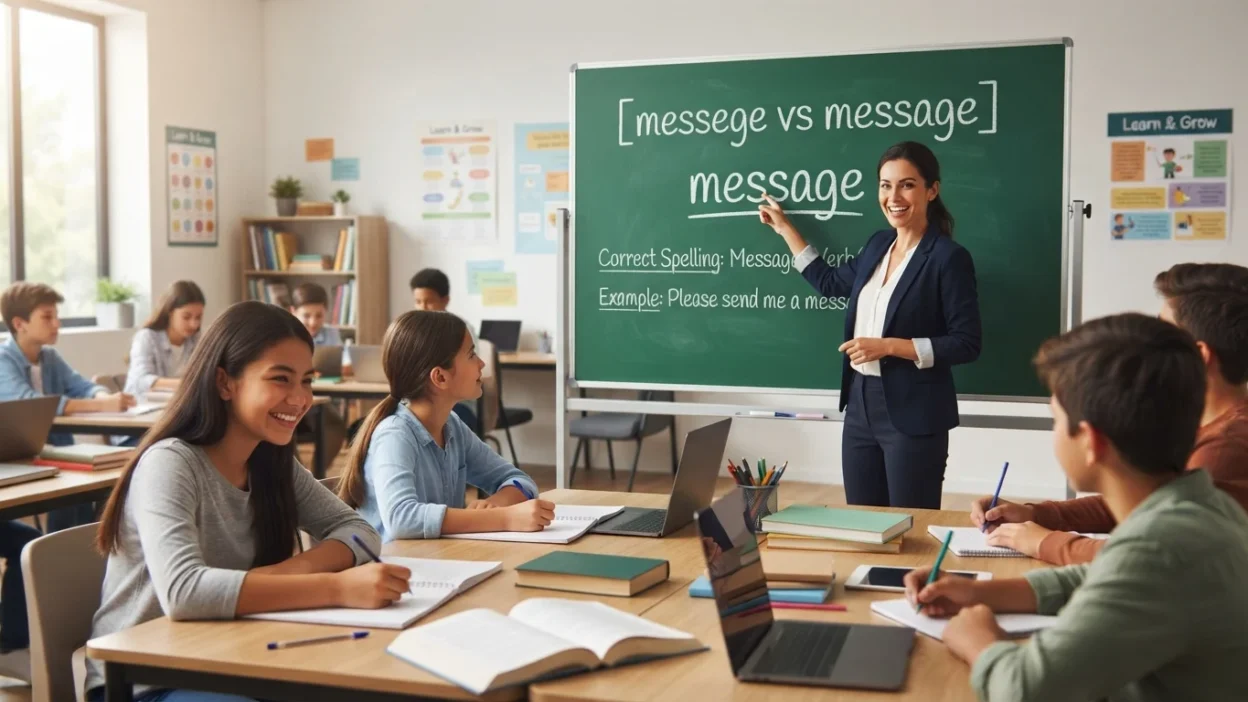
When comparing “messege vs message,” the correct spelling is message. “Messege” is a common spelling mistake and is not the standard English spelling. A message is a piece of information, communication or text that someone sends or gives to another person. For example, you might send a message to a friend, leave a message for a coworker or receive a message on your phone.
This spelling mistake is easy to make because message does not sound exactly like it looks. Many learners remember the first part correctly but accidentally write “messege” instead of “message.” Learning the correct spelling, meaning, pronunciation, and usage can help you avoid this mistake in school, work, emails, texts and everyday writing.
Quick Answer: Messege vs Message
Message is the correct English spelling. Messege is incorrect. The word message means information or communication sent from one person to another. Remember that the correct spelling contains “sage” at the end: message.
Why Do People Confuse “Messege” and “Message”?
People often confuse these spellings because message contains an unstressed vowel sound near the end. When people hear the word, they may remember the sound rather than the exact spelling.
The incorrect form “messege” can seem logical because the word is pronounced differently from how some learners expect it to be spelled.
Another reason is that English contains many words where vowel sounds and spellings do not match perfectly. As a result, learners may write messege even though they know exactly what they want to say.
The important point is simple:
- Message = correct
- Messege = incorrect
What Does “Message” Mean?
Message is a noun that means information, communication or an idea communicated from one person or group to another.
It can refer to different types of communication.
Message as written communication
A message can be a text, email, note, letter or other written communication.
Example:
I received a message from my teacher.
Message as spoken communication
A message can also be information communicated verbally.
Example:
She left a message for her brother.
Message as an important idea
The word can also describe the main idea or lesson communicated by a speech, book, film, advertisement or story.
Example:
The movie has a powerful message about friendship.
Message as a verb
Message can also be used as a verb, especially in informal digital communication.
Example:
Please message me when you arrive.
What Does “Messege” Mean?
Messege is not the standard spelling of an English word. It is a misspelling of message.
If you want to refer to a text, email, note, communication, or expressed idea, use message.
Incorrect:
I sent you a messege.
Correct:
I sent you a message.
Messege vs Message: Comparison Table
| Feature | Messege | Message |
|---|---|---|
| Correct spelling | ❌ No | ✅ Yes |
| Standard English word | ❌ No | ✅ Yes |
| Meaning | None as the standard spelling | Information or communication |
| Common use | Spelling mistake | Everyday English |
| Example | I sent a messege. ❌ | I sent a message. ✅ |
| Suitable for formal writing | No | Yes |
When Should You Use “Message”?
Use message whenever you are talking about information or communication sent, spoken, written, or expressed.
Common situations include:
- Sending a text message
- Receiving an email
- Leaving a phone message
- Writing a note
- Giving someone information
- Communicating an important idea
- Discussing the meaning of a book or movie
- Sending someone a private message online
Examples of Correct Usage
- I sent a message to my friend.
- Did you receive my message?
- She left a message on my phone.
- Please read the message carefully.
- He sent me a message this morning.
- I forgot to reply to her message.
- The teacher sent a message to the students.
- Can you message me when you get home?
- The book has an important message about kindness.
- What was the main message of the speech?
- I received a message from my manager.
- Please leave a message after the tone.
- The advertisement sends a clear message to consumers.
- She messaged her sister about the meeting.
- The story’s message is easy to understand.
Common Mistakes with “Messege vs Message”
Mistake 1: Writing “messege”
The most common error is replacing the a in message with e.
❌ Messege
✅ Message
Mistake 2: Using the incorrect spelling in formal writing
Even if the meaning is clear, messege should not be used in essays, applications, emails, reports, or professional communication.
Always use message.
Mistake 3: Confusing the noun and verb forms
Message can be both a noun and a verb.
As a noun:
I received your message.
As a verb:
Message me later.
The spelling stays the same.
Mistake 4: Assuming pronunciation determines spelling
English spelling cannot always be predicted perfectly from pronunciation. It is better to learn the written form directly.
Memory Trick for “Message”
A simple way to remember the spelling is:
MESSAGE = MESS + AGE
Think of the word as:
mess + age = message
The important part to remember is the ending:
-sage
So write:
✅ message
Not:
❌ messege
You can also remember this short sentence:
A message has “sage” at the end.
American vs British English
The spelling message is standard in both American English and British English.
There is no major spelling difference between the two varieties for this word.
For example:
American English:
I sent you a message.
British English:
I sent you a message.
Both use message.
However, the word may be used in different contexts depending on the communication system or situation. For example, British and American speakers may have different preferences for related terms such as text, text message, or mobile message, but the spelling message itself remains the same.
Similar Words to “Message”
Several words are related to message, but they do not always have exactly the same meaning.
Communication
Information shared between people or groups.
Good communication is important in a relationship.
Note
A short written piece of information.
She left a note on the table.
Text
A written message sent through a phone or messaging service.
I sent him a text.
An electronic message sent through email.
I received an email from my teacher.
Notice
Information given to inform people about something.
The school posted a notice about the holiday.
Statement
Something officially said or written.
The company released a statement.
Announcement
Information publicly given to a group of people.
The principal made an announcement.
Final Verdict: Messege or Message?
The correct spelling is message.
Messege is a spelling error and should not be used in standard English writing. Whether you are writing a text, email, school assignment, business document, or social media post, use message.
Remember the spelling:
Messege ❌
Message ✅
If you are unsure, think of the ending “-sage.” This simple memory trick can help you remember the correct form.
Frequently Asked Questions
Is “messege” a correct spelling?
No. Messege is a misspelling. The correct spelling is message.
What is the correct spelling: messege or message?
The correct spelling is message.
What does message mean?
A message is information, communication, or an idea communicated from one person or group to another.
Can “message” be a verb?
Yes. Message can be used as a verb, especially in digital communication.
Example:
Message me when you arrive.
Is “messege” accepted in formal English?
No. Messege is not the standard spelling and should be corrected to message.
Is “message” spelled differently in British English?
No. Message has the same spelling in British and American English.
How can I remember the spelling of message?
Remember MESS + AGE = MESSAGE or remember that message ends with -sage.
What is another word for message?
Depending on the context, alternatives can include communication, note, text, email, announcement, statement, or notice.
Remember This
When you see “messege vs message,” choose message.
- ❌ Messege = incorrect spelling
- ✅ Message = correct spelling
- Message can be a noun or a verb.
- It can refer to written, spoken, digital, or symbolic communication.
- The spelling is the same in American and British English.
- Remember: MESS + AGE = MESSAGE.
Conclusion
The difference between messege and message is simply a matter of correct spelling. Message is the standard English word for information, communication, or an idea shared with someone. Messege is an incorrect spelling and should be avoided in both formal and informal writing.
For students, ESL learners, and anyone improving their English, remembering the correct spelling can prevent a very common writing mistake. Whenever you need this word, choose message and remember its -sage ending.