
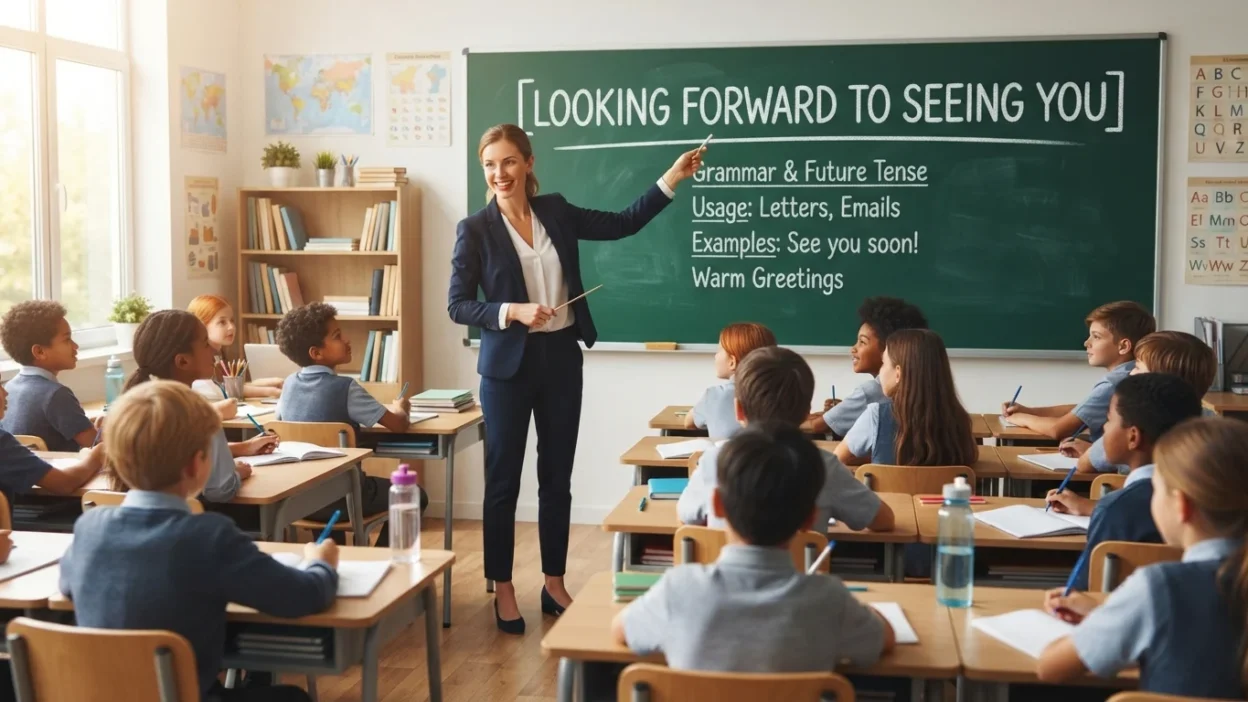
“Looking forward to seeing you” is a correct and natural English expression used to say that you are excited, pleased or happy about meeting someone in the future. It is common in emails, messages, conversations, invitations and professional communication. For example, “I’m looking forward to seeing you tomorrow” means that you are happy about the upcoming meeting.
A common grammar question is why English uses “seeing” instead of “see.” The answer is that “look forward to” is followed by a noun, pronoun, or gerund (-ing form). Therefore we say “I’m looking forward to seeing you,” not “I’m looking forward to see you.” Understanding this small grammar rule helps you write more natural English and avoid one of the most common mistakes with this expression.
Quick Answer
“Looking forward to seeing you” is correct. It means you are happy or excited about meeting someone in the future. The expression “look forward to” is followed by a noun or -ing form, so “seeing” is correct. For example: “I’m looking forward to seeing you next week.”
Why Do People Confuse “Looking Forward to Seeing You”?
The confusion usually comes from the word “to.”
Many English learners learn that to is followed by the base form of a verb:
- to see
- to meet
- to visit
- to talk
For example:
I want to see you.
However, “to” in “look forward to” is a preposition, not the infinitive marker.
After a preposition, English normally uses a noun, pronoun, or gerund.
Therefore:
I’m looking forward to seeing you.
is correct.
Not:
I’m looking forward to see you.
Looking Forward to Seeing You: Meaning and Usage
“Looking forward to seeing you” expresses positive anticipation about meeting someone.
It can mean:
- I am happy that I will see you.
- I am excited about meeting you.
- I am anticipating our meeting positively.
- I am pleased about seeing you soon.
Example
I’m looking forward to seeing you tomorrow.
This tells the other person that you are happy about your upcoming meeting.
The expression can be used with different time expressions:
- I’m looking forward to seeing you tomorrow.
- I’m looking forward to seeing you next week.
- I’m looking forward to seeing you soon.
- I’m looking forward to seeing you at the event.
Looking Forward to Seeing You in Emails
The expression is especially common at the end of emails.
Professional Example
I’m looking forward to seeing you at the meeting next Monday.
This is polite and professional.
Friendly Example
Looking forward to seeing you soon!
This sounds warmer and more casual.
Formal Example
I look forward to seeing you at the conference.
This is also correct and is often used in professional communication.
Looking Forward to Seeing You vs Looking Forward to See You
| Expression | Correct? | Reason | Example |
|---|---|---|---|
| Looking forward to seeing you | ✅ Yes | “To” is a preposition, so the gerund “seeing” follows it | I’m looking forward to seeing you. |
| Looking forward to see you | ❌ No | “See” is the base verb and does not follow “look forward to” in this structure | I’m looking forward to seeing you. |
| I look forward to seeing you | ✅ Yes | Correct formal/professional structure | I look forward to seeing you soon. |
| I’m looking forward to seeing you | ✅ Yes | Correct continuous form | I’m looking forward to seeing you tomorrow. |
When Should You Use “Looking Forward to Seeing You”?
1. Before a Planned Meeting
Use it when you know you will meet someone.
I’m looking forward to seeing you at the office tomorrow.
2. In Professional Emails
It is common when confirming a meeting, appointment, interview, or event.
I look forward to seeing you at the interview.
3. In Friendly Messages
You can use it with friends and family.
I’m looking forward to seeing you this weekend!
4. After Making Plans
Great! I’m looking forward to seeing you on Saturday.
5. At the End of an Email
Thank you for your time. I’m looking forward to seeing you next week.
20 Examples of “Looking Forward to Seeing You”
- I’m looking forward to seeing you tomorrow.
- I’m looking forward to seeing you next week.
- We’re looking forward to seeing you at the event.
- I’m really looking forward to seeing you again.
- I look forward to seeing you at the meeting.
- She is looking forward to seeing you soon.
- They are looking forward to seeing you this weekend.
- I’m looking forward to seeing you at the conference.
- We’re looking forward to seeing you at the office.
- I’m looking forward to seeing you after the holidays.
- I’m really looking forward to seeing you again.
- He is looking forward to seeing you in person.
- I look forward to seeing you on Monday.
- We look forward to seeing you at the ceremony.
- I’m looking forward to seeing you at the restaurant.
- Everyone is looking forward to seeing you again.
- I’m looking forward to seeing you later today.
- We’re looking forward to seeing you at the celebration.
- I look forward to seeing you during your visit.
- I’m looking forward to seeing you soon!
Common Mistakes
Mistake 1: “Looking Forward to See You”
Incorrect:
I’m looking forward to see you.
Correct:
I’m looking forward to seeing you.
The reason is grammatical: to is a preposition in the expression look forward to.
Mistake 2: Forgetting “Am,” “Is,” or “Are”
When using the continuous form, you need the appropriate form of be.
Incorrect:
I looking forward to seeing you.
Correct:
I’m looking forward to seeing you.
Other examples:
She’s looking forward to seeing you.
They’re looking forward to seeing you.
Mistake 3: Using “See” After “To”
Remember that look forward to takes a noun or gerund.
Correct:
I look forward to meeting you.
I look forward to hearing from you.
I look forward to seeing you.
Mistake 4: Confusing “Look Forward” With “Hope”
These expressions are related but not identical.
I look forward to seeing you.
shows positive anticipation about a future event.
I hope to see you.
expresses a desire or possibility.
Memory Trick
Remember this simple rule:
LOOK FORWARD TO + NOUN / -ING
Examples:
- look forward to seeing
- look forward to meeting
- look forward to hearing
- look forward to talking
- look forward to working
A useful memory sentence is:
After “look forward to,” use ing.
So:
I look forward to seeing you. ✅
Not:
I look forward to see you. ❌
American vs British English
“Looking forward to seeing you” is correct in both American and British English.
There is no major difference in the grammar of this expression between the two varieties.
American English:
I’m looking forward to seeing you next week.
British English:
I’m looking forward to seeing you next week.
The expression is widely understood in both forms of English and is suitable for personal and professional communication.
Similar Expressions
I Look Forward to Seeing You
This is slightly more formal and is especially common in professional emails.
I look forward to seeing you at the meeting.
I’m Looking Forward to Seeing You
This sounds natural, warm, and conversational.
I’m looking forward to seeing you this weekend.
Looking Forward to Seeing You
This is a shortened version often used in informal emails and messages.
Looking forward to seeing you soon!
I Hope to See You
This expresses a wish or possibility rather than definite anticipation.
I hope to see you at the event.
I Can’t Wait to See You
This is more enthusiastic and informal.
I can’t wait to see you again!
It Will Be Great to See You
This is friendly and positive.
It will be great to see you next week.
Final Verdict: Is “Looking Forward to Seeing You” Correct?
Yes, “looking forward to seeing you” is completely correct.
The important grammar rule is that “look forward to” is followed by a noun, pronoun, or gerund (-ing form). Therefore, seeing is correct in this expression.
Use:
I’m looking forward to seeing you. ✅
Avoid:
I’m looking forward to see you. ❌
You can use the expression in professional emails, friendly messages, invitations, meeting confirmations, and everyday conversations.
Frequently Asked Questions
Is “looking forward to seeing you” grammatically correct?
Yes. It is a standard and natural English expression meaning that you are happy or excited about seeing someone in the future.
Why do we say “seeing” instead of “see”?
Because “to” in “look forward to” is a preposition. A noun or gerund follows it, so seeing is correct.
Is “looking forward to see you” wrong?
Yes, in standard English, “looking forward to see you” is incorrect. The correct expression is “looking forward to seeing you.”
Is “I look forward to seeing you” formal?
Yes. “I look forward to seeing you” is polite and commonly used in professional emails, business communication, interviews, meetings, and formal arrangements.
Is “I’m looking forward to seeing you” informal?
It can be used in both informal and professional situations. It often sounds warm and natural, while “I look forward to seeing you” can sound slightly more formal.
Can I say “looking forward to seeing you soon”?
Yes. “Looking forward to seeing you soon” is natural and commonly used in messages, emails, and conversations.
What is the difference between “I hope to see you” and “I look forward to seeing you”?
“I hope to see you” expresses a desire or possibility. “I look forward to seeing you” expresses positive anticipation about a future meeting.
Remember This
The key rule is simple:
Look forward to + noun or -ing form
So:
- I look forward to seeing you.
- I look forward to meeting you.
- I look forward to hearing from you.
- I look forward to talking with you.
- I look forward to working with you.
The correct phrase is:
Looking forward to seeing you.
Conclusion
“Looking forward to seeing you” is a correct, natural and widely used English expression for showing positive anticipation about meeting someone. It works well in everyday conversations, friendly messages, professional emails, meetings, invitations and other situations where a future meeting is expected.
The most important grammar point is the use of seeing. In “look forward to,” the word to functions as a preposition, so it is followed by a noun or ing form. That is why we say “I look forward to seeing you,” rather than “I look forward to see you.”