
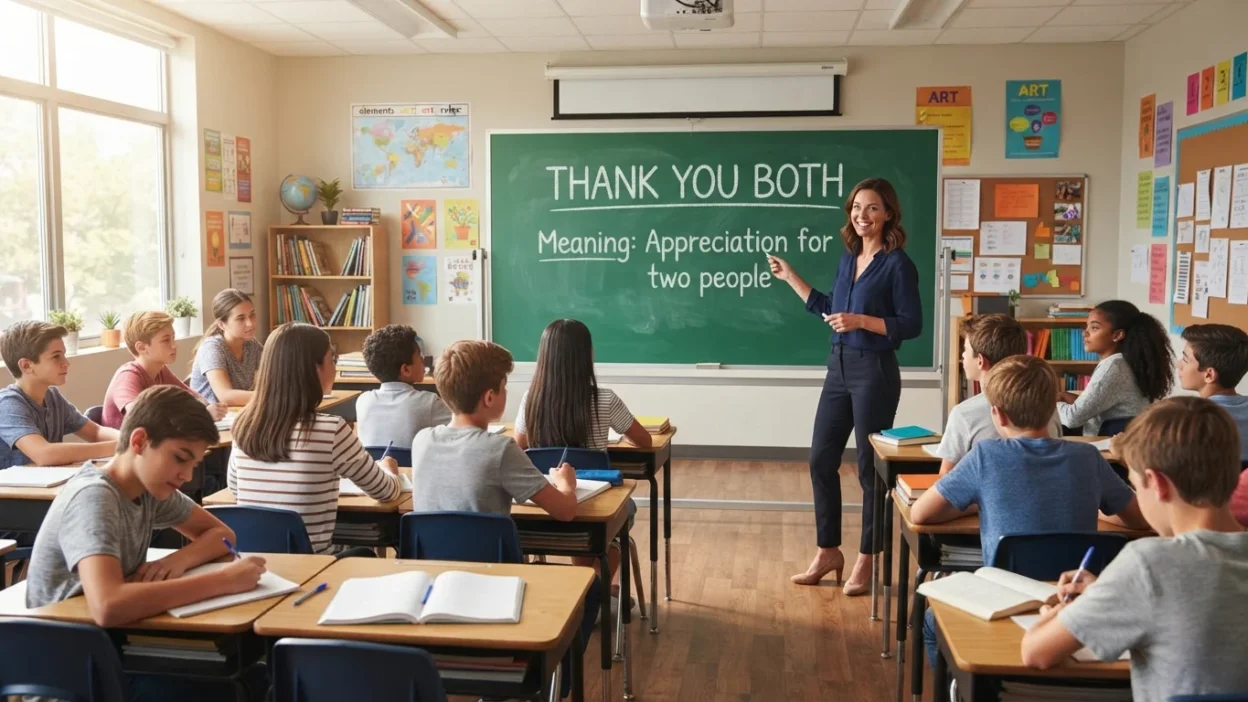
Both “thank you both” and “thanks to both of you” are correct English expressions, but they are used in different ways. “Thank you both” is a direct and natural way to express gratitude to two people. “Thanks to both of you” can also express gratitude, but “thanks to” can have another meaning: it can mean because of or as a result of someone or something.
For example, if two friends help you, you can say, “Thank you both for helping me.” You can also say, “Thanks to both of you for helping me.” However, in everyday conversation, “thank you both” is usually more direct and straightforward when you are personally thanking two people. Understanding the difference helps you choose the right expression in conversations, emails, messages and professional situations.
Quick Answer
“Thank you both” is the most direct way to thank two people. “Thanks to both of you” is also correct when expressing gratitude, but “thanks to” can also mean “because of.” For a simple personal thank you, “thank you both” is usually the clearest choice.
Why Do People Confuse “Thank You Both” and “Thanks to Both of You”?
The two expressions contain similar words and can both be used when addressing two people.
For example:
Thank you both for your help.
and:
Thanks to both of you for your help.
Both sentences can express appreciation.
The main difference is sentence structure and meaning.
Thank you both directly addresses two people.
Thanks to both of you can directly express gratitude, but the phrase “thanks to” also has a separate meaning: because of.
For example:
Thanks to both of you, we finished the project on time.
This can mean that the two people helped make the successful result possible.
Because of this additional meaning, context is important.
“Thank You Both”: Meaning and Usage
“Thank you both” is a direct expression of gratitude addressed to two people.
Here, both means the two people being addressed.
When Should You Say “Thank You Both”?
Use “thank you both” when you want to thank two people directly.
It works well in:
- Everyday conversations
- Text messages
- Emails
- Workplace communication
- School situations
- Speeches
- Social situations
- Personal conversations
Examples
Thank you both for coming today.
Thank you both for your support.
Thank you both for helping me with this project.
The structure is simple:
Thank you + both + optional reason
For example:
Thank you both for your help.
This is a very natural construction.
“Thanks to Both of You”: Meaning and Usage
“Thanks to both of you” is another way to express gratitude toward two people.
It can be followed by a reason:
Thanks to both of you for helping me.
It can also be used to describe a positive result caused or helped by two people:
Thanks to both of you, we completed the work early.
In the second sentence, the expression can be understood as:
Because of both of you, we completed the work early.
This is an important difference because “thanks to” has two common uses.
Use 1: Expressing Gratitude
Thanks to both of you for your kindness.
Here, the speaker is thanking two people.
Use 2: Showing Cause or Result
Thanks to both of you, the event was successful.
Here, “thanks to” explains why something happened successfully.
It means something close to:
Because of your help, the event was successful.
Thank You Both vs Thanks to Both of You
| Expression | Main function | Tone | Example |
|---|---|---|---|
| Thank you both | Directly thanks two people | Natural and direct | Thank you both for helping me. |
| Thanks to both of you | Thanks two people or indicates their contribution caused a result | Natural, slightly more contextual | Thanks to both of you, we finished early. |
| Thank you to both of you | Directly expresses appreciation to two people | Polite and slightly more formal | Thank you to both of you for your support. |
| Thanks, both of you | Informal direct thanks | Casual | Thanks, both of you! |
When Should You Use Each Expression?
Use “Thank You Both” for Direct Thanks
Choose “thank you both” when you are simply thanking two people.
Example:
Thank you both for your advice.
This is short, clear, and natural.
Use “Thanks to Both of You” for Appreciation or Contribution
Choose “thanks to both of you” when you want to emphasize the contribution of two people.
Example:
Thanks to both of you, we were able to finish the project.
The phrase connects the two people with the successful result.
Use “Thank You to Both of You” for Extra Emphasis
You can also say:
Thank you to both of you for your support.
This is grammatically correct and can sound especially appropriate in a speech, public message, or written acknowledgment.
Use “Thanks, Both of You” in Casual Situations
In an informal conversation, you might say:
Thanks, both of you!
This sounds friendly and conversational.
20 Examples of “Thank You Both” and “Thanks to Both of You”
Examples With “Thank You Both”
- Thank you both for helping me with my homework.
- Thank you both for coming to the meeting.
- Thank you both for your kind words.
- Thank you both for supporting our team.
- Thank you both for your valuable advice.
- Thank you both for making my birthday special.
- Thank you both for taking the time to meet with me.
- Thank you both for your patience.
- Thank you both for helping us solve the problem.
- Thank you both for being there when I needed help.
Examples With “Thanks to Both of You”
- Thanks to both of you for your support.
- Thanks to both of you, we completed the project on time.
- Thanks to both of you for making the event successful.
- Thanks to both of you, I understood the lesson much better.
- Thanks to both of you for helping us prepare.
- Thanks to both of you, everything went smoothly.
- Thanks to both of you for your hard work.
- Thanks to both of you, we found a solution quickly.
- Thanks to both of you for helping me prepare for the presentation.
- Thanks to both of you, the team reached its goal.
Common Mistakes
Mistake 1: Saying “Thank You Boths”
Do not make both plural.
Incorrect:
Thank you boths.
Correct:
Thank you both.
“Both” already refers to two people or things.
Mistake 2: Saying “Thank You Both of You”
This expression is sometimes heard in informal speech, but it is unnecessary and less natural.
Instead, use:
Thank you both.
or:
Thank you to both of you.
Mistake 3: Confusing “Thanks To” With Direct Thanks
Remember that “thanks to” can mean because of.
Compare:
Thanks to both of you for your help.
with:
Thanks to the rain, the crops grew well.
The second sentence does not express personal gratitude. It means the rain caused or contributed to the result.
Mistake 4: Assuming “Thanks to” Is Always a Thank You
Not necessarily.
For example:
Thanks to the new software, we finished the work faster.
Here, “thanks to” means because of or as a result of, not that the speaker is thanking the software.
Memory Trick
Use this simple rule:
“Thank you both” = directly thanking two people.
“Thanks to both of you” = thanking two people or highlighting their contribution to a result.
You can remember it like this:
Thank you both → direct thanks
Thanks to both of you → thanks or result
If you are simply unsure what to say when addressing two people, “Thank you both” is a clear and natural choice.
American vs British English
Both “thank you both” and “thanks to both of you” are used in American and British English.
There is no major American-versus-British spelling difference here.
Examples in both varieties include:
Thank you both for your help.
Thanks to both of you for your support.
The choice usually depends more on the context, tone, and intended meaning than on the variety of English being used.
Similar Expressions
Several other expressions can be used when thanking two people.
Thank You to Both of You
This is correct and direct.
Thank you to both of you for your help.
It can sound slightly more deliberate or formal than “thank you both.”
Thanks, Both of You
This is casual and friendly.
Thanks, both of you!
It works especially well in conversation or informal messages.
Thank You Both So Much
This adds stronger appreciation.
Thank you both so much for your support.
Many Thanks to Both of You
This sounds polite and is particularly suitable for written communication.
Many thanks to both of you for your assistance.
I Appreciate You Both
This is another way to express gratitude.
I really appreciate you both helping me.
For more formal writing, you might say:
I appreciate both of your contributions.
Final Verdict: Thank You Both or Thanks to Both of You?
Both expressions are correct, but they are not always interchangeable.
Use “thank you both” when you want to give direct thanks to two people. It is simple, natural, and suitable for both casual and professional situations.
Use “thanks to both of you” when you want to thank two people or emphasize that their help contributed to a particular result.
For example:
Thank you both for your help.
is a straightforward expression of gratitude.
Meanwhile:
Thanks to both of you, we finished the project on time.
emphasizes the connection between their help and the successful result.
Frequently Asked Questions
Is “thank you both” grammatically correct?
Yes. “Thank you both” is grammatically correct and is a natural way to thank two people directly.
Is “thanks to both of you” correct?
Yes. “Thanks to both of you” is correct. It can express gratitude, and “thanks to” can also mean “because of” or “as a result of.”
Which is more natural: “thank you both” or “thanks to both of you”?
For a simple, direct expression of gratitude, “thank you both” is very natural. “Thanks to both of you” is also natural when the context emphasizes the contribution of the two people or a resulting outcome.
Can I say “thank you to both of you”?
Yes. “Thank you to both of you” is grammatically correct and is often used when the speaker wants to explicitly identify the two people being thanked.
Is “thank you both” formal or informal?
“Thank you both” works in both formal and informal situations. The surrounding words and context can make the message more casual or more formal.
Can I use “thank you both” in an email?
Yes. It is perfectly appropriate in an email.
For example:
Thank you both for taking the time to review my proposal.
What does “thanks to both of you” mean?
It can mean “thank you both,” but it can also mean “because of both of you” or “as a result of both of your efforts,” depending on context.
Remember This
When you are directly thanking two people, use:
Thank you both.
When you want to emphasize their contribution to an outcome, you can use:
Thanks to both of you.
Also remember:
- Thank you both = direct gratitude
- Thanks to both of you = gratitude or contribution/result
- Thank you to both of you = direct, slightly more deliberate
- Thanks, both of you! = casual and friendly
Conclusion
Both “thank you both” and “thanks to both of you” are correct expressions, but they can communicate slightly different ideas. “Thank you both” is a simple and direct way to express gratitude to two people, while “thanks to both of you” can also emphasize that their help contributed to a particular result.
For everyday conversations, emails, and messages, “thank you both” is an easy and natural choice when you simply want to thank two people. When the context focuses on the result of their help, “thanks to both of you” can be especially useful.