
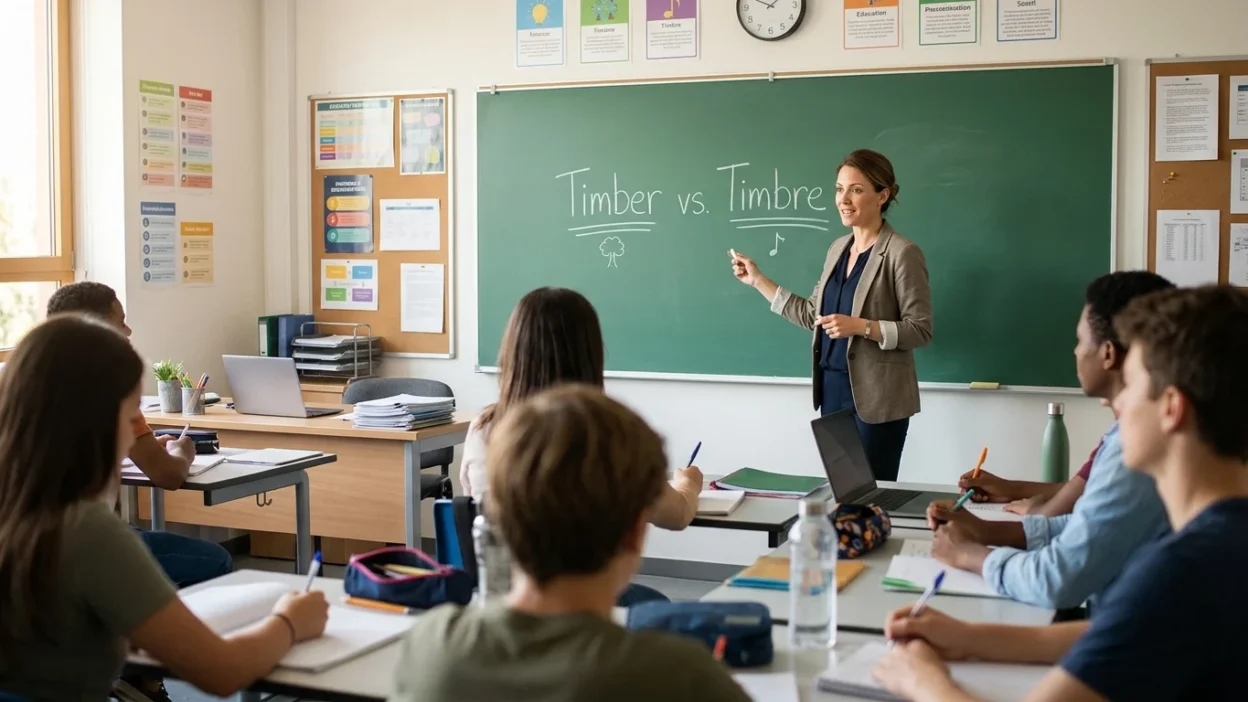
Have you ever confused timber with timbre?
These two words look and sound similar but they have completely different meanings. One is related to wood and building materials, while the other describes the quality of a sound or musical tone. Knowing the difference will help you use both words correctly in writing and conversation.
Timber refers to wood used for construction, carpentry and other practical purposes. For example “The workers used timber to build the house.” Timbre, on the other hand, refers to the distinctive quality of a sound that helps you recognize a voice or musical instrument, even when it produces the same note as another sound. For example “The singer has a warm timbre.” Although these words share similar spelling and pronunciation, their meanings belong to different subjects. Understanding when to use timber and when to use timbre is especially helpful for students, writers, builders, musicians and anyone learning English vocabulary.
Quick Answer: Timber vs Timbre
Timber means wood used for building or other purposes. Timbre means the distinctive quality or character of a sound, such as a voice or musical instrument. Use timber when discussing wood and construction and use timbre when describing how a sound feels or differs from another sound.
Why Do People Confuse Timber and Timbre?
People often confuse timber and timbre because the words differ by only one letter and are pronounced similarly in many English accents. However, their meanings and uses are unrelated.
Another reason for confusion is that both words appear in specialized contexts. Timber is common in construction, forestry, and woodworking, while timbre is frequently used in music, acoustics and discussions of the human voice.
Here is the easiest way to distinguish them:
- Timber = wood: Think of trees, lumber, beams, and building materials.
- Timbre = sound quality: Think of voices, musical instruments and the unique character of a sound.
Remembering these associations will help you choose the correct spelling whenever you write about construction or music.
1. What Does Timber Mean?
Timber is wood that is prepared or suitable for building, construction, carpentry, or other practical uses. Depending on the context and regional variety of English, it can refer to standing trees suitable for harvesting, harvested wood, or processed structural wood.
Timber is an important material in construction because it can be used to make roofs, floors, walls, furniture, and structural supports.
Examples of Timber in Sentences
- The builders used timber to construct the roof.
- The company imports timber from different countries.
- The old house has beautiful timber beams.
- The carpenter selected strong timber for the project.
- The forest contains trees suitable for timber production.
In each sentence, timber refers to wood or trees intended for practical use.
Common Uses of Timber
Timber is used in many industries and everyday activities, including:
- Construction: Building frames, roof supports, floors, and walls.
- Furniture making: Creating tables, chairs, cupboards, and beds.
- Carpentry: Making doors, window frames, shelves, and wooden fittings.
- Forestry: Managing and harvesting trees for wood products.
- Outdoor structures: Building fences, decks, and sheds.
The exact meaning of timber can vary slightly by region. For example, British English often uses timber where American English commonly uses lumber for processed wood sold for construction.
2. What Does Timbre Mean?
Timbre is the distinctive quality of a sound that allows you to distinguish one voice or musical instrument from another, even when they produce the same musical note at the same loudness.
It is sometimes described as tone color or tone quality. Timbre depends on characteristics such as a sound’s frequency components, how it begins and fades, and how those components change over time.
For example, a piano and a violin can play the same note, yet their sounds remain noticeably different. That difference is largely related to their timbre.
Examples of Timbre in Sentences
- The singer has a rich, warm timbre.
- The violin’s bright timbre stood out in the orchestra.
- The two singers have different vocal timbres.
- The flute produces a light, airy timbre.
- The recording captured the natural timbre of the guitar.
In these examples, timbre describes the character or quality of a sound rather than its loudness or pitch alone.
Common Descriptions of Timbre
People use many adjectives to describe timbre, including:
- Warm: Full, rounded, and pleasant in character.
- Bright: Clear, sharp, or rich in higher-frequency qualities.
- Dark: Deep or less prominent in higher-frequency qualities.
- Rich: Full and complex in sound.
- Breathy: Having an audible quality of airflow, often in a voice.
- Metallic: Having a ringing or metal-like character.
- Smooth: Even and soft in character.
- Raspy: Rough or slightly harsh in quality.
These descriptions are useful in music, singing, audio production, and speech analysis.
3. Timber vs Timbre: Comparison Table
| Feature | Timber | Timbre |
|---|---|---|
| Meaning | Wood used for construction or other purposes | The distinctive quality of a sound |
| Main subject | Wood, trees, and building materials | Music, voices, and acoustics |
| Common context | Construction, forestry, carpentry | Singing, instruments, sound recording |
| Related words | Lumber, wood, logs | Tone quality, tone color |
| Example | The timber supports the roof. | Her voice has a gentle timbre. |
| Memory clue | Timber is material | Timbre is sound character |
The key difference is that timber is associated with wood, while timbre describes how a sound is perceived.
4. When Should You Use Timber or Timbre?
Choosing the correct word becomes easy when you identify the subject of your sentence.
Use Timber When Talking About Wood
Choose timber when your sentence concerns trees, wooden materials, construction, or carpentry.
Examples:
- The builders ordered more timber.
- The house has a timber frame.
- The carpenter cut the timber to the required length.
- The company specializes in sustainable timber.
Quick test: If you could replace the word with wood or lumber without significantly changing the intended meaning, timber may be correct.
Use Timbre When Talking About Sound
Choose timbre when describing the distinctive quality of a voice, instrument, or other sound.
Examples:
- The singer’s timbre is instantly recognizable.
- The cello has a deep, expressive timbre.
- The microphone captures the timbre of the speaker’s voice.
- Each instrument contributes a different timbre to the music.
Quick test: If your sentence is about how a sound is characterized or distinguished from another sound, timbre is probably the correct word.
5. Timber vs Timbre: 12 Example Sentences
These examples show how the two words work in everyday and professional contexts.
Examples Using Timber
- The workers carried timber to the construction site. — Wood is being used for building.
- The cabin was made from local timber. — The sentence describes the building material.
- The carpenter inspected the timber for damage. — The wood is being checked for quality.
- The roof is supported by heavy timber beams. — Timber refers to structural wood.
- The company sells timber to furniture manufacturers. — The wood is a commercial product.
- The forest is managed to support sustainable timber production. — The sentence concerns harvesting and forestry.
Examples Using Timbre
- The singer’s timbre makes her voice easy to recognize. — The sound has a distinctive character.
- The flute has a clear, delicate timbre. — The sentence describes the instrument’s sound quality.
- The piano and violin have different timbres. — Their sounds differ in character.
- The audio engineer wanted to preserve the singer’s natural timbre. — The sound’s original quality should remain intact.
- His deep vocal timbre suited the narration. — The sentence describes the character of his voice.
- The composer combined contrasting timbres to create a richer musical texture. — Different sound qualities contribute to the composition.
6. Common Mistakes When Using Timber and Timbre
Although the words look similar, they cannot usually replace one another. Here are common mistakes to avoid.
Mistake 1: Using Timber to Describe a Voice
Incorrect: The singer has a beautiful timber.
Correct: The singer has a beautiful timbre.
Why? The sentence describes the quality of the singer’s voice, not wood.
Mistake 2: Using Timbre to Describe Building Materials
Incorrect: The builders ordered timbre for the roof.
Correct: The builders ordered timber for the roof.
Why? The builders need wood for construction, so timber is the correct word.
Mistake 3: Assuming Timbre Means Loudness
Incorrect understanding: The loudness of a sound is its timbre.
Correct understanding: Timbre is the distinctive quality of a sound, not simply how loud it is.
Loudness concerns how strong or intense a sound seems. Timbre helps distinguish the character of one sound from another.
Mistake 4: Assuming Timber and Timbre Are Different Spellings of the Same Word
These words are separate vocabulary items with different meanings. Their similar spelling does not make them interchangeable.
- Timber relates to wood.
- Timbre relates to sound quality.
7. Memory Trick: How to Remember Timber vs Timbre
Use these simple memory tricks to keep the words straight.
Trick 1: Timber Has an “E” for Environment
Think of forests, trees, and wood. Timber comes from trees and is used for construction and other purposes.
Example: The builder ordered timber for the new house.
Trick 2: Timbre Has an “R” for Resonance
Think of music, voices, and sound. Timbre describes the distinctive character of a sound.
Example: The singer’s timbre is soft and warm.
Trick 3: Picture Two Different Situations
- A carpenter carrying wooden beams reminds you of timber.
- A musician playing a violin reminds you of timbre.
Connecting each word to a familiar image makes the difference easier to remember.
8. Timber vs Timbre in American and British English
The basic meanings of timber and timbre are the same in American and British English, but their everyday usage differs slightly.
| Context | British English | American English |
|---|---|---|
| Wood prepared for construction | Timber is common | Lumber is often preferred |
| Standing trees suitable for harvesting | Timber can be used | Timber is also used |
| Distinctive quality of a sound | Timbre | Timbre |
| Sound quality in music | Timbre or tone quality | Timbre or tone quality |
Is Timber the Same as Lumber?
Not always in every technical context, but the terms overlap. In American English, lumber commonly refers to wood that has been processed into boards or other construction sizes. Timber can refer to trees suitable for harvesting or to large structural pieces of wood.
British English commonly uses timber for many kinds of construction wood.
Is Timbre Spelled Differently in American and British English?
No. Timbre is spelled the same way in both varieties of English. Its meaning also remains the same: the distinctive quality of a sound.
9. Similar Words and Related Terms
Understanding related vocabulary can help you use timber and timbre more accurately.
Words Related to Timber
- Wood: The general material that forms the trunks and branches of trees.
- Lumber: Wood processed into boards and other pieces, especially in American English.
- Logs: Sections of tree trunks or large branches.
- Plywood: An engineered wood product made from layers of wood veneer.
- Carpentry: The craft of cutting, shaping, and joining wood.
Example: The carpenter used plywood for the cabinet and solid timber for its frame.
Words Related to Timbre
- Tone: A sound or its perceived quality, depending on context.
- Pitch: How high or low a sound seems.
- Loudness: How strong or intense a sound seems.
- Resonance: The strengthening or prolonging of sound under certain conditions.
- Texture: The way different sounds combine or interact in music.
Example: The singer changed the pitch and loudness of the note while maintaining a recognizable vocal timbre.
Remember that these related terms are not exact synonyms. Each describes a different aspect of wood, sound, or music.
10. Final Verdict: Timber or Timbre?
Use timber when talking about wood, trees, or construction materials. Use timbre when describing the distinctive quality of a voice or musical sound.
For example, “The builders used timber for the roof” is correct because the sentence concerns wood. “The singer has a rich timbre” is correct because the sentence describes sound quality.
If you are unsure which word to use, identify the subject first. If it involves building materials, choose timber. If it involves music, voices, or acoustics, choose timbre. This simple distinction will help you spell and use both words correctly.
11. Frequently Asked Questions
1. What is the main difference between timber and timbre?
Timber means wood used for construction or other purposes, while timbre means the distinctive quality of a sound. They are different words with different meanings.
2. Is it timber or timbre when describing a singer’s voice?
Use timbre. For example, “The singer has a warm timbre” describes the distinctive character of the singer’s voice.
3. Is timber the same as lumber?
The meanings overlap, but regional usage differs. American English commonly uses lumber for processed construction wood, while British English frequently uses timber. The precise distinction can depend on the type of wood and the context.
4. What is an example of timbre in music?
A piano and a flute can play the same note but sound different. Their distinctive sound qualities are examples of different timbres.
5. Are timber and timbre pronounced the same?
They are pronounced similarly in many English accents, and some speakers pronounce them identically. Pronunciation can vary by region, but their meanings remain different.
6. Can I use timber and timbre interchangeably?
No. Timber refers to wood or construction material, while timbre refers to sound quality. Substituting one for the other will usually change the meaning or make the sentence incorrect.
7. Does timbre mean pitch or volume?
No. Timbre describes the distinctive character of a sound. Pitch relates to how high or low a sound seems, while volume in everyday language relates to loudness.
12. Remember This
- Timber = wood: Used in construction, carpentry, and forestry.
- Timbre = sound quality: Used to describe voices and musical instruments.
- Use timber when discussing wooden beams, boards, or building materials.
- Use timbre when discussing a singer’s voice or an instrument’s sound.
- American English often prefers lumber for processed construction wood.
- Timbre has the same spelling in American and British English.
Conclusion
The difference between timber and timbre is easy to understand once you connect each word to its subject. Timber refers to wood used for building and other practical purposes, while timbre describes the unique quality of a sound. Although the words look and sound similar, they belong to different contexts and cannot be used interchangeably.
To remember the distinction, picture a carpenter working with timber and a musician creating different timbres with an instrument. These simple associations will help you choose the correct word in essays, professional writing, music discussions and everyday conversation.