
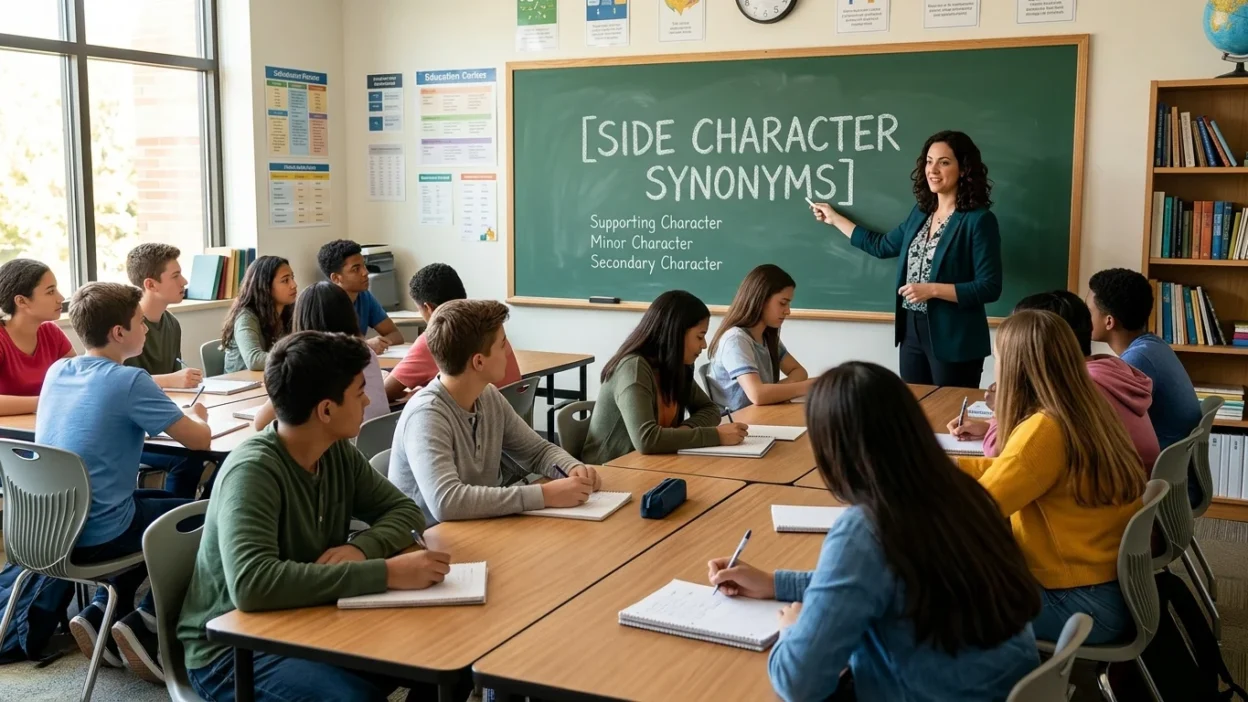
Looking for the best side character synonyms?
Whether you’re a student, ESL learner, writer, storyteller, or content creator, learning different ways to say side character can improve your vocabulary and help you write more engaging stories.
A side character is a character who supports the main character (the protagonist) but is not the central focus of the story. Side characters help develop the plot, add depth to the story, provide conflict or humor and enrich the fictional world.
In this complete guide, you’ll learn the meaning of side character, discover 30 useful synonyms, understand when to use each one and see beginner friendly examples.
What Does Side Character Mean?
Meaning of Side Character
A side character is a supporting or secondary character who plays an important role in a story without being the main protagonist.
Example of Side Character
- The side character became a fan favorite.
- Every great novel includes memorable side characters.
- The movie’s side characters added humor and emotion.
30 Best Side Character Synonyms
1. Supporting Character
Meaning: A character who supports the main story.
Example: The supporting character stole every scene.
Best Usage: Literature and film.
2. Secondary Character
Meaning: A character with an important but non-leading role.
Example: The secondary character helped solve the mystery.
Best Usage: General storytelling.
3. Minor Character
Meaning: A character with limited screen or page time.
Example: Even the minor characters felt realistic.
Best Usage: Literary analysis.
4. Background Character
Meaning: A character who appears mostly in the background.
Example: The background characters made the town feel alive.
Best Usage: Film and animation.
5. Supporting Role
Meaning: A non-leading role in a story.
Example: She won an award for her supporting role.
Best Usage: Movies and theater.
6. Ensemble Character
Meaning: A member of a larger cast.
Example: Every ensemble character had a unique personality.
Best Usage: Television and theater.
7. Companion
Meaning: A character who accompanies the protagonist.
Example: The hero’s companion provided valuable advice.
Best Usage: Fantasy and adventure.
8. Ally
Meaning: A character who supports the main character.
Example: The detective relied on his trusted ally.
Best Usage: Action and fantasy.
9. Sidekick
Meaning: A loyal helper to the main character.
Example: The superhero’s sidekick saved the day.
Best Usage: Adventure and comics.
10. Confidant
Meaning: Someone the main character trusts with secrets.
Example: She shared everything with her confidant.
Best Usage: Drama and romance.
11. Friend
Meaning: A close companion of the protagonist.
Example: His best friend encouraged him.
Best Usage: Everyday storytelling.
12. Foil
Meaning: A character whose traits contrast with another character.
Example: The foil highlighted the hero’s kindness.
Best Usage: Literary analysis.
13. Mentor
Meaning: A character who teaches or guides.
Example: The mentor prepared the hero for battle.
Best Usage: Adventure and fantasy.
14. Guide
Meaning: Someone who leads or advises another character.
Example: The guide helped them through the forest.
Best Usage: Adventure stories.
15. Advisor
Meaning: A character who gives advice.
Example: The king trusted his advisor.
Best Usage: Historical fiction.
16. Associate
Meaning: Someone connected with the main character.
Example: The detective questioned his associate.
Best Usage: Mystery stories.
17. Colleague
Meaning: A coworker in the story.
Example: Her colleague helped solve the case.
Best Usage: Workplace fiction.
18. Partner
Meaning: Someone who works alongside the protagonist.
Example: The police partners solved the mystery together.
Best Usage: Crime and action.
19. Team Member
Meaning: A member of the protagonist’s group.
Example: Every team member contributed.
Best Usage: Action and sports.
20. Cast Member
Meaning: One of the characters in a story.
Example: Every cast member had an important role.
Best Usage: Theater and television.
21. Recurring Character
Meaning: A character who appears repeatedly.
Example: The recurring character became popular.
Best Usage: TV series.
22. Guest Character
Meaning: A character appearing briefly.
Example: The guest character appeared in one episode.
Best Usage: Television.
23. Featured Character
Meaning: A character given noticeable attention.
Example: The featured character had an emotional storyline.
Best Usage: Entertainment writing.
24. Deuteragonist
Meaning: The second most important character after the protagonist.
Example: The deuteragonist played a vital role in the story.
Best Usage: Literary analysis.
25. Tritagonist
Meaning: The third most important character in a story.
Example: The tritagonist influenced the ending.
Best Usage: Literary studies.
26. Comic Relief
Meaning: A character who provides humor.
Example: The comic relief kept the audience laughing.
Best Usage: Movies and novels.
27. Love Interest
Meaning: A character involved romantically with another.
Example: The love interest supported the hero.
Best Usage: Romance stories.
28. Neighboring Character
Meaning: A nearby or surrounding supporting character.
Example: The neighboring character appeared in several scenes.
Best Usage: Creative writing.
29. Peripheral Character
Meaning: A character on the edge of the main plot.
Example: The peripheral character still impacted the story.
Best Usage: Literary criticism.
30. Non Lead Character
Meaning: Any character who is not the protagonist.
Example: The non lead characters enriched the plot.
Best Usage: General storytelling.
When to Use Different Side Character Synonyms
Quick Comparison Guide
| Synonym | Best Used For | Tone |
|---|---|---|
| Supporting Character | General storytelling | Neutral |
| Sidekick | Adventure and comics | Informal |
| Secondary Character | Literary analysis | Formal |
| Minor Character | Books and films | Neutral |
| Deuteragonist | Literary studies | Academic |
| Foil | Character analysis | Academic |
| Mentor | Fantasy and adventure | Neutral |
| Comic Relief | Comedy | Neutral |
| Recurring Character | TV series | Neutral |
| Peripheral Character | Literary criticism | Formal |
How to Choose the Right Synonym
For General Storytelling
Use:
- Supporting Character
- Secondary Character
- Minor Character
- Companion
- Partner
For Literary Analysis
Choose:
- Deuteragonist
- Tritagonist
- Foil
- Peripheral Character
- Secondary Character
For Adventure Stories
Use:
- Sidekick
- Ally
- Mentor
- Guide
- Team Member
For Television and Film
Choose:
- Supporting Role
- Recurring Character
- Guest Character
- Cast Member
- Featured Character
For Comedy
Use:
- Comic Relief
- Sidekick
- Friend
- Companion
- Supporting Character
Common Mistakes When Using Side Character Synonyms
Understand the Meaning of “Side Character”
A side character supports the main story but is not always a minor character. Some supporting characters play major roles throughout a story.
Match the Synonym to the Context
Use sidekick for loyal companions, mentor for teachers, foil for contrasting personalities, and deuteragonist when referring to the second most important character.
Avoid Confusing Character Roles
A protagonist is the main character, while a supporting character helps develop the plot. Not every supporting character is a deuteragonist.
Why Learning Side Character Synonyms Improves Your Vocabulary
Understanding side character synonyms helps you:
- Write stronger stories
- Analyze books and films more effectively
- Expand your storytelling vocabulary
- Improve creative writing
- Communicate more precisely
- Better understand literary terms
Using the right synonym makes your writing clearer and more engaging.
Conclusion
Learning side character synonyms gives you more ways to describe characters who support the main story. While side character is the most common expression, alternatives such as supporting character, secondary character, sidekick, mentor, foil and deuteragonist are useful in different storytelling and literary contexts.
By understanding each synonym’s meaning, example and ideal usage, you’ll improve your vocabulary, strengthen your writing and analyze stories with greater confidence.