
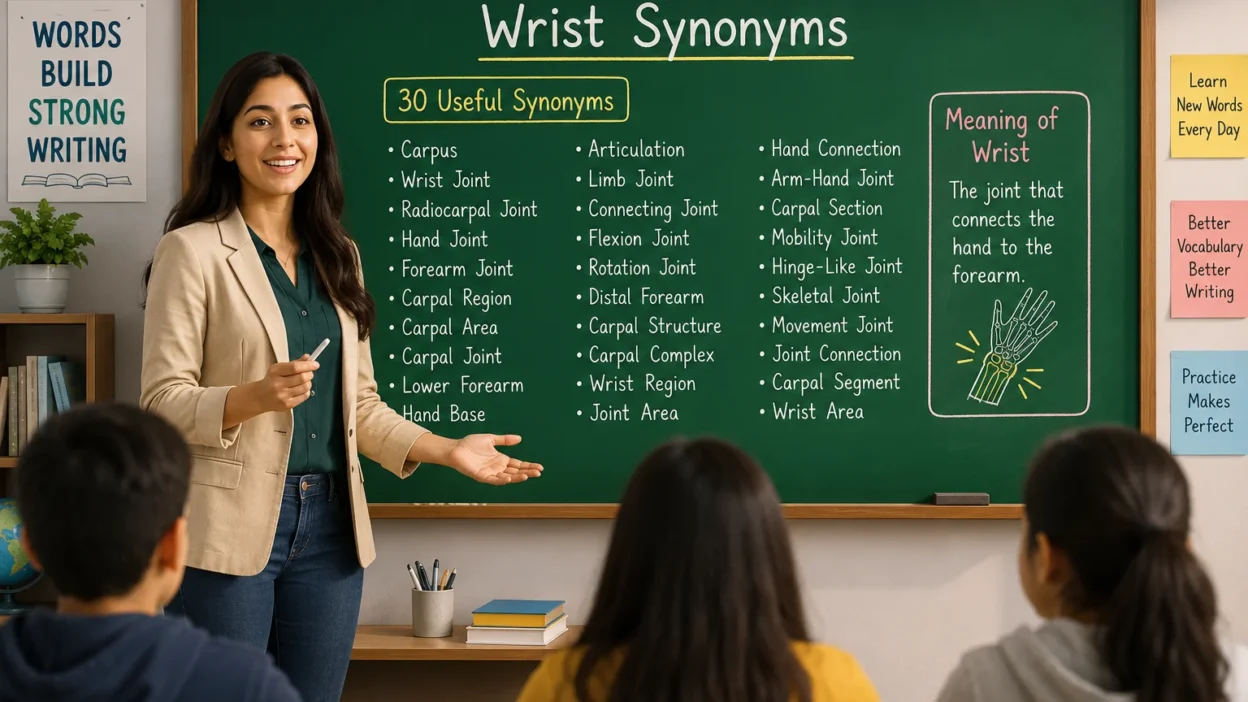
The word wrist is commonly used to describe the joint that connects the hand to the forearm. It is an important part of the human body that allows movement, flexibility and control of the hand. Whether you are writing about anatomy, sports injuries, fashion accessories or everyday actions, understanding wrist synonyms can help improve your vocabulary and make your writing more precise.
Learning different words related to the wrist is especially useful for students, ESL learners, writers, and content creators. While there are not many exact one word replacements for “wrist,” there are several anatomical, descriptive and context based alternatives that can be used depending on the situation.
In this guide, you’ll discover 30 useful wrist synonyms and related terms, along with their meanings, example sentences and best usage contexts.
What Does “Wrist” Mean?
Meaning of Wrist
A wrist is the flexible joint between the hand and the forearm. It contains several small bones, ligaments, tendons, and muscles that allow the hand to move in different directions.
Usage Context
The word “wrist” is commonly used in:
- Anatomy and medical discussions
- Sports and fitness content
- Fashion and jewelry descriptions
- Daily conversations
- Injury and health-related writing
Example:
She wore a beautiful bracelet around her wrist.
30 Wrist Synonyms and Related Words
1. Carpus
Meaning: The group of bones that form the wrist.
Example: The doctor examined the carpus after the accident.
Best Usage Context: Medical and anatomical writing.
2. Wrist Joint
Meaning: The joint connecting the hand and forearm.
Example: He injured his wrist joint while lifting weights.
Best Usage Context: Health and fitness content.
3. Radiocarpal Joint
Meaning: The primary joint of the wrist.
Example: The radiocarpal joint allows hand movement.
Best Usage Context: Scientific and medical texts.
4. Hand Joint
Meaning: A joint near the hand area.
Example: The hand joint became swollen after the fall.
Best Usage Context: Informal anatomy discussions.
5. Forearm Joint
Meaning: The connection point between the forearm and hand.
Example: The forearm joint was wrapped in a bandage.
Best Usage Context: General health writing.
6. Carpal Region
Meaning: The wrist area containing carpal bones.
Example: Pain developed in the carpal region.
Best Usage Context: Medical reports.
7. Carpal Area
Meaning: The area around the wrist.
Example: The therapist massaged the carpal area.
Best Usage Context: Healthcare discussions.
8. Carpal Joint
Meaning: Another name for the wrist joint.
Example: The carpal joint remained stiff.
Best Usage Context: Anatomy content.
9. Lower Forearm
Meaning: The section of the arm closest to the wrist.
Example: The tattoo extended across the lower forearm.
Best Usage Context: Descriptive writing.
10. Hand Base
Meaning: The area where the hand begins.
Example: The pain started at the hand base.
Best Usage Context: Informal descriptions.
11. Articulation
Meaning: A place where bones meet.
Example: The articulation showed signs of strain.
Best Usage Context: Medical terminology.
12. Limb Joint
Meaning: A joint within a limb.
Example: The limb joint required treatment.
Best Usage Context: General anatomy.
13. Connecting Joint
Meaning: A joint linking two body parts.
Example: The connecting joint helps with flexibility.
Best Usage Context: Educational content.
14. Flexion Joint
Meaning: A joint that enables bending movements.
Example: The flexion joint was exercised regularly.
Best Usage Context: Physical therapy discussions.
15. Rotation Joint
Meaning: A joint allowing rotational movement.
Example: The rotation joint helps with hand positioning.
Best Usage Context: Functional anatomy.
16. Distal Forearm
Meaning: The far end of the forearm near the wrist.
Example: The fracture occurred in the distal forearm.
Best Usage Context: Medical reports.
17. Carpal Structure
Meaning: The wrist’s bone framework.
Example: The carpal structure appeared normal.
Best Usage Context: Anatomy studies.
18. Carpal Complex
Meaning: The complete wrist bone system.
Example: The carpal complex absorbed the impact.
Best Usage Context: Orthopedic discussions.
19. Wrist Region
Meaning: The area surrounding the wrist.
Example: Swelling developed in the wrist region.
Best Usage Context: General medical writing.
20. Joint Area
Meaning: An area containing a joint.
Example: The joint area was tender to touch.
Best Usage Context: Health-related content.
21. Hand Connection
Meaning: The point where the hand joins the arm.
Example: The hand connection remained flexible.
Best Usage Context: Simple educational explanations.
22. Arm-Hand Joint
Meaning: The joint connecting arm and hand.
Example: The arm-hand joint supports movement.
Best Usage Context: Beginner anatomy learning.
23. Carpal Section
Meaning: The wrist portion of the arm.
Example: The carpal section experienced discomfort.
Best Usage Context: Anatomical descriptions.
24. Mobility Joint
Meaning: A joint responsible for movement.
Example: The mobility joint functioned properly.
Best Usage Context: Physical therapy content.
25. Hinge Like Joint
Meaning: A joint that bends similarly to a hinge.
Example: The hinge like joint aids flexibility.
Best Usage Context: Educational anatomy articles.
26. Skeletal Joint
Meaning: A joint within the skeletal system.
Example: The skeletal joint remained healthy.
Best Usage Context: Biology content.
27. Movement Joint
Meaning: A joint involved in body movement.
Example: The movement joint was carefully examined.
Best Usage Context: Health education.
28. Joint Connection
Meaning: A place where bones connect.
Example: The joint connection showed no damage.
Best Usage Context: Basic anatomy explanations.
29. Carpal Segment
Meaning: A section relating to the wrist bones.
Example: The carpal segment was protected with a brace.
Best Usage Context: Medical writing.
30. Wrist Area
Meaning: The general area around the wrist.
Example: The wrist area became sore after exercise.
Best Usage Context: Everyday conversations.
Wrist Synonyms Comparison Table
| Term | Formality | Best For |
|---|---|---|
| Carpus | High | Medical writing |
| Wrist Joint | Medium | Health articles |
| Radiocarpal Joint | Very High | Scientific content |
| Carpal Region | High | Anatomy discussions |
| Wrist Area | Low | Everyday use |
| Lower Forearm | Medium | Descriptive writing |
| Hand Base | Low | Informal explanations |
| Distal Forearm | High | Clinical reports |
| Carpal Structure | High | Educational content |
| Hand Connection | Low | Beginner learning |
How to Choose the Right Synonym
For Medical Writing
Use:
- Carpus
- Radiocarpal Joint
- Carpal Region
- Distal Forearm
- Carpal Complex
These terms sound professional and are commonly found in anatomy and healthcare materials.
For Educational Content
Use:
- Wrist Joint
- Forearm Joint
- Hand Connection
- Arm-Hand Joint
- Carpal Area
These are easier for students and ESL learners to understand.
For Everyday Writing
Use:
- Wrist Area
- Hand Base
- Lower Forearm
- Joint Area
These terms are simple and natural in casual communication.
For Scientific Research
Use:
- Radiocarpal Joint
- Carpal Structure
- Carpal Segment
- Articulation
- Skeletal Joint
These provide greater technical accuracy.
Common Tips When Using Wrist Synonyms
Consider Your Audience
Medical professionals may prefer technical terms, while general readers usually understand simpler alternatives better.
Match the Context
Choose anatomy-based terms for healthcare content and everyday alternatives for blogs or conversations.
Avoid Overcomplicating
If your audience is unfamiliar with anatomy, using “wrist” itself may be the clearest option.
Prioritize Clarity
The best synonym is always the one that makes your meaning easy to understand.
Conclusion
Understanding wrist synonyms can help you write more accurately and professionally. While “wrist” is often the clearest term, alternatives such as carpus, wrist joint, radiocarpal joint, carpal region and wrist area can add variety and precision depending on your audience and purpose.
Students, ESL learners, writers and content creators can benefit from knowing these related terms because they improve vocabulary, enhance clarity, and make writing more engaging. When choosing a synonym, always consider the context, formality level and the knowledge of your readers.