The word bad is one of the most common adjectives in the English language. People use it every day to describe something negative, unpleasant, poor in quality, or undesirable. While “bad” is simple and easy to understand, using it repeatedly can make your writing sound repetitive and less engaging.
Learning synonyms for bad can help students, ESL learners, writers, and content creators express themselves more clearly and accurately. Different synonyms can communicate different levels of negativity, from mild disappointment to serious problems.
In this guide, you’ll learn the meaning of “bad,” discover 30 useful synonyms, see example sentences, and understand when to use each one.
What Does Bad Mean?
Bad means not good, unpleasant, harmful, poor in quality, or undesirable.
Example:
The weather was bad yesterday.
The word “bad” can describe many things, including behavior, situations, experiences, quality, health, and performance.
Why Learn Synonyms for Bad?
Learning alternatives to “bad” can help you:
- Avoid repeating the same word
- Improve your writing style
- Express different levels of negativity
- Build a stronger vocabulary
- Make descriptions more precise
- Create more engaging content
Different situations require different words, and choosing the right synonym helps communicate your message more effectively.
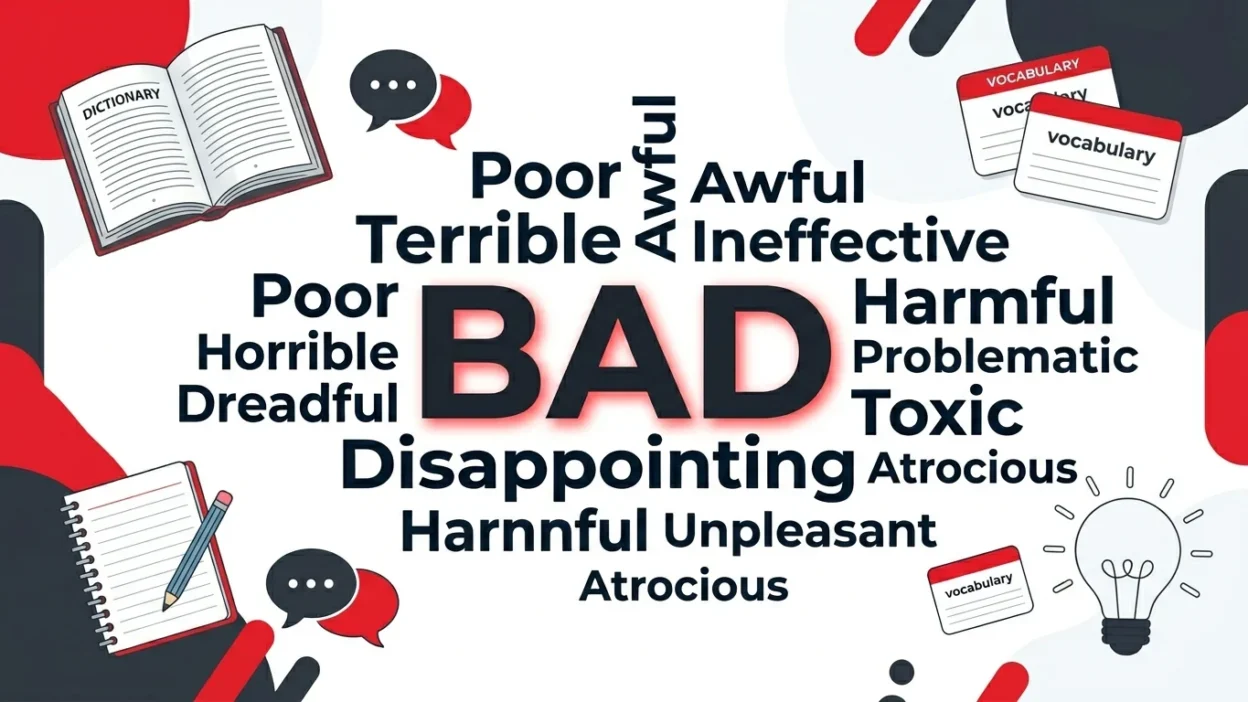
30 Synonyms for Bad
1. Poor
Meaning: Low in quality or standard.
Example: The restaurant received poor reviews.
Best Usage Context: Quality and performance.
2. Terrible
Meaning: Extremely bad.
Example: The team had a terrible season.
Best Usage Context: Strong negative situations.
3. Awful
Meaning: Very unpleasant or bad.
Example: The movie was awful.
Best Usage Context: Informal conversations.
4. Horrible
Meaning: Extremely unpleasant.
Example: They experienced horrible weather during the trip.
Best Usage Context: Negative experiences.
5. Dreadful
Meaning: Very bad or unpleasant.
Example: The hotel service was dreadful.
Best Usage Context: Formal and informal writing.
6. Unpleasant
Meaning: Not enjoyable.
Example: It was an unpleasant conversation.
Best Usage Context: Everyday situations.
7. Inferior
Meaning: Lower in quality.
Example: The cheaper product was inferior.
Best Usage Context: Comparisons.
8. Unsatisfactory
Meaning: Not meeting expectations.
Example: The results were unsatisfactory.
Best Usage Context: Academic and professional settings.
9. Defective
Meaning: Having a fault or problem.
Example: The company replaced the defective item.
Best Usage Context: Products and equipment.
10. Faulty
Meaning: Not working correctly.
Example: The faulty wiring caused issues.
Best Usage Context: Technical problems.
11. Weak
Meaning: Lacking strength or effectiveness.
Example: The argument was weak.
Best Usage Context: Performance and ideas.
12. Inadequate
Meaning: Not enough or insufficient.
Example: The resources were inadequate.
Best Usage Context: Formal writing.
13. Substandard
Meaning: Below the required quality.
Example: The building materials were substandard.
Best Usage Context: Professional settings.
14. Harmful
Meaning: Causing damage or injury.
Example: Smoking is harmful to health.
Best Usage Context: Health and safety.
15. Damaging
Meaning: Causing negative effects.
Example: The rumor was damaging to his reputation.
Best Usage Context: Long-term consequences.
16. Negative
Meaning: Unfavorable or pessimistic.
Example: She had a negative attitude.
Best Usage Context: Opinions and outlooks.
17. Unfavorable
Meaning: Not beneficial.
Example: The company faced unfavorable conditions.
Best Usage Context: Business and reports.
18. Disappointing
Meaning: Failing to meet expectations.
Example: The test results were disappointing.
Best Usage Context: Expectations.
19. Miserable
Meaning: Extremely unhappy or uncomfortable.
Example: He felt miserable after the loss.
Best Usage Context: Feelings and emotions.
20. Pathetic
Meaning: Very poor or inadequate.
Example: The effort was pathetic.
Best Usage Context: Strong criticism.
21. Appalling
Meaning: Shockingly bad.
Example: The conditions were appalling.
Best Usage Context: Serious criticism.
22. Atrocious
Meaning: Extremely bad.
Example: The customer service was atrocious.
Best Usage Context: Strong negative reviews.
23. Abysmal
Meaning: Extremely poor.
Example: Sales figures were abysmal.
Best Usage Context: Performance evaluations.
24. Unacceptable
Meaning: Not good enough to be accepted.
Example: His behavior was unacceptable.
Best Usage Context: Rules and standards.
25. Rotten
Meaning: Very bad or unpleasant.
Example: They had rotten luck.
Best Usage Context: Informal speech.
26. Nasty
Meaning: Unpleasant or offensive.
Example: She received a nasty comment online.
Best Usage Context: Behavior and attitudes.
27. Toxic
Meaning: Harmful or damaging.
Example: The workplace became toxic.
Best Usage Context: Relationships and environments.
28. Destructive
Meaning: Causing serious damage.
Example: The storm was highly destructive.
Best Usage Context: Events and behavior.
29. Problematic
Meaning: Causing difficulties.
Example: The proposal was problematic.
Best Usage Context: Professional discussions.
30. Ineffective
Meaning: Not producing the desired result.
Example: The treatment proved ineffective.
Best Usage Context: Performance and outcomes.
Comparison Guide: When to Use Different Synonyms for Bad
| Synonym | Best For | Tone |
|---|---|---|
| Poor | Quality issues | Neutral |
| Terrible | Strong negativity | Informal |
| Awful | Everyday criticism | Casual |
| Unsatisfactory | Professional feedback | Formal |
| Harmful | Health and safety | Serious |
| Disappointing | Expectations | Mild |
| Appalling | Strong criticism | Formal |
| Toxic | Relationships | Modern |
| Problematic | Difficult situations | Professional |
| Ineffective | Results and performance | Neutral |
How to Choose the Right Synonym
For Poor Quality
Use:
- Poor
- Inferior
- Substandard
- Defective
These focus on quality issues.
For Strong Negative Opinions
Use:
- Terrible
- Awful
- Horrible
- Atrocious
These express strong dislike.
For Professional Writing
Use:
- Unsatisfactory
- Inadequate
- Problematic
- Ineffective
These sound more formal and objective.
For Harmful Situations
Use:
- Harmful
- Toxic
- Damaging
- Destructive
These emphasize negative effects.
For Disappointment
Use:
- Disappointing
- Unpleasant
- Unfavorable
These communicate mild to moderate negativity.
Common Mistakes When Using Synonyms for Bad
Using Extremely Strong Words Too Often
Words like “atrocious” and “appalling” should be used only when the situation truly deserves them.
Ignoring Context
Some synonyms work better in professional settings, while others fit casual conversations.
Choosing a Word That Is Too Harsh
Consider the tone of your writing and audience before selecting a synonym.
Overusing Negative Language
Using too many strong negative words can make writing feel exaggerated.
Conclusion
Learning synonyms for bad can greatly improve your vocabulary and writing skills. While “bad” is useful, alternatives such as poor, terrible, awful, disappointing, harmful, problematic, and ineffective can help you communicate more accurately and effectively.
The best synonym depends on the situation, tone, and audience. By understanding the differences between these words, you’ll be able to describe negative experiences, opinions, and situations with greater clarity and precision.