
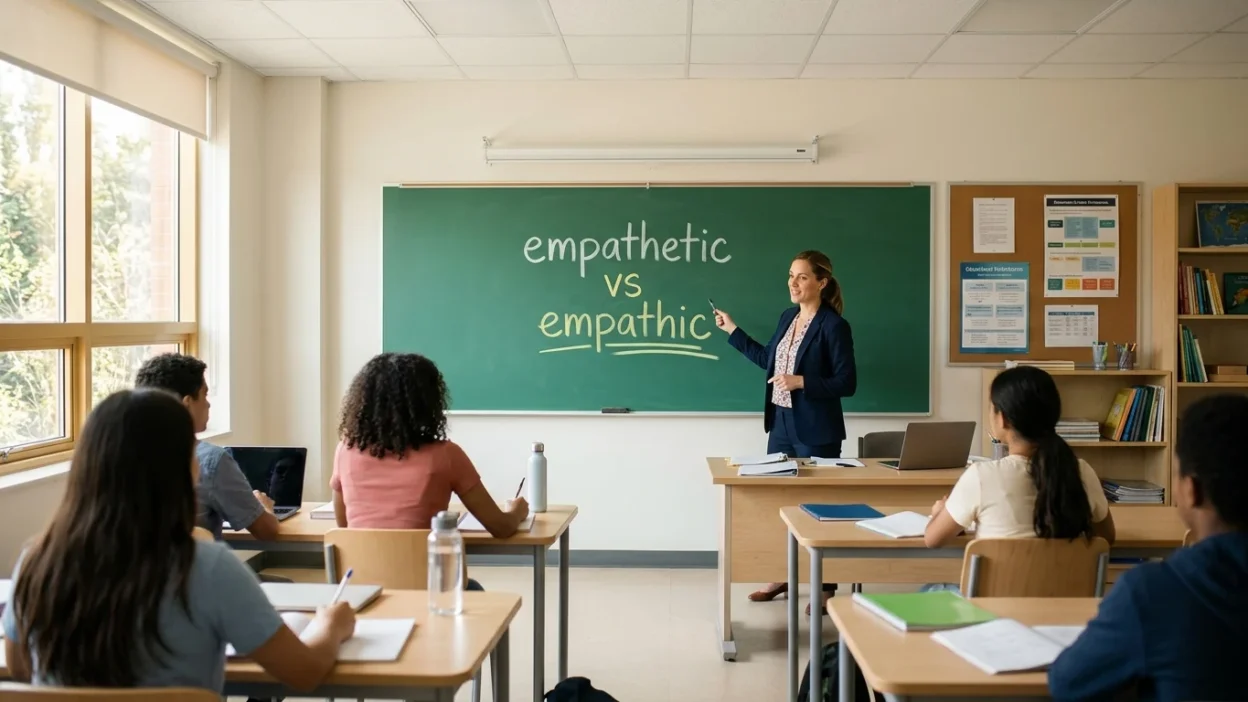
The words empathetic and empathic both describe the ability to understand and share another person’s feelings. Although they look different, they have almost the same meaning and are often used interchangeably. The main difference is that empathetic is more common in everyday English, while empathic is also correct and appears frequently in discussions about psychology, emotional understanding and human behavior.
Choosing between these words can be confusing because both relate to empathy, compassion and emotional awareness. For students writers, professionals and English learners, knowing how these terms work can make communication clearer and more natural. For example you can describe a person as an “empathetic listener” or an “empathic listener” without changing the basic meaning. Both expressions suggest that the listener understands another person’s emotions. In most situations, empathetic is the safer choice for general writing, but empathic is equally valid when it suits your preferred style or context.
Quick Answer: Empathetic vs Empathic
Empathetic and empathic both mean showing or having empathy the ability to understand another person’s feelings or perspective. They are generally interchangeable but empathetic is more common in everyday conversation and general writing. Empathic is also correct and is often used in psychology and discussions of emotional understanding.
Why Do People Confuse Empathetic and Empathic?
People confuse these words because they come from the same root, empathy and describe nearly identical qualities. Both can refer to someone who recognizes another person’s emotions and tries to understand their experience.
The difference is mainly one of usage and preference, not meaning. Neither word is inherently more compassionate or emotionally intelligent than the other.
Consider these examples:
- Empathetic: She is an empathetic teacher who listens to her students.
- Empathic: She is an empathic teacher who listens to her students.
Both sentences are correct. The first may sound more familiar to many English speakers, while the second is also natural in appropriate contexts.
1. What Does Empathetic Mean?
Empathetic is an adjective that describes someone who can understand and respond thoughtfully to another person’s feelings, experiences or point of view.
An empathetic person tries to understand what someone else is going through rather than judging them immediately. This quality can help people build trust, communicate effectively and maintain supportive relationships.
Examples of empathetic
- She gave her friend an empathetic response after hearing the difficult news.
- An empathetic manager listens to employees’ concerns.
- The teacher was empathetic toward students who struggled with the assignment.
- He is an empathetic person who makes others feel understood.
When is empathetic most useful?
Use empathetic when writing for a general audience or describing emotional understanding in everyday situations.
It works especially well in discussions about:
- Relationships and friendships
- Parenting and teaching
- Leadership and teamwork
- Customer service
- Emotional support
- Communication skills
For example, “An empathetic leader understands the concerns of the team” is a clear and natural sentence.
2. What Does Empathic Mean?
Empathic is also an adjective meaning able to understand or share another person’s feelings. It describes the same basic quality as empathetic.
The word is often used in psychology, counseling, healthcare, and discussions of interpersonal communication. However, it is not limited to professional or academic writing. You can use it in ordinary conversation, too.
Examples of empathic
- The counselor used an empathic approach to understand the client’s concerns.
- An empathic response can help someone feel heard.
- The nurse showed an empathic understanding of the patient’s anxiety.
- His empathic listening helped resolve the disagreement.
When is empathic most useful?
Choose empathic when it fits the tone of your writing, particularly in discussions involving emotional understanding, counseling, or psychological concepts.
Common contexts include:
- Empathic listening
- Empathic communication
- Empathic understanding
- Counseling and psychotherapy
- Healthcare and patient support
- Emotional awareness and social behavior
These are common combinations, but empathetic can also be used in many of the same contexts.
Empathetic vs Empathic: Comparison Table
| Feature | Empathetic | Empathic |
|---|---|---|
| Meaning | Understanding another person’s feelings | Understanding another person’s feelings |
| Part of speech | Adjective | Adjective |
| General usage | More common in everyday English | Also correct; often used in professional or academic contexts |
| Tone | Familiar and conversational | Sometimes sounds more technical or concise |
| Psychology | Commonly used | Commonly used |
| Correctness | Correct | Correct |
| Example | She is an empathetic friend. | She is an empathic friend. |
| Best general choice | Often the safest option | A good alternative when preferred |
When Should You Use Empathetic or Empathic?
Both words are correct, so your choice usually depends on style, audience and context.
Use empathetic in everyday writing
Empathetic is a good default when speaking about friends, family members, teachers, managers or other people who understand others’ emotions.
Examples:
- She is an empathetic mother.
- He gave me an empathetic reply.
- We need more empathetic leaders.
This form is especially useful when you want familiar, accessible wording.
Use empathic in professional or psychological contexts
Empathic works well in discussions of counseling, healthcare, emotional understanding and communication techniques.
Examples:
- The therapist practiced empathic listening.
- The study explored empathic responses to emotional situations.
- Nurses need strong empathic communication skills.
These examples do not mean empathic is more scientifically accurate. Both adjectives can be appropriate in professional writing.
Use either word when both fit
In many sentences, replacing one word with the other does not change the meaning.
- An empathetic listener can help people feel understood.
- An empathic listener can help people feel understood.
Choose the version that sounds most natural for your audience, and remain consistent throughout a piece of writing.
12 Examples of Empathetic vs Empathic in Sentences
Here are examples showing how both words can be used naturally.
- Empathetic: My friend was empathetic when I explained my problems.
- Empathic: My friend was empathic when I explained my problems.
- Empathetic: An empathetic teacher understands that students learn at different speeds.
- Empathic: An empathic teacher recognizes when students need additional support.
- Empathetic: The manager took an empathetic approach to the employee’s concerns.
- Empathic: The counselor demonstrated empathic listening during the session.
- Empathetic: She wrote an empathetic message to someone experiencing grief.
- Empathic: The nurse showed empathic understanding toward the patient.
- Empathetic: An empathetic response can make a difficult conversation easier.
- Empathic: His empathic communication helped the two colleagues understand each other.
- Empathetic: Good customer service often requires an empathetic attitude.
- Empathic: The research examined empathic responses to other people’s emotions.
In each example, the adjective describes an ability or willingness to understand another person’s emotional experience.
Common Mistakes to Avoid
Mistake 1: Thinking one word is incorrect
Incorrect assumption: “Empathic” is not a real word.
Correction: Both empathetic and empathic are standard English adjectives.
Mistake 2: Believing empathetic always means more caring
Neither word automatically indicates a greater level of compassion. The meaning depends on the person, situation and surrounding sentence.
Mistake 3: Using empathic only in psychology
Although empathic is common in professional discussions, it can also describe friends, family members, teachers and other people.
Mistake 4: Confusing empathy with sympathy
Empathy involves understanding or sharing another person’s feelings or perspective. Sympathy generally involves concern for someone who is experiencing difficulty.
For example:
- Empathy: “I can understand why you feel disappointed.”
- Sympathy: “I’m sorry you’re going through this.”
The two concepts can overlap but they are not identical.
Mistake 5: Assuming empathy means agreeing with someone
You can understand another person’s feelings without agreeing with their opinions or actions. Empathy involves understanding their perspective, not necessarily approving of it.
Memory Trick: How to Remember the Difference
Remember this simple rule:
Empathetic = the familiar everyday choice.
Empathic = an equally correct alternative.
Both words are connected to empathy, so their core meaning is the same. If you are unsure which one to use in an essay, email or general article, choose empathetic. If empathic fits the tone of your writing, there is no need to avoid it.
American vs British English: Is There a Difference?
There is no major difference in meaning between empathetic and empathic in American and British English. Both forms are understood and accepted in both varieties.
Writers in either variety may prefer one form over the other depending on context, professional terminology or personal style. Empathetic is a common choice in general communication, while empathic also appears in professional discussions of psychology and counseling.
For example, these sentences are acceptable in both American and British English:
- She is an empathetic teacher.
- She is an empathic teacher.
Neither spelling is specifically American or British. The choice is primarily stylistic.
Similar Words Related to Empathetic and Empathic
Several related words describe emotional understanding, kindness, or concern. However, they do not all mean exactly the same thing.
| Word | Meaning | Example |
|---|---|---|
| Compassionate | Showing concern and a desire to help | She is compassionate toward people in need. |
| Sympathetic | Showing concern for someone’s difficulties | He was sympathetic when I lost my job. |
| Understanding | Recognizing another person’s situation or feelings | My manager was understanding about the delay. |
| Sensitive | Aware of other people’s feelings | She is sensitive to her colleagues’ needs. |
| Considerate | Thinking about other people’s needs | He was considerate of everyone’s time. |
| Caring | Showing kindness and concern | She is a caring friend. |
| Kindhearted | Naturally kind and caring | He is a kindhearted person. |
| Perceptive | Quick to notice or understand things | The perceptive teacher noticed her student’s anxiety. |
Important distinction: Empathetic and empathic are the closest synonyms in this list. Words such as compassionate and sympathetic are related, but they emphasize different aspects of emotional response.
Final Verdict: Empathetic or Empathic?
Both empathetic and empathic are correct, and both describe the ability to understand another person’s feelings. The main difference is how they are commonly used, not what they mean.
Choose empathetic for everyday conversations, general articles, and familiar descriptions of caring or understanding people. Choose empathic when it suits the tone of your writing, including discussions of counseling, healthcare, and emotional communication.
If you need one reliable choice, use empathetic. It is widely understood and works naturally in most contexts. Remember, however, that empathic is not a mistake or an inferior form.
Frequently Asked Questions
1. Are empathetic and empathic the same?
Yes. Both words describe the ability to understand or share another person’s feelings. They are generally interchangeable, although individual writers may prefer one form in particular contexts.
2. Which word is more common: empathetic or empathic?
Empathetic is generally more common in everyday English and general writing. Empathic is also widely recognized, especially in discussions of psychology, counseling, and communication.
3. Is empathic grammatically correct?
Yes. Empathic is a standard English adjective. You can correctly write “an empathic listener,” “an empathic response,” or “an empathic approach.”
4. Is empathetic better than empathic?
Neither word is inherently better. Empathetic is often the more familiar choice for general audiences, while empathic may suit certain professional or academic contexts.
5. Can I use empathic in academic writing?
Yes. Empathic is appropriate in academic writing, including discussions of emotional understanding, counseling, healthcare, and interpersonal communication. Follow any terminology preferences specified by your institution or publication.
6. What is the difference between empathetic and sympathetic?
Empathetic describes understanding or sharing another person’s feelings or perspective. Sympathetic usually emphasizes concern or compassion for someone experiencing difficulty. The meanings can overlap, but they are not identical.
7. What is the noun form of empathetic and empathic?
The main related noun is empathy. For example, “Her empathy helped her understand the student’s concerns.” The adjective empathetic or empathic describes someone or something that demonstrates this quality.
Remember This
- Empathetic: A common, natural choice for everyday English.
- Empathic: An equally correct alternative, often used in professional and psychological contexts.
- Empathy: The ability to understand or share another person’s feelings.
- Sympathy: Concern for another person’s difficulty or suffering.
When deciding between empathetic and empathic, focus on your preferred style and audience rather than searching for a strict difference in meaning.
Conclusion
The difference between empathetic and empathic is small because both words express the same central idea: understanding another person’s feelings or perspective. Both are grammatically correct and either can describe a supportive friend, an understanding teacher or a thoughtful professional. In everyday writing, empathetic is often the easiest choice because it is familiar to a broad audience.
However, empathic is not wrong, overly formal or limited to psychology. It is a useful alternative that appears in many discussions of emotional awareness and communication. Choose the word that best fits your sentence, keep your usage consistent and remember that genuine empathy is about understanding another person’s experience rather than simply choosing the right adjective.