
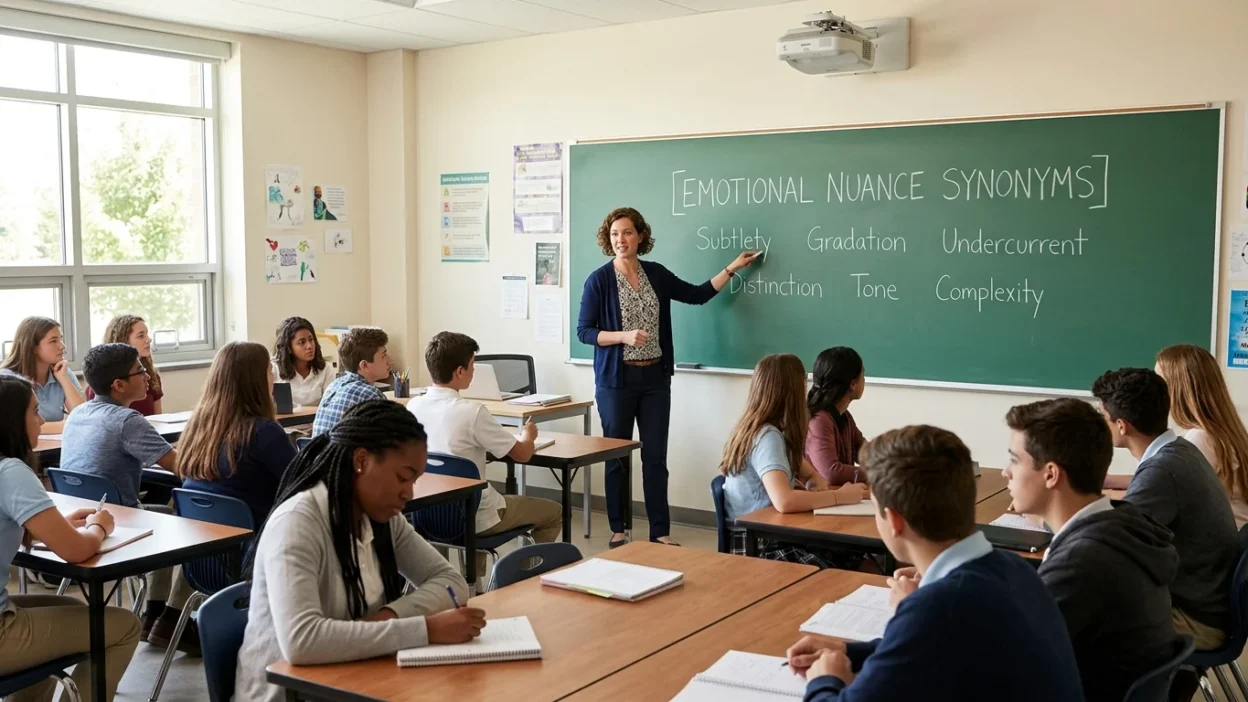
Emotional nuance refers to the small differences, shades and subtle changes in feelings or emotional expression. It helps us describe emotions more accurately instead of using only basic words such as happy, sad, angry or afraid.
Understanding emotional nuance synonyms is especially useful for writers, students, ESL learners, psychologists, storytellers and content creators. The right word can show whether someone feels slightly disappointed, deeply hurt, quietly hopeful or cautiously excited.
In this guide, we explore 30 useful synonyms and related expressions for emotional nuance, along with simple meanings, examples and the best situations for using each one.
What Does Emotional Nuance Mean?
Emotional nuance means the subtle differences or layers within a person’s emotions.
For example, sadness can include disappointment, loneliness, grief, regret, or frustration. These feelings are related, but they are not exactly the same.
Consider these sentences:
“She was sad.”
“She felt quietly disappointed but tried to remain hopeful.”
The second sentence contains more emotional nuance because it gives us a clearer picture of what the person is feeling.
30 Emotional Nuance Synonyms and Alternatives
1. Emotional Subtlety
Meaning: Small and delicate differences in emotional feelings or expression.
Example: The actor brought emotional subtlety to the character.
Best usage: Literature, acting, storytelling and criticism.
2. Emotional Complexity
Meaning: Having several emotions or emotional layers at the same time.
Example: The novel explores the emotional complexity of grief.
Best usage: Literature, psychology and academic writing.
3. Emotional Depth
Meaning: The richness and seriousness of someone’s emotional experience.
Example: Her performance gave the character remarkable emotional depth.
Best usage: Writing, acting, film and literature.
4. Emotional Sensitivity
Meaning: Awareness of delicate feelings and emotional changes.
Example: His emotional sensitivity helped him understand his friend’s concerns.
Best usage: Relationships, psychology and personal writing.
5. Emotional Refinement
Meaning: A developed ability to recognize or express subtle emotions.
Example: The author’s emotional refinement is clear throughout the novel.
Best usage: Literature, criticism and sophisticated writing.
6. Emotional Layering
Meaning: The presence of multiple emotional levels within a situation or character.
Example: The story uses emotional layering to make the character feel realistic.
Best usage: Creative writing, storytelling and film analysis.
7. Emotional Richness
Meaning: A wide range of meaningful and detailed emotions.
Example: The poem is known for its emotional richness.
Best usage: Literature, poetry, music and artistic criticism.
8. Emotional Texture
Meaning: The distinctive qualities and variations of emotional experience.
Example: The dialogue adds emotional texture to the scene.
Best usage: Creative writing, film, theater and literary analysis.
9. Emotional Complexity
Meaning: A mixture of different or sometimes conflicting emotions.
Example: The character’s emotional complexity makes the story compelling.
Best usage: Fiction, psychology and academic writing.
10. Emotional Gradation
Meaning: Different levels or degrees of emotional intensity.
Example: The writer carefully shows the emotional gradation of the character’s anger.
Best usage: Literary analysis and descriptive writing.
11. Emotional Shades
Meaning: Slight variations within an emotion.
Example: The poem captures many emotional shades of love.
Best usage: Poetry, literature and creative writing.
12. Emotional Layers
Meaning: Different feelings that exist beneath or alongside the obvious emotion.
Example: Her smile revealed several emotional layers.
Best usage: Storytelling, psychology and character development.
13. Emotional Distinctions
Meaning: Differences between similar emotional states.
Example: The author makes clear emotional distinctions between guilt and regret.
Best usage: Academic and analytical writing.
14. Emotional Variations
Meaning: Different forms or degrees of emotional experience.
Example: The character experiences many emotional variations throughout the story.
Best usage: General, creative and academic writing.
15. Emotional Subtleties
Meaning: Small emotional details that may not be immediately obvious.
Example: The actress conveyed the emotional subtleties of the scene beautifully.
Best usage: Literature, acting and film analysis.
16. Affective Nuance
Meaning: Subtle differences in emotional states or responses.
Example: The study examines affective nuance in interpersonal communication.
Best usage: Psychology, research and academic writing.
17. Emotional Fine Tuning
Meaning: Careful adjustment or recognition of small emotional differences.
Example: The writer uses emotional fine tuning to make the dialogue believable.
Best usage: Creative writing and storytelling.
18. Emotional Delicacy
Meaning: The fragile or sensitive quality of emotional situations.
Example: The novel handles the emotional delicacy of loss with care.
Best usage: Literature, relationships and sensitive topics.
19. Emotional Sophistication
Meaning: A developed ability to understand complicated or subtle emotions.
Example: The character demonstrates impressive emotional sophistication.
Best usage: Literature, psychology and professional writing.
20. Emotional Awareness
Meaning: The ability to recognize and understand emotions.
Example: Emotional awareness can improve communication.
Best usage: Psychology, education, relationships and self development.
21. Emotional Perception
Meaning: The ability to notice and interpret emotional signals.
Example: Her emotional perception allowed her to recognize his discomfort.
Best usage: Psychology, communication, and academic writing.
22. Emotional Insight
Meaning: A deep understanding of feelings and emotional behavior.
Example: The memoir provides valuable emotional insight.
Best usage: Psychology, literature, essays, and personal writing.
23. Emotional Sensibility
Meaning: The ability to respond to and appreciate emotional experiences.
Example: The poet’s emotional sensibility is evident in every verse.
Best usage: Literature, art, and criticism.
24. Emotional Dimension
Meaning: The emotional aspect of a situation, person, or experience.
Example: The report considers the emotional dimension of the problem.
Best usage: Academic, professional, and analytical writing.
25. Emotional Range
Meaning: The variety of emotions a person can experience or express.
Example: The actor displayed an impressive emotional range.
Best usage: Acting, writing, music, and performance.
26. Emotional Spectrum
Meaning: The full range of possible emotional states.
Example: The film explores a broad emotional spectrum.
Best usage: Creative writing, psychology, film, and general writing.
27. Emotional Expression
Meaning: The way feelings are communicated through words, behavior, or actions.
Example: His emotional expression was restrained but powerful.
Best usage: Psychology, writing, communication, and art.
28. Emotional Layers of Meaning
Meaning: Different feelings and interpretations contained within an experience.
Example: The poem contains several emotional layers of meaning.
Best usage: Literary and artistic analysis.
29. Subtle Emotional Shifts
Meaning: Small changes in someone’s emotional state.
Example: The author captures the character’s subtle emotional shifts.
Best usage: Fiction, storytelling, and character analysis.
30. Shades of Feeling
Meaning: Small differences between related feelings.
Example: The story explores the many shades of feeling that accompany friendship.
Best usage: Creative, literary, and descriptive writing.
Quick Comparison of Emotional Nuance Synonyms
| Alternative | Main Meaning | Tone | Best Use |
|---|---|---|---|
| Emotional subtlety | Small emotional differences | Sophisticated | Literature |
| Emotional complexity | Multiple feelings or layers | Formal | Psychology |
| Emotional depth | Rich emotional experience | Neutral | Writing/acting |
| Emotional sensitivity | Awareness of feelings | Neutral | Relationships |
| Emotional layering | Multiple emotional levels | Creative | Storytelling |
| Emotional richness | Variety and depth | Literary | Poetry/art |
| Emotional texture | Quality of emotional expression | Creative | Film/writing |
| Emotional shades | Small variations in feelings | Literary | Creative writing |
| Emotional distinctions | Differences between emotions | Formal | Academic writing |
| Affective nuance | Subtle emotional states | Technical | Psychology |
| Emotional awareness | Understanding emotions | Neutral | Education |
| Emotional insight | Deep understanding of feelings | Formal | Psychology/writing |
| Emotional range | Variety of emotions | Neutral | Acting/performance |
| Emotional spectrum | Full range of feelings | Neutral | General/creative |
| Emotional dimension | Emotional aspect of something | Formal | Analysis |
How to Choose the Right Emotional Nuance Synonym
For Creative Writing
Use:
- Emotional subtlety
- Emotional texture
- Emotional layering
- Emotional shades
- Shades of feeling
- Subtle emotional shifts
These phrases can help you describe characters and scenes in a vivid way.
For Academic Writing
Choose:
- Emotional complexity
- Emotional distinctions
- Affective nuance
- Emotional perception
- Emotional awareness
- Emotional dimension
These expressions work well in psychology, education, communication, and research.
For Literature and Poetry
Try:
- Emotional depth
- Emotional richness
- Emotional texture
- Emotional sophistication
- Emotional shades
- Emotional layers
These words emphasize the richness and complexity of artistic expression.
For Relationships and Communication
Useful choices include:
- Emotional sensitivity
- Emotional awareness
- Emotional perception
- Emotional insight
- Emotional delicacy
- Emotional expression
These terms can describe how people understand and communicate feelings.
Emotional Nuance vs Emotional Complexity
These terms are closely related but have different focuses.
Emotional nuance emphasizes small differences and subtle variations in feelings.
Emotional complexity emphasizes multiple or conflicting emotions.
For example:
“The character shows emotional nuance.”
This means the character’s feelings are expressed with subtle differences.
“The character shows emotional complexity.”
This means the character may experience several emotions at once.
Emotional Nuance vs Emotional Depth
Emotional depth describes how profound or meaningful an emotional experience is.
Emotional nuance describes the subtle details within that experience.
For example:
“The novel has emotional depth.”
This suggests that the story explores meaningful feelings.
“The novel has emotional nuance.”
This suggests that the writer carefully distinguishes between different emotional states.
Emotional Nuance vs Emotional Sensitivity
Emotional sensitivity refers to being aware of or responsive to feelings.
Emotional nuance refers to the subtle differences within those feelings.
A person can have strong emotional sensitivity and therefore notice emotional nuances more easily.
Why Is Emotional Nuance Important?
Emotional nuance makes communication more accurate.
Instead of saying someone is simply angry, you might describe them as frustrated, irritated, disappointed, resentful or quietly upset.
These words communicate different emotional experiences.
For writers, emotional nuance can also make characters feel more realistic. Real people rarely experience only one simple emotion. Someone might feel excited and nervous at the same time or happy while also feeling a little sad.
Final Thoughts
Emotional nuance refers to the subtle differences, layers, and variations within human feelings. It allows us to describe emotions with greater accuracy instead of relying on simple labels.
The best alternative depends on what you want to emphasize. Use emotional subtlety for small differences, emotional complexity for multiple feelings, emotional depth for profound experiences and emotional layering for several emotional levels.
Learning these emotional nuance synonyms can help students, ESL learners, writers, and content creators express feelings more clearly and create richer, more meaningful communication.