
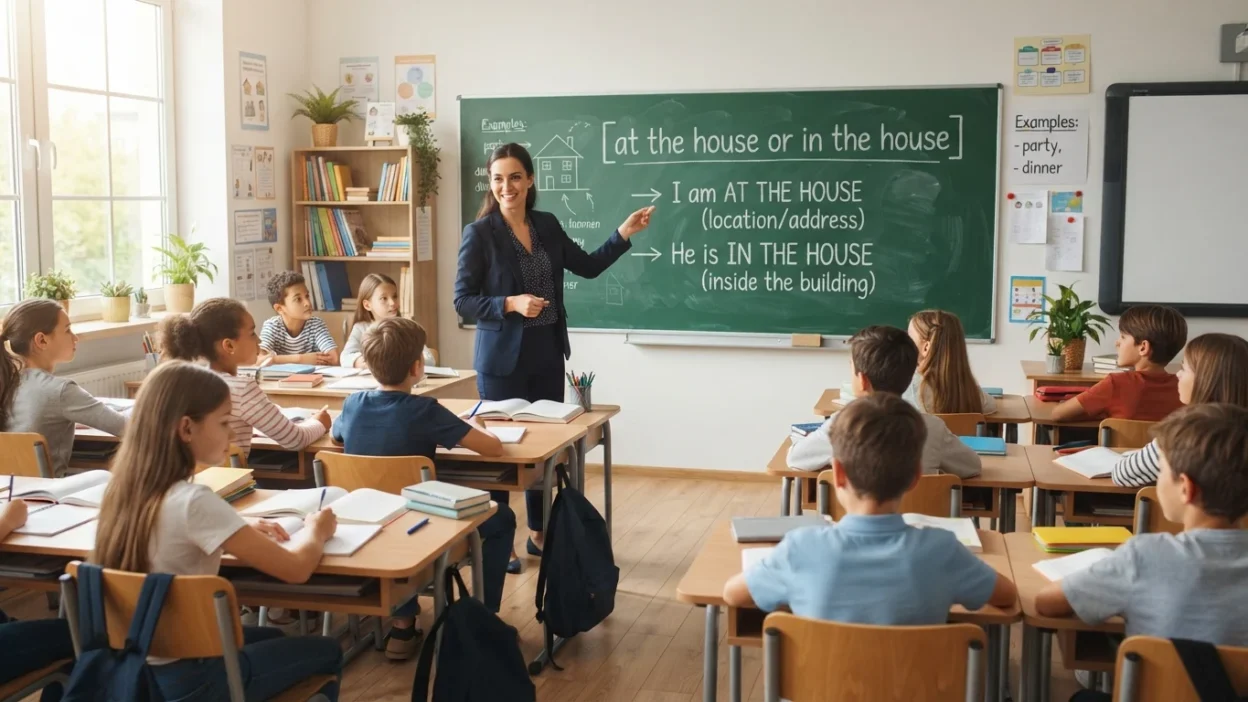
If you are unsure whether to say “at the house” or “in the house,” both expressions are grammatically correct but they do not mean exactly the same thing. The difference depends on whether you are talking about a general location or being inside the building.
We use “at the house” when we mean someone is at or around a particular house, often focusing on the location rather than the inside of the building. We use “in the house” when someone or something is physically inside the house. Understanding this small difference can make your English sound much more natural and precise.
Quick Answer
“At the house” refers to being at a house or its general location, while “in the house” specifically means being inside the house. For example “She is at the house” focuses on her location, while “She is in the house” tells us she is physically inside it.
Why Do People Confuse “At the House” and “In the House”?
The confusion happens because both at and in can describe locations.
The main difference is the level of location you want to express:
- At the house = at that location or property
- In the house = inside the building
- At often gives a general location.
- In usually emphasizes being inside an enclosed space.
Compare these:
- John is at the house.
This tells us John is at the house location. He could be inside, outside, in the yard, or near the property. - John is in the house.
This clearly tells us John is inside the house.
At the House
“At the house” is used when you want to identify a person’s general location.
The expression does not necessarily mean that the person is physically inside the building. They could be in the garden, driveway, garage or somewhere else on or around the property.
Examples
- Sarah is at the house right now.
- I’ll meet you at the house at six.
- My brother is at the house with his friends.
- We left our bags at the house.
- Is Dad at the house?
- The workers are at the house today.
When Should You Use “At the House”?
Use “at the house” when:
- You are talking about a general location.
- You are identifying where someone is.
- The exact position inside or outside is not important.
- You are referring to the house as a meeting point or destination.
For example:
I’ll see you at the house.
The important information is the location where you will meet. It does not necessarily say that you will meet inside the house.
In the House
“In the house” means physically inside the house.
It is more specific than “at the house.” If someone says, “The children are in the house,” we understand that the children are inside the building.
Examples
- The children are in the house.
- There is someone in the house.
- My phone is in the house.
- She is cooking in the house.
- We stayed in the house during the storm.
- The dog is in the house.
When Should You Use “In the House”?
Use “in the house” when:
- Someone is physically inside.
- Something is located inside the building.
- You want to emphasize the interior of the house.
- You are contrasting inside with outside.
For example:
The children are in the house, but their parents are in the garden.
Here, in clearly identifies the children’s position as being inside the building.
At the House vs In the House: Comparison Table
| Expression | Meaning | Main Focus | Example |
|---|---|---|---|
| At the house | At the house location | General location | She is at the house. |
| In the house | Inside the house | Interior location | She is in the house. |
| At | A general point or location | Where someone is | We are at the house. |
| In | Inside an enclosed place | Where someone or something is physically located | We are in the house. |
When to Use “At the House”
Use “at the house” when the house is being treated as a location or meeting point.
Example 1
I’ll meet you at the house.
This means the house is the place where you will meet.
Example 2
Tom is at the house.
Tom is at that location, but we do not know exactly where he is on the property.
Example 3
The plumber is at the house.
The plumber has arrived at the property. He may be inside, outside, or somewhere around the house.
When to Use “In the House”
Use “in the house” when you specifically mean inside the building.
Example 1
My sister is in the house.
She is physically inside the house.
Example 2
There is a cat in the house.
The cat is inside the building.
Example 3
It is very warm in the house.
This describes conditions inside the house.
20 Examples of “At the House” and “In the House”
- My parents are at the house.
They are at the house location. - My parents are in the house.
They are physically inside. - I’ll meet you at the house.
The house is the meeting location. - I’ll wait for you in the house.
The speaker will wait inside. - The workers are at the house.
They have arrived at the property. - The workers are in the house.
They are working inside. - Is your brother at the house?
Is he at that location? - Is your brother in the house?
Is he inside the building? - We stayed at the house all afternoon.
We remained at that location. - We stayed in the house all afternoon.
We remained inside the house. - There are several people at the house.
Several people are at the location. - There are several people in the house.
Several people are inside. - The children are playing at the house.
The house is the general location. - The children are playing in the house.
They are playing inside. - I’ll leave the package at the house.
The package will be left at the property. - The package is in the house.
The package is inside. - We arrived at the house early.
We reached the house location. - We went inside the house.
We entered the building. - Someone is waiting at the house.
Someone is waiting at that location. - Someone is waiting in the house.
Someone is waiting inside.
Common Mistakes
Mistake 1: Thinking “At the House” Always Means Inside
Incorrect assumption:
“At the house” means someone is definitely inside.
Better understanding:
“At the house” gives a general location. The person could be inside or outside.
Mistake 2: Using “In” for Every Location
You should not automatically use in whenever you mention a house.
For example:
I’ll meet you at the house.
This is natural when the house is the meeting location.
If you say:
I’ll meet you in the house.
It specifically suggests that the meeting will happen inside.
Mistake 3: Forgetting the Context
The same person can be described with both expressions at different moments:
James is at the house.
He is at the property.
James is in the house.
He is specifically inside.
Memory Trick
Remember:
AT = general location
IN = inside
Think of at as pointing to a place:
I am at the house.
Think of in as putting you inside a space:
I am in the house.
A simple rule is:
At the house = where?
In the house = where exactly inside?
American vs British English
Both “at the house” and “in the house” are used in American and British English.
The basic distinction is the same in both varieties:
- at the house = at the house/location
- in the house = inside the house
Usage can vary slightly depending on context and regional speaking habits, but the fundamental meaning remains consistent.
Similar Expressions
Several related expressions can help you understand the difference.
At home
At home means at your home or residence.
I’m at home right now.
In the home
In the home emphasizes being inside a home or can refer to conditions or activities within a household.
There are several plants in the home.
At my house
This refers to the general location of the speaker’s house.
Come over at seven. We’ll be at my house.
In my house
This specifically means inside the speaker’s house.
There are three bedrooms in my house.
Outside the house
This means outside the building.
The children are playing outside the house.
Final Verdict: At the House or In the House?
Both “at the house” and “in the house” are correct, but they communicate different ideas.
Use “at the house” when you are talking about the house as a general location or destination. Use “in the house” when you specifically mean that someone or something is physically inside the building.
The easiest way to remember the difference is:
At = general location
In = inside
So, if you simply want to say where someone is, “at the house” may be appropriate. If you want to make it clear that the person is inside, choose “in the house.”
Frequently Asked Questions
Is “at the house” grammatically correct?
Yes. “At the house” is grammatically correct and commonly used when referring to a house as a general location or meeting point.
Is “in the house” grammatically correct?
Yes. “In the house” is correct and specifically means inside the house.
What is the difference between “at the house” and “in the house”?
“At the house” refers to the general location, while “in the house” means physically inside the building.
Can “at the house” mean inside the house?
Yes, depending on context. “At the house” does not specify whether someone is inside or outside. If you need to clearly say they are inside, use “in the house.”
Should I say “I am at the house” or “I am in the house”?
Both can be correct. Say “I am at the house” for the general location and “I am in the house” when you specifically mean you are inside.
Which is correct: “meet me at the house” or “meet me in the house”?
Both can be correct, but the meaning differs. “Meet me at the house” identifies the house as the meeting location. “Meet me in the house” specifically tells someone to meet you inside.
Do British and American English use these expressions differently?
Both British and American English use these expressions, and the basic distinction between general location and interior location is the same.
Remember This
- At the house = at the general location.
- In the house = inside the building.
- Use at when the exact position is not important.
- Use in when you want to emphasize the interior.
- “At the house” does not necessarily mean inside.
- “In the house” clearly indicates an interior location.
Conclusion
The expressions “at the house” and “in the house” are both correct, but they emphasize different aspects of location. “At the house” treats the house as a general place or destination, while “in the house” specifically describes someone or something located inside the building.
When choosing between them, think about what you want your reader or listener to understand. If you only need to identify the general location, use “at the house.” If you need to make the interior location clear, use “in the house.” This simple distinction will help you use both expressions naturally and accurately.