
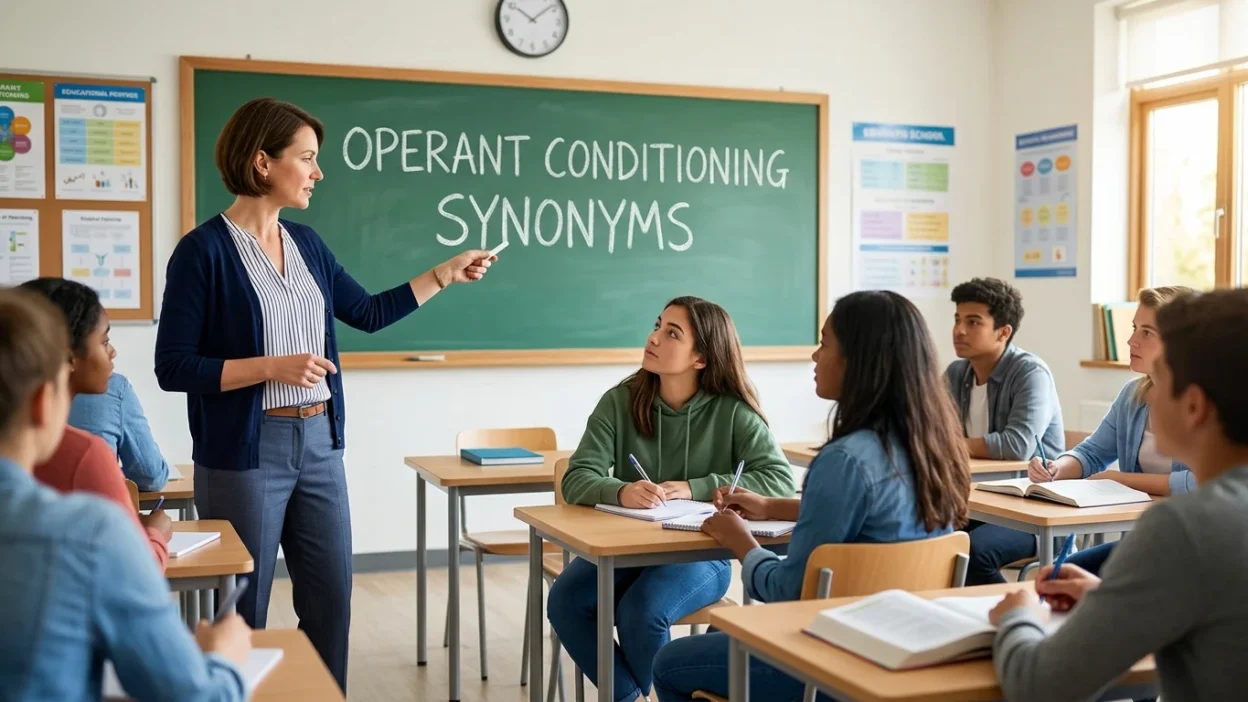
Looking for the best operant conditioning synonyms?
Whether you’re a student, ESL learner, psychology enthusiast, teacher, researcher or content creator, understanding related terms for operant conditioning can improve your vocabulary and deepen your understanding of behavioral psychology.
Unlike ordinary words, operant conditioning is a technical psychology term introduced by psychologist B.F. Skinner. It does not have many exact synonyms. Instead, there are several closely related terms, alternative names, and concepts that are often used in similar contexts.
In this guide, you’ll learn the meaning of operant conditioning, discover 30 related alternatives, understand when to use each one and see simple examples.
What Does Operant Conditioning Mean?
Meaning of Operant Conditioning
Operant conditioning is a learning process in which behavior is strengthened or weakened through rewards (reinforcement) and punishments.
Example of Operant Conditioning
- A child receives praise for finishing homework, making the child more likely to complete homework again.
- A dog learns to sit because it receives a treat.
- An employee earns a bonus for meeting sales goals.
30 Operant Conditioning Synonyms and Related Terms
1. Instrumental Conditioning
Meaning: Another name for operant conditioning.
Example: Instrumental conditioning explains how rewards shape behavior.
Best Usage: Psychology textbooks.
2. Behavioral Conditioning
Meaning: Learning through changes in behavior.
Example: Behavioral conditioning is used in animal training.
Best Usage: General psychology.
3. Behavior Modification
Meaning: Changing behavior through reinforcement or punishment.
Example: Teachers use behavior modification techniques in classrooms.
Best Usage: Education and therapy.
4. Reinforcement Learning
Meaning: Learning through rewards.
Example: Reinforcement learning encourages positive habits.
Best Usage: Psychology and artificial intelligence.
5. Reward Based Learning
Meaning: Learning by receiving rewards.
Example: Reward based learning motivates students.
Best Usage: Education.
6. Response Learning
Meaning: Learning appropriate responses to situations.
Example: Response learning develops through repeated practice.
Best Usage: Psychology.
7. Trial and Error Learning
Meaning: Learning through repeated attempts.
Example: Children often learn by trial and error.
Best Usage: Education.
8. Associative Learning
Meaning: Learning by connecting actions with outcomes.
Example: Operant conditioning is a form of associative learning.
Best Usage: Psychology.
9. Habit Formation
Meaning: Developing repeated behaviors.
Example: Daily exercise becomes habit formation through repetition.
Best Usage: Self improvement.
10. Behavioral Training
Meaning: Teaching desired behaviors.
Example: Behavioral training helps service dogs.
Best Usage: Animal training.
11. Positive Reinforcement
Meaning: Adding a reward to encourage behavior.
Example: Praise is positive reinforcement.
Best Usage: Psychology.
12. Negative Reinforcement
Meaning: Removing something unpleasant to encourage behavior.
Example: Turning off an alarm after fastening a seatbelt is negative reinforcement.
Best Usage: Psychology.
13. Positive Punishment
Meaning: Adding an unpleasant consequence to reduce behavior.
Example: A speeding ticket is positive punishment.
Best Usage: Behavioral science.
14. Negative Punishment
Meaning: Removing something enjoyable to reduce behavior.
Example: Losing phone privileges is negative punishment.
Best Usage: Parenting and education.
15. Contingency Learning
Meaning: Learning based on consequences.
Example: Contingency learning links actions with outcomes.
Best Usage: Psychology.
16. Consequence Based Learning
Meaning: Learning from the results of actions.
Example: Consequence based learning improves decision-making.
Best Usage: Education.
17. Action Outcome Learning
Meaning: Learning that actions produce specific outcomes.
Example: Children quickly understand action-outcome learning.
Best Usage: Behavioral research.
18. Reward Conditioning
Meaning: Conditioning primarily through rewards.
Example: Reward conditioning increased participation.
Best Usage: Education.
19. Incentive Learning
Meaning: Learning influenced by incentives.
Example: Incentive learning boosts employee performance.
Best Usage: Business.
20. Behavioral Reinforcement
Meaning: Strengthening desired behaviors.
Example: Behavioral reinforcement encourages consistency.
Best Usage: Therapy.
21. Response Reinforcement
Meaning: Reinforcing a particular response.
Example: Response reinforcement helped the child learn quickly.
Best Usage: Education.
22. Learning by Consequences
Meaning: Learning from outcomes.
Example: Learning by consequences shapes daily habits.
Best Usage: General psychology.
23. Operant Learning
Meaning: A shortened name for operant conditioning.
Example: Operant learning explains many everyday behaviors.
Best Usage: Psychology.
24. Behavior Shaping
Meaning: Gradually developing a desired behavior.
Example: Trainers use behavior shaping to teach complex tricks.
Best Usage: Animal training.
25. Conditioning Process
Meaning: The process of learning through conditioning.
Example: The conditioning process requires repetition.
Best Usage: Educational writing.
26. Reinforcement Process
Meaning: Learning through reinforcement.
Example: The reinforcement process improves performance.
Best Usage: Psychology.
27. Motivation-Based Learning
Meaning: Learning influenced by motivation.
Example: Motivation based learning increases engagement.
Best Usage: Education.
28. Adaptive Learning
Meaning: Learning behaviors that help achieve goals.
Example: Adaptive learning allows animals to survive.
Best Usage: Behavioral science.
29. Response Conditioning
Meaning: Conditioning specific behavioral responses.
Example: Response conditioning occurs through repeated practice.
Best Usage: Psychology.
30. Skinnerian Conditioning
Meaning: Operant conditioning based on B.F. Skinner’s theory.
Example: Skinnerian conditioning transformed behavioral psychology.
Best Usage: Academic writing.
When to Use Different Operant Conditioning Synonyms
Quick Comparison Guide
| Term | Best Used For | Tone |
|---|---|---|
| Instrumental Conditioning | Academic psychology | Formal |
| Behavior Modification | Therapy and education | Professional |
| Reinforcement Learning | Psychology and AI | Technical |
| Positive Reinforcement | Education and parenting | Professional |
| Trial-and-Error Learning | General learning | Neutral |
| Behavior Shaping | Animal training | Professional |
| Consequence-Based Learning | Education | Neutral |
| Habit Formation | Self-improvement | Neutral |
| Operant Learning | Psychology | Formal |
| Skinnerian Conditioning | Academic discussions | Formal |
How to Choose the Right Term
For Psychology Courses
Use:
- Instrumental Conditioning
- Operant Learning
- Skinnerian Conditioning
- Associative Learning
- Contingency Learning
For Education
Choose:
- Behavior Modification
- Positive Reinforcement
- Reward-Based Learning
- Consequence-Based Learning
- Habit Formation
For Parenting
Use:
- Positive Reinforcement
- Negative Punishment
- Behavior Shaping
- Reward Conditioning
- Learning by Consequences
For Animal Training
Choose:
- Behavior Shaping
- Behavioral Training
- Operant Learning
- Reinforcement Process
- Response Reinforcement
For Artificial Intelligence
Use:
- Reinforcement Learning
- Reward-Based Learning
- Action-Outcome Learning
- Adaptive Learning
- Incentive Learning
Common Mistakes When Using Operant Conditioning Synonyms
Don’t Confuse Operant Conditioning with Classical Conditioning
Operant conditioning involves learning through consequences (rewards and punishments).
Classical conditioning involves learning through associations between two stimuli, such as Pavlov’s dogs learning to associate a bell with food.
Match the Term to the Context
Use instrumental conditioning as the closest technical synonym, behavior modification for therapy and education, and reinforcement learning when discussing psychology or artificial intelligence.
Remember That Most Are Related Terms
Unlike common vocabulary words, operant conditioning has very few true synonyms. Many terms in this list are closely related concepts rather than exact replacements.
Why Learning Operant Conditioning Synonyms Improves Your Vocabulary
Understanding operant conditioning synonyms and related terms helps you discuss learning and behavior more accurately.
Benefits include:
- Better psychology vocabulary
- Stronger academic writing
- Improved understanding of behavioral science
- More effective educational communication
- Greater variety in word choice
- Clearer discussions about learning and motivation
Using the appropriate term makes your writing more precise and professional.
Conclusion
Learning operant conditioning synonyms and related terms helps you describe behavioral learning with greater accuracy. While instrumental conditioning is the closest true synonym, related expressions such as behavior modification, reinforcement learning, behavior shaping and Skinnerian conditioning are useful in specific contexts.
By understanding each term’s meaning, example and ideal usage, you’ll strengthen your psychology vocabulary and communicate more confidently in academic, educational and professional settings.