
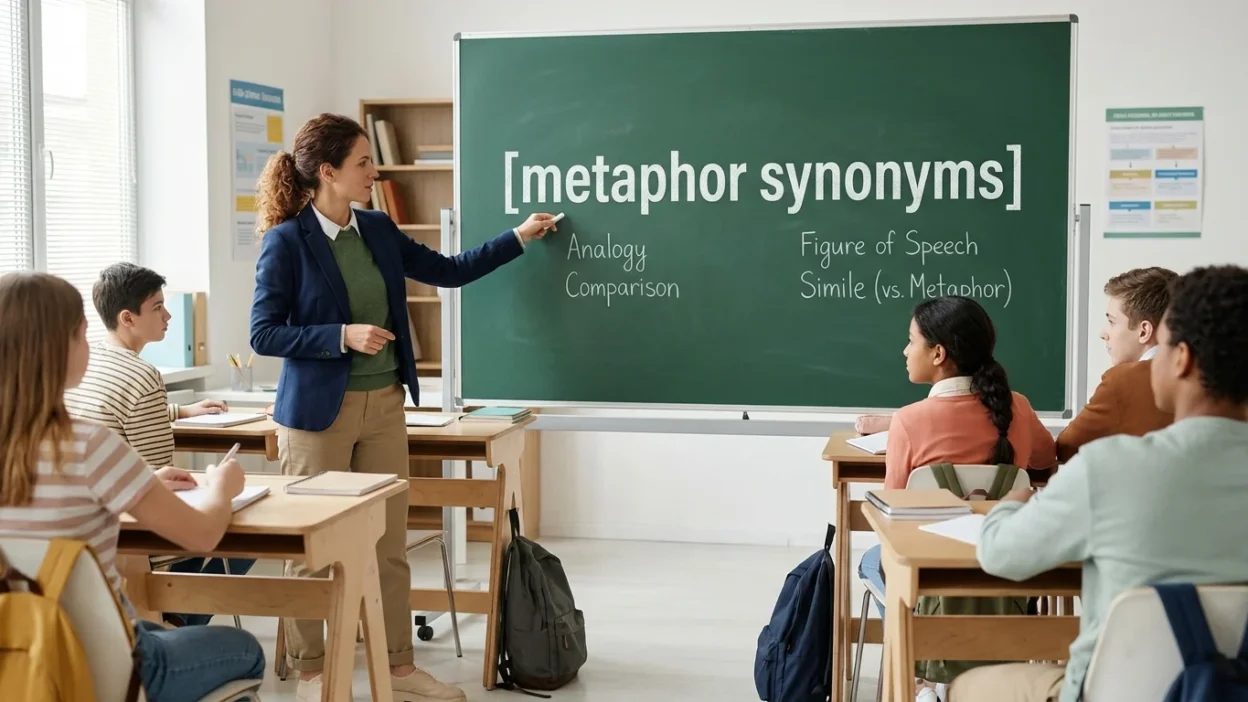
Looking for the best metaphor synonyms?
The word metaphor is commonly used in literature, poetry, storytelling, speeches and everyday communication. Learning related words and alternatives can help students, ESL learners, writers and content creators better understand figurative language and express ideas creatively.
A metaphor does more than simply describe something. It compares one thing to another without using “like” or “as”, helping readers understand an idea through a different image or concept.
What Does “Metaphor” Mean?
A metaphor is a figure of speech in which one thing is described as another thing to create a comparison or deeper meaning.
Examples
- Time is a thief.
- Her voice was music to my ears.
- The classroom was a zoo.
- His words were a knife.
In these examples, the comparison is not meant literally. It creates a particular image or feeling.
30 Useful Metaphor Synonyms and Related Terms
1. Analogy
Meaning: A comparison between two things used to explain an idea.
Example: The teacher used an analogy to explain how the computer works.
Best Usage: Academic and educational writing.
2. Figure of Speech
Meaning: A creative use of language that differs from literal meaning.
Example: “The world is a stage” is a famous figure of speech.
Best Usage: Literature and language studies.
3. Comparison
Meaning: Showing how two things are similar or related.
Example: The poem uses a comparison between life and a journey.
Best Usage: General and academic writing.
4. Symbol
Meaning: Something that represents a larger idea or meaning.
Example: The dove is often used as a symbol of peace.
Best Usage: Literature and art.
5. Representation
Meaning: Something that stands for or expresses another idea.
Example: The character serves as a representation of courage.
Best Usage: Academic and literary analysis.
6. Allegory
Meaning: A story, image, or work in which characters and events represent deeper ideas.
Example: The novel is an allegory about political power.
Best Usage: Literature and academic writing.
7. Imagery
Meaning: Descriptive language that creates pictures or sensory impressions in the reader’s mind.
Example: The poet uses vivid imagery to describe the forest.
Best Usage: Poetry and literary analysis.
8. Symbolism
Meaning: The use of symbols to communicate deeper meanings.
Example: The story uses symbolism to represent freedom.
Best Usage: Literature and art.
9. Simile
Meaning: A comparison using “like” or “as.”
Example: Her smile was like sunshine.
Best Usage: Creative writing.
Note: A simile is related to a metaphor but is not an exact synonym.
10. Comparison Figure
Meaning: A figurative expression that compares one idea with another.
Example: The writer uses a comparison figure to make the concept easier to understand.
Best Usage: Literary discussions.
11. Figurative Expression
Meaning: Language that communicates something beyond its literal meaning.
Example: “He has a heart of stone” is a figurative expression.
Best Usage: General and literary writing.
12. Figurative Language
Meaning: Language that uses creative or nonliteral meanings.
Example: The poem is filled with figurative language.
Best Usage: English and literature classes.
13. Trope
Meaning: A recurring figurative idea, device, or convention.
Example: The journey is a common literary trope.
Best Usage: Literary and cultural analysis.
14. Motif
Meaning: A repeated image, idea, symbol, or theme in a work.
Example: Water is a recurring motif in the novel.
Best Usage: Literary analysis.
15. Emblem
Meaning: An object or image that represents an idea or quality.
Example: The crown is an emblem of power.
Best Usage: Literature, history, and visual symbolism.
16. Sign
Meaning: Something that indicates or represents something else.
Example: The dark clouds were a sign of coming rain.
Best Usage: General and analytical writing.
17. Allusion
Meaning: An indirect reference to a well-known person, event, work, or idea.
Example: The poem contains an allusion to Greek mythology.
Best Usage: Literature and academic writing.
18. Illustration
Meaning: An example or comparison used to explain an idea.
Example: The teacher gave an illustration to make the theory easier to understand.
Best Usage: Education and explanatory writing.
19. Parallel
Meaning: Something similar or comparable to another thing.
Example: The writer draws a parallel between childhood and old age.
Best Usage: Academic and analytical writing.
20. Correlation
Meaning: A relationship or connection between two things.
Example: The author explores the correlation between fear and power.
Best Usage: Academic writing.
Note: This is not a direct synonym for metaphor.
21. Connotation
Meaning: An additional feeling or meaning associated with a word.
Example: The word “home” has positive connotations for many people.
Best Usage: Language and literary analysis.
22. Evocation
Meaning: Something that brings a particular feeling, image, or memory to mind.
Example: The poem creates an evocation of childhood.
Best Usage: Literary writing.
23. Personification
Meaning: Giving human qualities to animals, objects, or abstract ideas.
Example: “The wind whispered through the trees” uses personification.
Best Usage: Creative writing.
Note: Personification is a type of figurative language, not a direct synonym for metaphor.
24. Hyperbole
Meaning: An intentional exaggeration used for emphasis.
Example: “I’ve told you a million times” is hyperbole.
Best Usage: Creative and informal writing.
25. Idiom
Meaning: A common expression whose meaning is different from its literal words.
Example: “Break the ice” is an English idiom.
Best Usage: Everyday English.
26. Parable
Meaning: A short story that teaches a moral or deeper lesson.
Example: The teacher told a parable about honesty.
Best Usage: Religious, educational, and literary contexts.
27. Fable
Meaning: A short story, often involving animals, that teaches a lesson.
Example: The fable teaches the importance of patience.
Best Usage: Children’s literature and moral storytelling.
28. Conceit
Meaning: An extended or unusual metaphor, especially in poetry.
Example: The poet develops an elaborate conceit comparing love to a journey.
Best Usage: Literary analysis.
29. Extended Metaphor
Meaning: A metaphor developed throughout several sentences, lines, or an entire work.
Example: The poem uses an extended metaphor of life as a voyage.
Best Usage: Poetry and literary analysis.
30. Figurative Comparison
Meaning: A nonliteral comparison used to create meaning or imagery.
Example: The author uses a figurative comparison to describe loneliness.
Best Usage: Literature and creative writing.
When to Use Different Metaphor-Related Words
| Word | Best Used For | Tone |
|---|---|---|
| Analogy | Explaining similarities | Academic |
| Figure of speech | Nonliteral language | General |
| Comparison | Showing similarities | General |
| Symbol | Representing an idea | Literary |
| Allegory | Deeper story meaning | Literary |
| Imagery | Creating mental pictures | Creative |
| Symbolism | Deeper symbolic meaning | Academic |
| Simile | Comparison using like/as | Creative |
| Figurative language | Nonliteral expression | Academic |
| Trope | Recurring literary device | Literary |
| Motif | Repeated idea or image | Academic |
| Emblem | Representing an idea | Formal |
| Allusion | Indirect reference | Literary |
| Personification | Human qualities to nonhumans | Creative |
| Hyperbole | Exaggeration | Creative |
| Idiom | Common nonliteral expression | Everyday |
| Parable | Story with a lesson | Educational |
| Conceit | Elaborate metaphor | Literary |
How to Choose the Right Metaphor Synonym
For Academic Writing
Use:
- Analogy
- Comparison
- Figurative language
- Symbolism
- Representation
- Parallel
Example:
The author uses an analogy to explain the relationship between memory and identity.
For Creative Writing
Use:
- Imagery
- Figurative expression
- Simile
- Personification
- Symbol
- Figurative comparison
Example:
The writer uses vivid imagery to create a sense of loneliness.
For Literary Analysis
Choose:
- Symbolism
- Allegory
- Motif
- Conceit
- Allusion
- Trope
- Extended metaphor
Example:
The recurring storm serves as a symbol of the character’s emotional conflict.
Metaphor vs Simile
A metaphor directly states that one thing is another.
Her voice was music.
A simile compares two things using like or as.
Her voice was like music.
Both create comparisons, but their structures are different.
Metaphor vs Analogy
A metaphor is usually a concise figurative comparison.
Life is a journey.
An analogy usually explains a relationship between two things in greater detail.
Learning a language is like building a house because both require a strong foundation.
An analogy is often used to make complicated ideas easier to understand.
Metaphor vs Symbol
A metaphor makes a comparison.
A symbol represents something beyond itself.
For example:
“The classroom was a battlefield.”
This is a metaphor.
A recurring image of a broken sword might symbolize defeat.
Metaphor vs Allegory
A metaphor can be a single phrase or sentence.
An allegory usually develops a deeper symbolic meaning across an entire story, poem, or work.
For example, a story about animals competing for control of a farm might represent political events. That is an allegorical structure.
Metaphor vs Imagery
Imagery creates sensory pictures in the reader’s mind.
A metaphor can be one way of creating imagery.
The moon was a silver coin.
This metaphor also creates visual imagery.
Therefore, imagery is broader than metaphor.
Common Types of Metaphors
Direct Metaphor
A direct metaphor clearly compares two things.
She is a star.
Implied Metaphor
The comparison is suggested rather than directly stated.
The lawyer attacked every weakness in the argument.
The word attacked implies a comparison between argument and battle.
Extended Metaphor
The comparison continues throughout a passage.
Life is a journey: we choose roads, face obstacles, and eventually reach our destination.
Dead Metaphor
A metaphor that has become so common that people often no longer notice its figurative origin.
Examples include:
- Foot of the mountain
- Branch of science
- Eye of a needle
- Head of a department
Why Learning Metaphor Synonyms Improves Your Vocabulary
Understanding metaphor synonyms and related terms helps you:
- Analyze poems and stories
- Improve creative writing
- Understand figurative language
- Write stronger essays
- Explain difficult ideas
- Recognize literary devices
It also helps you understand that not every figurative expression is technically a metaphor.
Conclusion
Learning metaphor synonyms gives you a broader understanding of figurative language and literary devices. Useful alternatives and related terms include analogy, figure of speech, comparison, symbol, representation, allegory, imagery, symbolism, simile, figurative expression, trope, motif, allusion, personification, hyperbole, idiom, parable, conceit and extended metaphor.
Remember that these words are not all exact synonyms. Analogy explains similarities, simile makes a comparison using “like” or “as,” symbolism gives objects or images deeper meaning, allegory develops symbolic meaning across a larger work and imagery creates sensory impressions.
Understanding these differences will help you become a more confident reader, writer and English learner.