
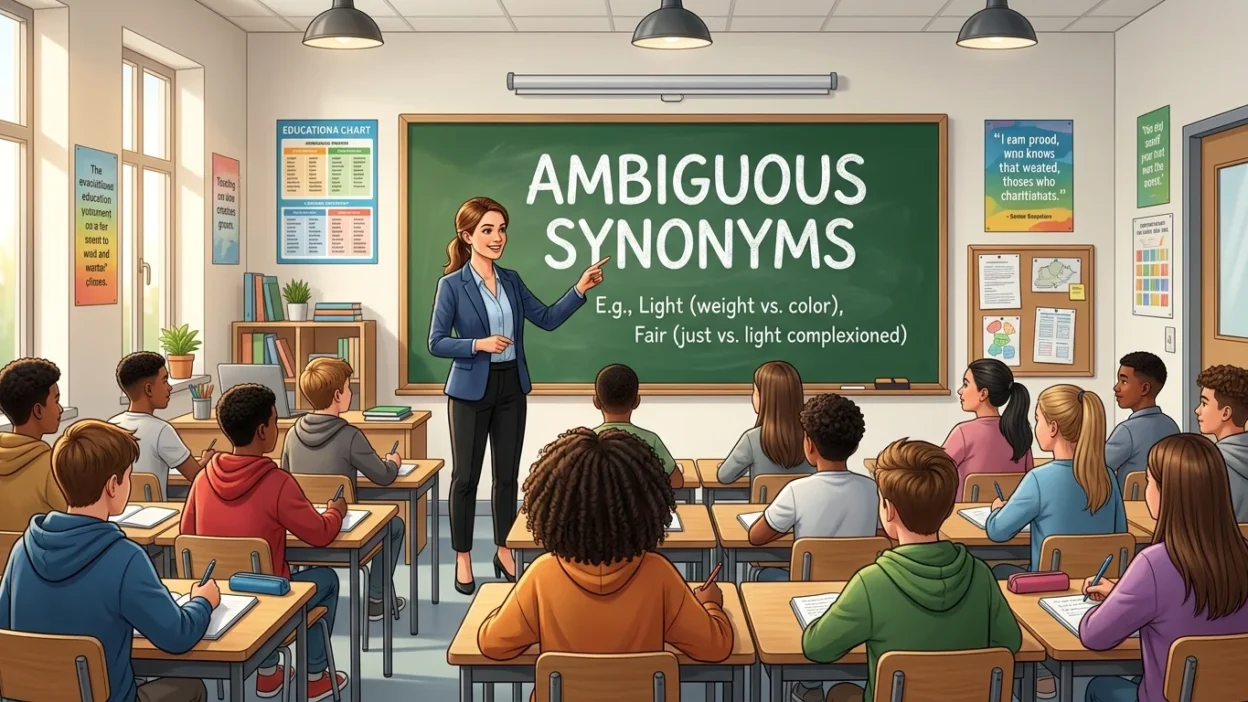
Looking for the best ambiguous synonyms?
The word ambiguous is used when something has more than one possible meaning or is unclear and open to different interpretations. It is especially useful in academic writing, literature, communication and everyday English.
Learning alternatives to ambiguous can help students, ESL learners, writers and content creators describe unclear ideas more accurately and avoid repeating the same word.
What Does “Ambiguous” Mean?
Ambiguous means unclear, uncertain, or capable of being understood in more than one way.
Examples
- His answer was ambiguous, so nobody knew what he meant.
- The ending of the movie was ambiguous.
- The contract contains an ambiguous sentence.
- Her expression was ambiguous and difficult to interpret.
The word can describe language, statements, situations, behavior, intentions, images, and meanings.
30 Best Ambiguous Synonyms
1. Unclear
Meaning: Difficult to understand or interpret.
Example: The instructions were unclear.
Best Usage: Everyday and general English.
2. Vague
Meaning: Not clearly expressed or defined.
Example: He gave a vague explanation of what happened.
Best Usage: Everyday, academic, and professional writing.
3. Uncertain
Meaning: Not known, decided, or definite.
Example: The outcome of the election remains uncertain.
Best Usage: General and formal writing.
4. Equivocal
Meaning: Open to more than one interpretation or deliberately unclear.
Example: The politician gave an equivocal response.
Best Usage: Formal and academic writing.
5. Doubtful
Meaning: Uncertain or unlikely to be true.
Example: It is doubtful that the plan will succeed.
Best Usage: General and formal English.
6. Indefinite
Meaning: Not clearly fixed, limited, or defined.
Example: The meeting was postponed for an indefinite period.
Best Usage: Formal and professional writing.
7. Indistinct
Meaning: Not clear or sharply defined.
Example: We could see an indistinct figure in the distance.
Best Usage: Descriptions, images, and writing.
8. Obscure
Meaning: Difficult to understand, see, or recognize.
Example: The meaning of the ancient text is obscure.
Best Usage: Formal and literary writing.
9. Cryptic
Meaning: Mysterious or difficult to understand.
Example: She left a cryptic message on my desk.
Best Usage: Descriptions, messages, and informal writing.
10. Mysterious
Meaning: Difficult to explain, understand, or identify.
Example: The mysterious note confused everyone.
Best Usage: General and creative writing.
11. Confusing
Meaning: Difficult to understand or follow.
Example: The instructions were confusing.
Best Usage: Everyday English.
12. Uncertainly Worded
Meaning: Expressed in a way that does not give a clear meaning.
Example: The policy was uncertainly worded.
Best Usage: Formal and analytical writing.
13. Open Ended
Meaning: Allowing several possible answers, interpretations, or outcomes.
Example: The question was deliberately open ended.
Best Usage: Education, research, and discussions.
14. Double Edged
Meaning: Having two possible effects or interpretations, often opposite ones.
Example: His comment was double edged and difficult to interpret.
Best Usage: Figurative and descriptive writing.
15. Two Sided
Meaning: Having two different aspects, meanings or interpretations.
Example: The issue is more two sided than it first appears.
Best Usage: General and analytical writing.
16. Multilayered
Meaning: Having several levels of meaning or interpretation.
Example: The novel has a multilayered message.
Best Usage: Literature and academic writing.
17. Polysemous
Meaning: Having multiple related meanings.
Example: The word “head” is polysemous because it has several meanings.
Best Usage: Linguistics and advanced academic writing.
18. Ambivalent
Meaning: Having mixed or conflicting feelings or attitudes.
Example: She felt ambivalent about accepting the offer.
Best Usage: Emotions and personal attitudes.
Note: Ambivalent does not mean exactly the same as ambiguous.
19. Conflicting
Meaning: Involving ideas, statements, or meanings that disagree with each other.
Example: The witness gave conflicting accounts of the incident.
Best Usage: Reports and analytical writing.
20. Contradictory
Meaning: Containing statements or ideas that cannot both be true.
Example: The report contains contradictory information.
Best Usage: Academic and formal writing.
21. Inconclusive
Meaning: Not producing a definite result or answer.
Example: The evidence was inconclusive.
Best Usage: Research, science, and formal writing.
22. Indeterminate
Meaning: Not clearly determined, known, or decided.
Example: The cause of the problem remains indeterminate.
Best Usage: Formal and technical writing.
23. Imprecise
Meaning: Not exact, accurate, or clearly defined.
Example: The report uses imprecise language.
Best Usage: Academic and professional writing.
24. General
Meaning: Lacking specific details or exact information.
Example: He gave only a general description of the event.
Best Usage: General and academic writing.
25. Noncommittal
Meaning: Avoiding a clear decision, opinion, or commitment.
Example: She gave a noncommittal answer when asked about her plans.
Best Usage: People, responses, and communication.
26. Evasive
Meaning: Avoiding giving a direct or clear answer.
Example: The witness was evasive when questioned.
Best Usage: Communication and formal contexts.
27. Elusive
Meaning: Difficult to understand, define, find, or achieve.
Example: The meaning of the poem remains elusive.
Best Usage: Literary and sophisticated writing.
28. Ambivalent Meaning
Meaning: Capable of suggesting conflicting interpretations.
Example: The character’s final statement has an ambivalent meaning.
Best Usage: Literary analysis.
29. Unresolved
Meaning: Not settled, answered or explained.
Example: Several questions remain unresolved.
Best Usage: Academic, professional and general writing.
30. Interpretive
Meaning: Requiring interpretation or allowing different interpretations.
Example: The artwork has an interpretive quality that invites discussion.
Best Usage: Art, literature, and academic writing.
When to Use Different Ambiguous Synonyms
| Synonym | Best Used For | Tone |
|---|---|---|
| Unclear | Difficult meaning | Neutral |
| Vague | Lack of detail | Neutral |
| Uncertain | Lack of certainty | Neutral |
| Equivocal | Deliberately unclear statements | Formal |
| Indefinite | Lack of fixed limits | Formal |
| Obscure | Difficult meaning | Literary |
| Cryptic | Mysterious messages | Descriptive |
| Confusing | Difficult to understand | Casual |
| Open-ended | Multiple possible answers | Academic |
| Multilayered | Several meanings | Literary |
| Polysemous | Multiple word meanings | Linguistic |
| Ambivalent | Mixed feelings | Emotional |
| Contradictory | Opposing statements | Formal |
| Inconclusive | No definite result | Academic |
| Imprecise | Lack of exactness | Formal |
| Noncommittal | Avoiding a clear answer | Professional |
| Evasive | Avoiding direct answers | Formal |
| Elusive | Difficult to grasp | Literary |
| Unresolved | Not settled | General |
| Interpretive | Requires interpretation | Academic |
How to Choose the Right Ambiguous Synonym
For Unclear Language
Use:
- Unclear
- Vague
- Imprecise
- Indistinct
- Obscure
Example:
The instructions were vague, so the students were unsure what to do.
For Unclear Answers
Use:
- Equivocal
- Noncommittal
- Evasive
- Vague
- Unclear
Example:
The manager gave a noncommittal response.
For Multiple Interpretations
Use:
- Open-ended
- Multilayered
- Interpretive
- Equivocal
- Ambiguous
Example:
The ending is open ended, allowing readers to form their own conclusions.
For Academic Writing
Use:
- Indeterminate
- Inconclusive
- Imprecise
- Equivocal
- Polysemous
- Unresolved
Example:
The available evidence remains inconclusive.
Ambiguous vs. Vague
These words are related but different.
Ambiguous means something can have two or more possible meanings.
The statement was ambiguous.
Vague means something lacks clear detail or precision.
His explanation was vague.
An ambiguous statement may have several interpretations, while a vague statement may simply lack enough information.
Ambiguous vs. Unclear
Unclear is a broad and simple word meaning difficult to understand.
Ambiguous is more specific: it often suggests that there are multiple possible interpretations.
The instructions were unclear.
The final sentence was ambiguous.
Ambiguous vs Uncertain
Uncertain usually describes something that is not known or definite.
The future is uncertain.
Ambiguous usually describes something whose meaning or interpretation is unclear.
Her answer was ambiguous.
Ambiguous vs Equivocal
Equivocal is a more formal word. It often describes language that intentionally avoids committing to one clear meaning.
The official gave an equivocal response.
Therefore, equivocal is especially useful when someone seems deliberately noncommittal.
Ambiguous vs Ambivalent
These two words are frequently confused.
Ambiguous = unclear or having multiple meanings.
Ambivalent = having mixed or conflicting feelings.
His statement was ambiguous.
She felt ambivalent about moving abroad.
Remember: ambiguous concerns meaning; ambivalent often concerns feelings.
Ambiguous Examples in Different Contexts
In Literature
The novel has an ambiguous ending.
This means readers can interpret the ending in different ways.
In Communication
His answer was equivocal.
This suggests that he did not give a clear answer.
In Academic Writing
The evidence remains inconclusive.
This means the evidence does not provide a definite conclusion.
In Everyday English
Her message was unclear.
This is a simple and natural alternative.
Common Mistakes When Using Ambiguous Synonyms
Don’t Treat Every Related Word as an Exact Synonym
Words such as ambivalent, uncertain, vague, and inconclusive have related meanings but are not interchangeable in every sentence.
Choose According to Meaning
If something lacks detail, use vague.
If something has multiple interpretations, use ambiguous.
If evidence does not prove something, use inconclusive.
If someone avoids answering directly, use evasive or noncommittal.
Why Learning Ambiguous Synonyms Improves Your Vocabulary
Learning alternatives to ambiguous can help you:
- Describe unclear ideas more precisely
- Improve academic writing
- Analyze literature
- Explain confusing statements
- Expand your ESL vocabulary
- Avoid repetitive language
- Communicate subtle differences in meaning
The right word can tell your reader why something is unclear instead of simply saying that it is unclear.
Conclusion
The word ambiguous describes something that is unclear, uncertain, or open to multiple interpretations. Useful synonyms and related terms include unclear, vague, uncertain, equivocal, indefinite, obscure, cryptic, confusing, open-ended, multilayered, polysemous, ambivalent, contradictory, inconclusive, indeterminate, imprecise, noncommittal, evasive, elusive and unresolved.
For everyday writing, unclear and vague are natural choices. For formal writing, equivocal, indeterminate, inconclusive, and imprecise can be more precise. In literature, multilayered, obscure, elusive and interpretive can help describe complex meanings.
Understanding these differences will make your writing clearer, more accurate and more expressive.